What Is Ginkgo Biloba?
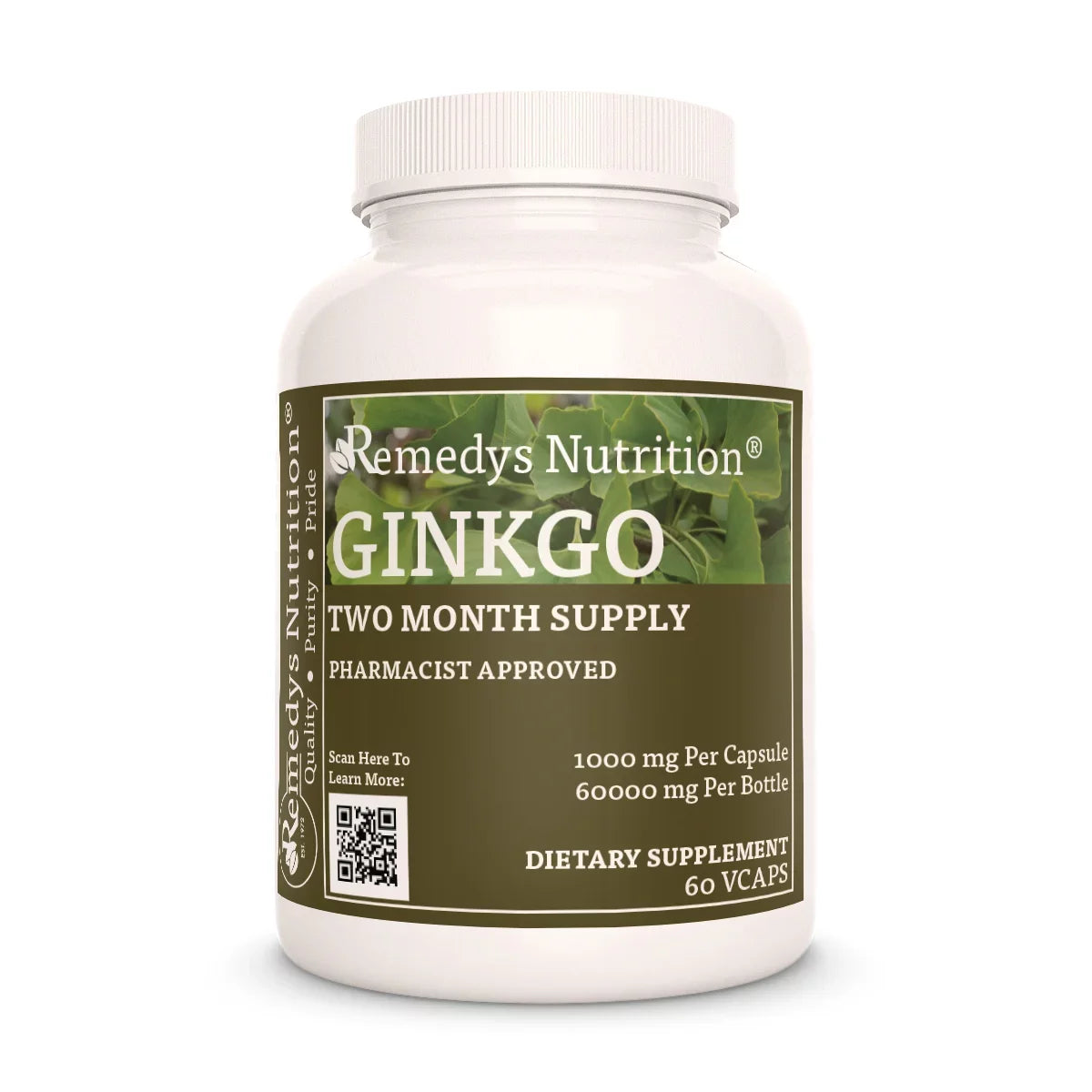
Ginkgo biloba is one of the oldest tree species alive, and its leaves are the source of the most-studied botanical extract in the memory and circulation category. Clinical research uses a standardized extract called EGb 761, defined as 24% flavone glycosides and 6% terpene lactones[1]Ginkgo Biloba Chemistry and Uses — PubMed View source. Remedy's Nutrition Ginkgo Biloba capsules deliver 1,000 mg of pure ginkgo leaf per vegan capsule, so this page covers what the evidence actually shows — including where raw leaf and standardized extract differ.
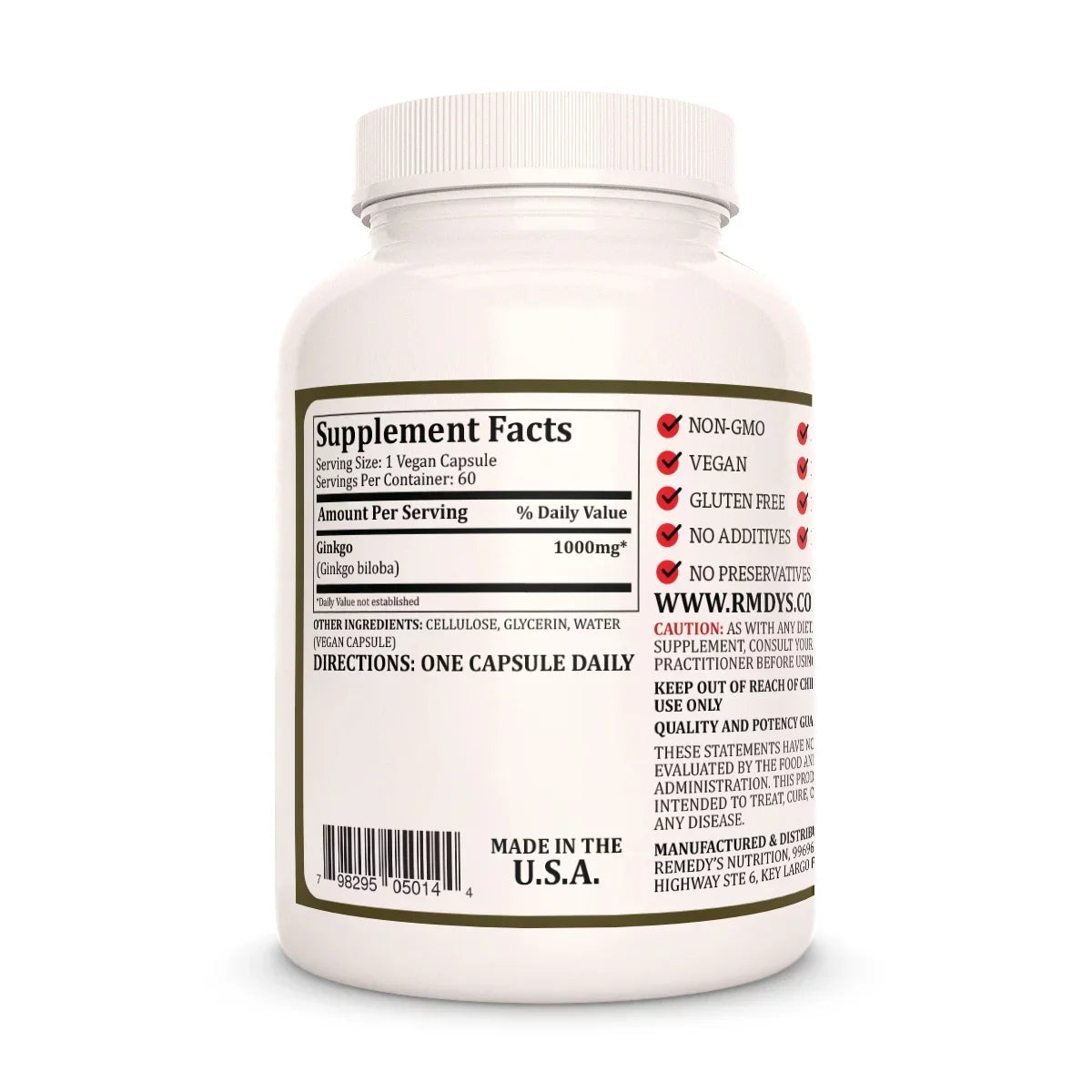
Supplement Facts
Serving size: 1 Vegan Capsule. Servings per container: 60.
| Amount Per Serving |
Amount |
% Daily Value |
| Ginkgo (Ginkgo biloba) |
1000 mg |
* |
* Daily Value not established.
Other ingredients: Cellulose, Glycerin, Water (vegan capsule)
Directions: One capsule daily.
Non-GMO, vegan, gluten free, no additives, no preservatives. Made in the USA.
Who Should Be Careful With This
This is not a list of side effects. It is the short list of situations where this ingredient is known to interact with something else, so you can check with your doctor or pharmacist before starting.
-
If you take a blood thinner or an antiplatelet, or you have a bleeding disorder. Ginkgo can increase bleeding risk.
-
Before any surgery or dental procedure. It is usual to stop ginkgo well in advance — ask your surgeon how long.
- If you take medicine for seizures or are pregnant.
Source: NCCIH, Ginkgo.
Ginkgo has 2 active compound groups that matter for how it works: flavone glycosides (antioxidant, free-radical scavenging) and terpene lactones, known as ginkgolides and bilobalide (blood-flow and platelet effects)[2]Ginkgo — National Center for Complementary and Integrative Health View source. Traditional Chinese medicine has used ginkgo leaf and seed for thousands of years, but modern clinical trials only became common after EGb 761 was standardized in the 1960s. For the full history and science breakdown, see our complete ginkgo biloba guide.
- Native to China; individual trees can live over 1,000 years
- Leaf extract standardized to EGb 761 is the form used in 90%-plus of clinical trials
- 2 primary compound groups: flavone glycosides and terpene lactones
- Remedy's capsule: 1,000 mg pure ginkgo leaf, no fillers, no binders
Ginkgo Biloba Benefits: Clinical Evidence
Ginkgo's research record is a mix of real, modest signals and some well-known negative trials. The table below summarizes the highest-quality evidence by benefit area, including where results were disappointing.
| Benefit Area |
Key Clinical Finding |
Dose Used in Trial |
| Existing Memory Impairment (MCI/Dementia) |
Meta-analysis of RCTs found a modest cognition benefit in people already diagnosed with mild cognitive impairment or Alzheimer's disease[3]Ginkgo for MCI and Alzheimer's Meta-Analysis — PubMed View source
|
120 to 240 mg EGb 761 daily, 12 to 24 weeks |
| Dementia Prevention (Healthy Adults) |
The GEM trial (n=3,069, about 6 years) found ginkgo did NOT reduce the incidence of dementia vs placebo[4]Ginkgo for Prevention of Dementia (GEM) — JAMA View source
|
120 mg twice daily |
| Cognitive Decline Rate |
GEM secondary analysis found no effect on the rate of cognitive decline across memory, language, and attention domains[5]Ginkgo for Preventing Cognitive Decline (GEM) — JAMA View source
|
120 mg twice daily, 6 years |
| Circulation and Blood Flow |
Terpene lactones inhibit platelet-activating factor (PAF), the mechanism behind ginkgo's blood-flow effects[6]Ginkgo Antiplatelet and Anticoagulant Interaction — PubMed View source
|
120 to 240 mg EGb 761 daily |
| Intermittent Claudication (Leg Circulation) |
Cochrane review found no statistically significant benefit on pain-free walking distance vs placebo[7]Ginkgo for Intermittent Claudication — Cochrane View source
|
120 to 240 mg daily, 6 to 24 weeks |
| Tinnitus |
Cochrane review found no reliable evidence of benefit for primary tinnitus[8]Ginkgo Biloba for Tinnitus — Cochrane View source
|
120 to 160 mg daily, 8 to 12 weeks |
| Vertigo and Dizziness |
Randomized trial found EGb 761 performed comparably to betahistine for dizziness symptom relief[9]EGb 761 and Betahistine for Vertigo RCT — PubMed View source
|
120 to 240 mg daily |
| Anxiety (GAD) |
Double-blind RCT found EGb 761 reduced Hamilton Anxiety Rating Scale scores vs placebo in generalized anxiety disorder[10]Ginkgo EGb 761 for Generalized Anxiety Disorder — PubMed View source
|
480 mg daily, 4 weeks |
- Modest cognitive benefit shown only in people with EXISTING memory impairment, not for prevention
- 2 large, long-term trials (GEM, GuidAge) found no dementia-prevention effect in healthy older adults
- Tinnitus and leg-circulation (claudication) evidence is weak-to-negative per Cochrane
- Anxiety and vertigo have the most consistent positive RCT signals
- Nearly every positive trial used 120 to 240 mg of standardized EGb 761, not raw leaf powder
3,069 healthy older adults were followed for about 6 years in the GEM trial — the largest ginkgo prevention study ever run — and researchers found no reduction in dementia incidence with 240 mg of EGb 761 daily vs placebo[4]Ginkgo for Prevention of Dementia (GEM) — JAMA View source.
How Ginkgo Biloba Works
Ginkgo's effects come from 2 compound families acting through different pathways. Flavone glycosides work as antioxidants, neutralizing free radicals in brain and vascular tissue. Terpene lactones — ginkgolides and bilobalide — inhibit platelet-activating factor (PAF), a signaling molecule involved in clotting and inflammation[6]Ginkgo Antiplatelet and Anticoagulant Interaction — PubMed View source. That PAF-inhibiting action is also why ginkgo carries a bleeding-risk warning, covered in the safety section below.
- EGb 761
- The standardized ginkgo leaf extract used in nearly all major clinical trials, defined as 24% flavone glycosides and 6% terpene lactones. Most research doses (120 to 240 mg) refer to this concentrated form, not raw leaf powder.
- Flavone glycosides
- Antioxidant plant compounds that make up 24% of standardized EGb 761 extract. They scavenge free radicals in brain and vascular tissue.
- Terpene lactones (ginkgolides and bilobalide)
- The 6% fraction of EGb 761 responsible for platelet-activating factor (PAF) inhibition — the mechanism behind both ginkgo's circulation effects and its bleeding-risk interactions.
Because Remedy's Nutrition capsule is 1,000 mg of whole ginkgo leaf rather than a concentrated 24/6 extract, the amount of active flavone glycosides and terpene lactones it delivers is not mg-for-mg equivalent to a 120 mg EGb 761 dose used in trials. Both forms have a place: standardized extract for matching research doses, whole leaf for a traditional, single-ingredient option.
Ginkgo Biloba for Memory and Cognition
Ginkgo's reputation as a "memory herb" is only partly supported. In people who already have mild cognitive impairment or Alzheimer's disease, meta-analyses of RCTs show a modest but real improvement in cognitive test scores at 120 to 240 mg EGb 761 daily for 12 to 24 weeks[3]Ginkgo for MCI and Alzheimer's Meta-Analysis — PubMed View source. That is different from prevention.
The 2008 GEM trial gave 3,069 adults over age 75 either 120 mg EGb 761 twice daily or placebo for an average of 6.1 years. Dementia incidence was virtually identical between groups[4]Ginkgo for Prevention of Dementia (GEM) — JAMA View source. A companion analysis found no slowing of cognitive decline across memory, language, and attention domains either[5]Ginkgo for Preventing Cognitive Decline (GEM) — JAMA View source. The 2012 GuidAge trial followed 2,854 adults with memory complaints for 5 years and found the same result: standardized EGb 761 did not reduce progression to Alzheimer's disease[11]GuidAge Ginkgo Alzheimer Prevention Trial — Lancet Neurology View source. A 2009 Cochrane review of the broader evidence concluded that any clinically meaningful, predictable benefit for dementia is inconsistent across trials[12]Ginkgo for Cognitive Impairment and Dementia — Cochrane View source.
The honest summary: ginkgo is not a dementia-prevention supplement. If you already have diagnosed cognitive impairment, some trials show a modest symptom benefit worth discussing with a doctor. If you are a healthy adult hoping to prevent future decline, the largest trials available (GEM, GuidAge) found no protective effect. For a deeper breakdown of the study data, see our guide to ginkgo biloba for memory support.
- Modest benefit shown ONLY in existing MCI or Alzheimer's, not in healthy adults
- GEM trial: 3,069 people, ~6 years, no dementia-prevention effect
- GuidAge trial: 2,854 people, 5 years, no reduction in Alzheimer's progression
- Effects on daily focus or brain fog, if any, typically take 4 to 6 weeks to notice
Ginkgo Biloba for Circulation and Blood Flow
Circulation support is ginkgo's best-mechanistic-fit use case. The terpene lactone fraction inhibits platelet-activating factor and supports peripheral blood flow, which is the traditional rationale for using ginkgo for cold hands and feet, mild circulatory complaints, and vascular support[6]Ginkgo Antiplatelet and Anticoagulant Interaction — PubMed View source. That said, the strongest test of a circulation claim — intermittent claudication, or leg pain from reduced blood flow when walking — came back negative in the 2013 Cochrane review: no statistically significant improvement in pain-free walking distance vs placebo across pooled trials[7]Ginkgo for Intermittent Claudication — Cochrane View source.
This does not mean ginkgo has zero vascular activity. It means the effect, if present, is too small or inconsistent to reliably treat a diagnosed circulatory condition like claudication or peripheral artery disease on its own. People using ginkgo for general, mild circulation support — rather than a diagnosed vascular disease — are working from the mechanism and traditional-use rationale rather than a strong positive RCT.
- Mechanism: terpene lactones inhibit platelet-activating factor (PAF)
- Cochrane 2013: no significant benefit for intermittent claudication (leg pain from poor circulation)
- Traditional use for cold hands/feet and mild circulatory complaints predates modern RCTs by centuries
- Diagnosed peripheral artery disease needs medical management, not supplement-only treatment
For the full mechanism breakdown and trial data, read our guide on ginkgo biloba for blood circulation.
Ginkgo Biloba for Tinnitus, Vertigo and Hearing
Tinnitus and vertigo are 2 of the most common reasons people search for ginkgo, and the evidence splits sharply between them. For tinnitus (ringing in the ears with no external sound), the 2013 Cochrane review found no reliable evidence of benefit across the available randomized trials[8]Ginkgo Biloba for Tinnitus — Cochrane View source. Anyone trying ginkgo for tinnitus should know upfront that the highest-quality evidence does not support it as a treatment.
Vertigo and dizziness tell a different story. A randomized double-blind trial comparing EGb 761 with betahistine — a standard prescription vertigo medication — found comparable symptom relief between the 2 treatments[9]EGb 761 and Betahistine for Vertigo RCT — PubMed View source. This is a narrower, more specific use case than general "hearing support," and results do not extend to hearing loss itself, which ginkgo has not been shown to treat.
- Tinnitus: Cochrane review found no reliable benefit — do not expect ringing relief
- Vertigo/dizziness: RCT found effects comparable to betahistine, a prescription option
- Sudden or one-sided hearing changes need urgent medical evaluation, not a supplement trial
- Typical trial length for vertigo studies: 4 to 12 weeks
See our dedicated breakdown of ginkgo biloba for tinnitus and ringing ears for the full study-by-study data.
Ginkgo Biloba for Anxiety, Mood and Sleep
Anxiety is one of ginkgo's more consistent positive findings. A double-blind, placebo-controlled trial in people with generalized anxiety disorder or adjustment disorder with anxious mood found that 480 mg of EGb 761 daily for 4 weeks significantly reduced Hamilton Anxiety Rating Scale scores compared with placebo[10]Ginkgo EGb 761 for Generalized Anxiety Disorder — PubMed View source. The proposed mechanism runs through the same antioxidant and vascular pathways that support brain blood flow generally, though the exact anti-anxiety mechanism is less well mapped than the circulation pathway.
Ginkgo is not marketed or studied as a sleep aid, and there is no dedicated ginkgo-for-insomnia trial base comparable to melatonin or valerian. Any sleep improvement reported anecdotally is more likely a downstream effect of reduced anxiety than a direct sedative action.
- 480 mg EGb 761 daily reduced anxiety scores in a 4-week RCT
- Effect measured via the Hamilton Anxiety Rating Scale, a standard clinical tool
- No dedicated sleep-specific trial base; any sleep benefit is likely secondary to anxiety relief
- 4 weeks was the trial duration; allow at least that long before judging results
Read the full anxiety study breakdown in our guide to ginkgo biloba for anxiety.
Why Choose Remedy's Nutrition Ginkgo Biloba
Remedy's Nutrition Ginkgo Biloba is a single-ingredient, filler-free whole-leaf formula kept simple on purpose, so you control the dose without hidden fillers or proprietary blends. For background on why single-ingredient formulas matter, see evidence-based ginkgo biloba benefits.
| What You Get |
Why It Matters |
| 1,000 mg pure ginkgo leaf per capsule |
Single-ingredient formula — no proprietary blends hiding the actual ginkgo content |
| 60 vegan capsules per bottle |
A 2-month supply at the standard 1 capsule daily serving |
| No fillers, binders, or preservatives |
Clean label; easier digestion and absorption than capsules padded with flow agents |
| Non-GMO, gluten-free, vegan and Kosher |
Free of corn, yeast, and dairy — suitable for most dietary restrictions |
| Handmade in Key Largo, FL, USA |
Small-batch capsule filling with pharmacist review of every formula |
Customer feedback on this product (Judge.me, 5.0 out of 5 average across verified reviews) echoes the research timeline above: one reviewer specifically described the effect as "subtle" and something that "builds over weeks," which lines up with the 4 to 6-week window seen across ginkgo's clinical trials rather than an immediate effect.
Ginkgo Biloba Dosage: How Much to Take Per Day
Clinical trials used 120 to 240 mg of standardized EGb 761 extract daily, split into 1 to 2 doses with food, for 4 to 6 weeks minimum before evaluating results. Remedy's Nutrition capsule delivers 1,000 mg of whole ginkgo leaf per capsule, which is not the same concentration as 120 mg of standardized extract — whole leaf is a traditional, single-ingredient option rather than a lab-concentrated match for the trial dose.
| Goal |
Daily Amount |
Timing |
Time to Judge Effect |
| General daily use (whole leaf) |
1 capsule (1,000 mg) |
With food, morning or evening |
4 to 6 weeks |
| Matching standardized research dose |
120 to 240 mg EGb 761 extract |
Split into 1 to 2 doses with food |
4 to 6 weeks |
| Anxiety (per RCT) |
480 mg EGb 761 extract |
Once daily |
4 weeks |
| Tinnitus/vertigo trials |
120 to 160 mg EGb 761 extract |
Split into 2 doses with food |
8 to 12 weeks |
| Before surgery |
Stop entirely |
1 to 2 weeks before any procedure |
Not applicable |
A 1000 mg ginkgo biloba capsule can be taken with or without food, but taking it with a meal tends to reduce the mild stomach upset some people notice on an empty stomach. Consistency matters more than timing: missing several days a week extends how long it takes to judge whether ginkgo is working for you.
On timing, morning or evening both work; because a minority find ginkgo mildly stimulating, move an evening dose earlier if it disrupts your sleep. There is no benefit to exceeding 240 mg of standardized extract per day, and higher amounts can raise bleeding risk rather than results.
- Trial-standard dose: 120 to 240 mg of standardized EGb 761 extract daily
- Remedy's whole-leaf capsule: 1,000 mg, 1 per day, 2-month supply per bottle
- Give any ginkgo regimen 4 to 6 weeks minimum before judging results
- Stop 1 to 2 weeks before any scheduled surgery
Safety and Drug Interactions
Bleeding risk is ginkgo's most important safety issue. Because terpene lactones inhibit platelet-activating factor, ginkgo can add to the effect of blood-thinning medications and increase bleeding risk, including spontaneous bleeding reported in case literature[13]Spontaneous Bleeding With Ginkgo Biloba — PubMed View source.
| Drug Class |
What to Do |
| Warfarin and other anticoagulants |
A systematic review of warfarin-supplement interactions specifically flags ginkgo as a bleeding-risk concern; do not combine without physician monitoring[14]Warfarin and Herbal Supplement Interactions — PubMed View source
|
| Aspirin and antiplatelet drugs (clopidogrel) |
Additive antiplatelet effect raises bleeding risk; coordinate with your prescriber before combining[6]Ginkgo Antiplatelet and Anticoagulant Interaction — PubMed View source
|
| NSAIDs (ibuprofen, naproxen) |
Mild additive bleeding effect with regular NSAID use; avoid daily stacking if surgery is upcoming |
| Seizure medications |
Ginkgo may lower the seizure threshold in rare cases; avoid if you have a seizure disorder or take anti-epileptic drugs |
| Before any surgery |
Stop ginkgo 1 to 2 weeks in advance because of bleeding-risk interactions with anesthesia and surgical bleeding control |
| Pregnancy and breastfeeding |
Not enough safety data exists; avoid ginkgo during pregnancy and lactation |
Reported side effects across trials are generally mild: headache, GI upset, and dizziness are most common, alongside occasional allergic skin reactions[1]Ginkgo Biloba Chemistry and Uses — PubMed View source. Serious bleeding events are uncommon but well-documented enough in case reports that anyone on blood thinners should talk to a doctor before starting[13]Spontaneous Bleeding With Ginkgo Biloba — PubMed View source. Our ginkgo biloba safety guide covers the full drug-by-drug interaction list.
Who Should Avoid Ginkgo Biloba
Ginkgo is well-tolerated for most healthy adults, but several groups should get medical clearance first or avoid it entirely.
| Group |
Why It Matters |
| Anyone on blood thinners |
Warfarin, apixaban, aspirin, and clopidogrel all carry additive bleeding risk with ginkgo's PAF-inhibiting action[6]Ginkgo Antiplatelet and Anticoagulant Interaction — PubMed View source
|
| Pregnant or breastfeeding people |
Insufficient safety data; avoid completely |
| People with seizure disorders |
Rare case reports link ginkgo to a lowered seizure threshold |
| Pre-surgical patients |
Stop 1 to 2 weeks before any planned procedure |
| Children and teens under 18 |
Not studied in this age group; keep out of reach of children |
| People with ginkgo or alkylphenol allergies |
Allergic skin reactions are a known, if uncommon, side effect |
If any of these apply to you, talk to your physician or pharmacist before adding ginkgo to your routine, especially if you are already taking a prescription blood thinner or have a procedure scheduled within the next 2 weeks.
Frequently Asked Questions
How many mg of ginkgo biloba should I take per day? +
Clinical trials use 120 to 240 mg of standardized EGb 761 extract daily, usually split into 1 to 2 doses with food. Remedy's Nutrition capsule provides 1,000 mg of whole ginkgo leaf per capsule, taken once daily. Whole leaf and standardized extract are measured differently, so match the form to the dose you are trying to follow.
Can you take too much ginkgo biloba? +
Yes. Going above 240 mg of standardized extract daily rarely adds benefit and can increase bleeding, headache, and stomach upset. Stick to the researched 120 to 240 mg range, or 1 whole-leaf capsule for general use. Never stack high doses with blood thinners, and stop ginkgo 1 to 2 weeks before any surgery.
Does ginkgo biloba actually help memory? +
Only in people with existing mild cognitive impairment or Alzheimer's disease, where meta-analyses show a modest benefit at 120 to 240 mg daily for 12 to 24 weeks. In 2 large trials totaling over 5,900 healthy older adults followed for 5 to 6 years (GEM and GuidAge), ginkgo did not prevent dementia or slow cognitive decline.
How long does it take to feel ginkgo biloba working? +
Most trials allow 4 to 6 weeks before measuring results, and some outcomes like nocturnal circulation or anxiety scores were assessed at 4 weeks. Tinnitus and vertigo trials ran 8 to 12 weeks. Give any ginkgo regimen at least a full month of consistent daily use before deciding whether it is working for you.
Is Remedy's ginkgo biloba capsule the same as EGb 761 extract? +
No. Remedy's capsule contains 1,000 mg of whole ginkgo leaf, while EGb 761 is a concentrated extract standardized to 24% flavone glycosides and 6% terpene lactones, dosed at 120 to 240 mg in most trials. Whole leaf and standardized extract are not equivalent mg-for-mg — check the label of any ginkgo product for a standardization claim if you want to match the research dose exactly.
Can I take ginkgo biloba with blood thinners? +
Not without medical supervision. Ginkgo's terpene lactones inhibit platelet-activating factor, and a systematic review specifically flags warfarin as a bleeding-risk interaction with ginkgo. Aspirin, clopidogrel, and regular NSAID use carry the same added bleeding risk. Talk to your doctor before combining any of these 4 drug classes with ginkgo.
Does ginkgo biloba help with tinnitus? +
The evidence does not support it. A 2013 Cochrane review of the available randomized trials found no reliable benefit for primary tinnitus (ringing in the ears). If tinnitus is your main goal, set realistic expectations and see a doctor for any sudden or one-sided ringing rather than relying on ginkgo alone.
Is ginkgo biloba good for anxiety? +
Yes, this is one of ginkgo's more consistent findings. A double-blind, placebo-controlled trial in generalized anxiety disorder found that 480 mg of EGb 761 daily for 4 weeks significantly reduced Hamilton Anxiety Rating Scale scores compared with placebo. That trial used standardized extract, not raw leaf powder.
What are the main side effects of ginkgo biloba? +
The 3 most common side effects across clinical trials are headache, mild GI upset, and dizziness, along with occasional allergic skin reactions. Serious bleeding events are uncommon but documented in case-report literature, mainly in people also taking blood-thinning medication. Stop use and consult a doctor if you notice unusual bruising or bleeding.
Should I stop taking ginkgo biloba before surgery? +
Yes. Because ginkgo's terpene lactones affect platelet function, most surgical guidance recommends stopping ginkgo 1 to 2 weeks before any planned procedure to reduce bleeding risk during and after surgery. Tell your surgical team about any ginkgo use during your pre-operative screening.
Is ginkgo biloba safe to take every day long term? +
For most healthy adults without bleeding-risk medications, daily use of 1,000 mg whole leaf or 120 to 240 mg standardized extract is generally well tolerated, including in trials running up to 6 years (the GEM study). People on blood thinners, with seizure disorders, or who are pregnant should avoid daily use without medical clearance first.
Does ginkgo biloba help with poor circulation? +
The mechanism supports it — terpene lactones inhibit platelet-activating factor and support peripheral blood flow — but the strongest circulation test, intermittent claudication (leg pain from poor circulation), showed no statistically significant benefit vs placebo in a 2013 Cochrane review. Diagnosed vascular disease needs medical management alongside any supplement use.
What is the difference between raw ginkgo leaf and standardized extract? +
Standardized extract (EGb 761) is concentrated to a guaranteed 24% flavone glycosides and 6% terpene lactones, and it is the form used in over 90% of clinical trials at 120 to 240 mg daily. A 1,000 mg raw leaf capsule, like Remedy's Nutrition ginkgo, is a whole-herb, single-ingredient option that is not concentrated to that same 24/6 ratio.
Who should not take ginkgo biloba at all? +
Avoid ginkgo, or use only with medical supervision, if you take warfarin or other blood thinners, are pregnant or breastfeeding, have a seizure disorder, have a surgery scheduled within 2 weeks, or are under 18. These 5 groups face the clearest documented risks in the research and case-report literature.
You May Also Like