What Is Cat's Claw?
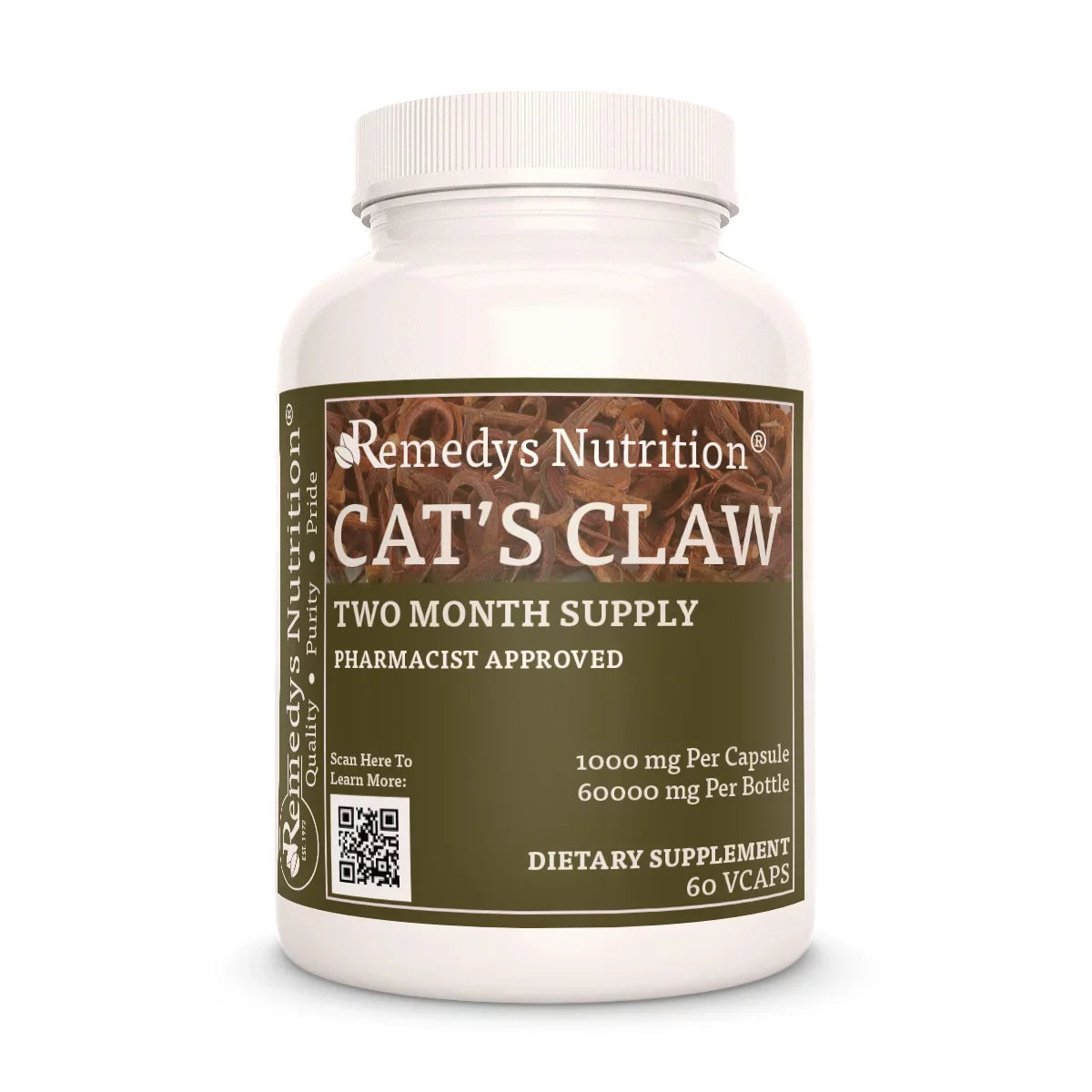
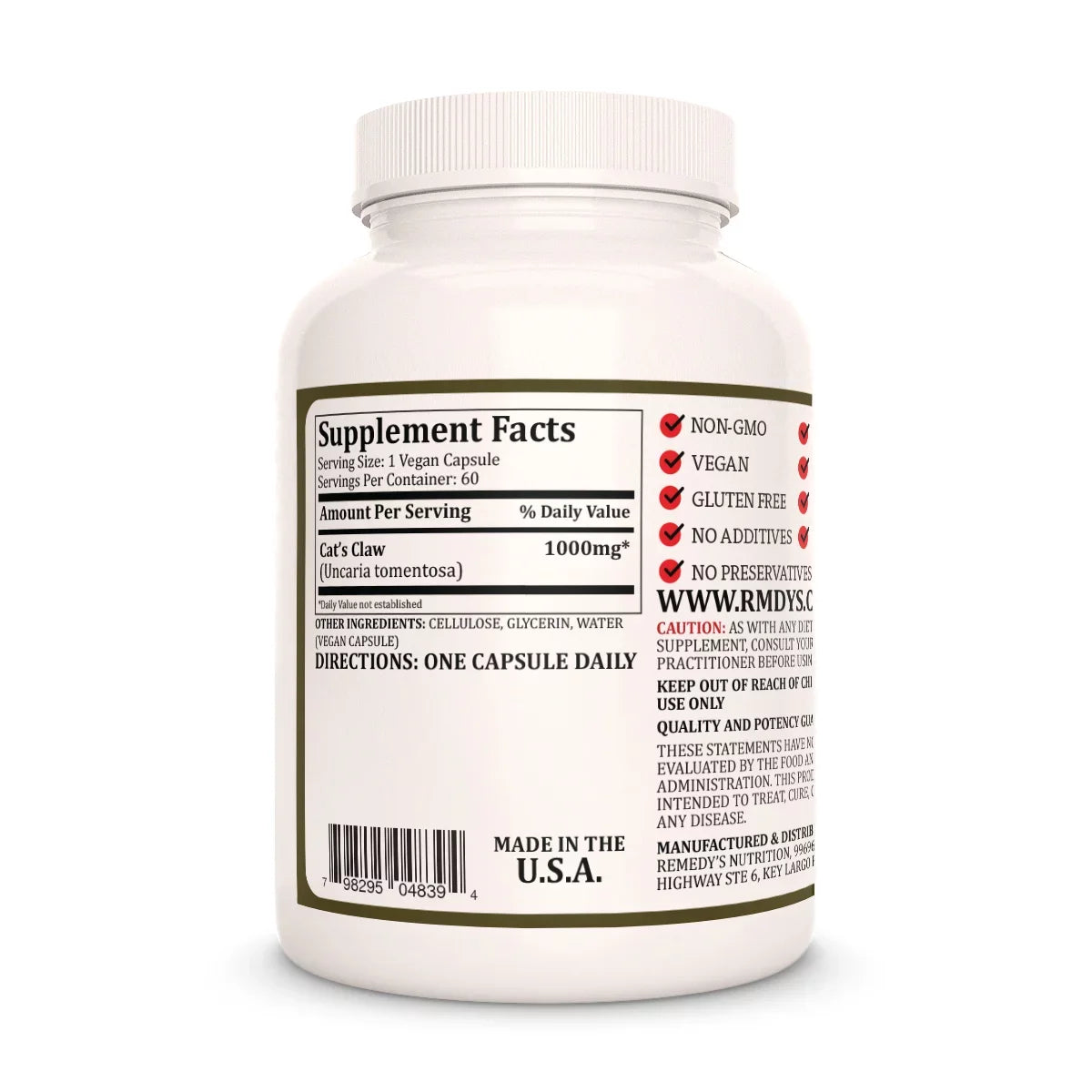
Cat's claw is the inner bark of an Amazonian woody vine, named for the pair of hooked thorns at each leaf node. Remedy's Cat's Claw delivers 1000 mg of bark per vegan capsule, with 60 capsules per bottle, so the usual daily range of 1000 to 3000 mg is 1 to 3 capsules.
Two species share the name. Uncaria tomentosa appears in most supplements and in the rheumatoid arthritis trial, while Uncaria guianensis was the species used in the knee osteoarthritis trial. A label that names only the genus leaves that out.
Its active compounds are oxindole alkaloids, and U. tomentosa occurs in 2 chemotypes, pentacyclic and tetracyclic. Our full explainer covers what cat's claw is and how it works.
Cat's Claw Benefits: What the Research Shows
Joint comfort is the tested use, from 2 small randomized trials covering 85 patients between them. Everything else, including the popular parasite and detox claims, sits well behind that.
| Use |
What the trials found |
Evidence tier |
| Knee osteoarthritis |
Activity pain improved within week 1 |
45 patients, 4 weeks |
| Rheumatoid arthritis |
Painful joints -53.2% vs -24.1% placebo |
40 patients, 24 blinded weeks |
| Quality of life in advanced cancer |
Improved, with 0 tumour responses |
51 patients, phase II |
| Immune markers |
1 small study of a specific extract |
Preliminary |
| Parasites and leaky gut |
No human trial located |
Unsupported |
The osteoarthritis result comes from a 4-week trial in which 30 patients took freeze-dried Uncaria guianensis and 15 took placebo, with pain at rest and at night showing no significant change.[1]Efficacy and safety of freeze-dried cat's claw in osteoarthritis of the knee: mechanisms of action of the species Uncaria guianensis — Inflammation Research (2001) View source Each claim is graded separately in our review of what the research actually found.
Cat's Claw for Joint Pain
The rheumatoid arthritis trial is the more striking of the 2 and the most often misread. Forty patients, all continuing sulfasalazine or hydroxychloroquine, took a purified pentacyclic extract or placebo for 24 double-blind weeks, and painful joints fell 53.2% against 24.1% on placebo.[2]Randomized double blind trial of an extract from the pentacyclic alkaloid-chemotype of Uncaria tomentosa for the treatment of rheumatoid arthritis — Journal of Rheumatology (2002) View source
-
Add-on design: Every patient stayed on their prescribed medication.
-
Authors' own word: A small preliminary study with modest benefit.
-
Never: A replacement for disease-modifying treatment.
The trial detail, joint by joint, is in cat's claw for arthritis and joint pain.
Being Straight About Cancer and Parasites
Two claims dominate the internet around this herb, and we are not going to repeat either. A phase II study gave 100 mg of dry extract 3 times daily to 51 people with advanced solid tumours: quality of life improved and fatigue fell, and no tumour response was detected.[3]Uncaria tomentosa (cat's claw) improves quality of life in patients with advanced solid tumors — Journal of Alternative and Complementary Medicine (2015) View source
-
Cancer: Quality-of-life support in 1 palliative study, not an antitumour effect.
-
Parasites: No human trial supports the claim at all.
-
Leaky gut: No human trial has measured intestinal permeability.
-
What to do instead: Get tested and treated for anything you actually suspect.
Those questions are answered in full on our page about cat's claw, immunity and gut health.
Why Choose Remedy's Cat's Claw
Because 2 species and 2 chemotypes share 1 shelf name, a vague label is a real problem. The design decision here is a stated species, a stated amount and nothing else in the capsule.
| What you get |
Why it matters |
| 1000 mg cat's claw bark per capsule |
1 capsule is a countable unit of the usual range |
| Single ingredient |
Any effect or reaction is traceable to 1 thing |
| Vegan capsule |
No gelatin, suitable for plant-based routines |
| 60 capsules per bottle |
60 days at 1 capsule, 20 days at 3 |
| Also available as a tincture |
For people who prefer drops to capsules |
The 2 formats are compared honestly in tincture versus capsules, including where each one wins.
How to Take Cat's Claw
Start with 1 capsule daily with food and build up over about 2 weeks. Most people who report stomach upset began at 3 capsules on the first day, which is the single most avoidable mistake with this herb.
| Week |
Capsules |
Notes |
| Week 1 |
1 |
With food, same time each day |
| Week 2 |
2 |
Only if week 1 was comfortable |
| Week 3 onward |
2 to 3 |
Split across 2 meals if preferred |
| If symptoms appear |
Drop back 1 capsule |
For a week, rather than stopping |
-
With food: The 1 timing instruction with a clear reason behind it.
-
4 to 8 weeks: A fair personal trial, with a tracked daily score.
-
Not on an empty stomach: The usual cause of early nausea.
Full dose arithmetic across all 3 formats is in our cat's claw dosage guide.
Safety and Who Should Avoid It
Cat's claw was well tolerated in both joint trials, with no deleterious blood or liver effects over 4 weeks and only minor side effects across 52 weeks. Its real cautions are about immune activity rather than toxicity.
| Situation |
What to do |
| Organ transplant, past or present |
Do not take it |
| Immunosuppressants or biologic therapy |
Clinician first |
| Autoimmune disease |
Discuss before starting |
| Pregnant, breastfeeding or trying to conceive |
Avoid |
| Surgery within 2 weeks |
Stop and tell your surgical team |
| On blood pressure or anticoagulant medication |
Mention it to your pharmacist |
The reasoning behind each of those 6 rows is set out on our page about cat's claw side effects and who should avoid it.
Frequently Asked Questions
What does cat's claw do for you? +
Its tested use is joint comfort. In 45 knee osteoarthritis patients, activity pain improved within the first week of a 4-week trial, and in 40 rheumatoid arthritis patients on standard drugs painful joints fell 53.2% versus 24.1% on placebo.
How many capsules should I take a day? +
Start with 1 capsule daily with food, then build to 2 or 3 across 2 weeks. The usual range is 1000 to 3000 mg of bark, which is 1 to 3 capsules at 1000 mg each.
Who should not take cat's claw? +
Transplant recipients, anyone on immunosuppressants or biologics, people with autoimmune disease without clinician input, anyone pregnant or breastfeeding, and anyone due for surgery within 2 weeks. That is 5 groups.
How long does cat's claw take to work? +
Faster than most joint herbs in 1 respect: the osteoarthritis trial recorded improvement in activity pain within the first week. The rheumatoid arthritis benefit was measured at 24 weeks, so allow 4 to 8 weeks for a fair test.
Does cat's claw kill parasites? +
Not 1 human trial supports that. It is a traditional claim rather than a tested one. Suspected parasitic infection needs stool testing and proper treatment rather than a bark supplement taken for 4 weeks.
Can cat's claw treat cancer? +
No. The phase II study in 51 patients with advanced tumours improved quality of life and reduced fatigue while detecting no tumour response at all. Anyone in cancer care should raise any supplement with their oncology team.
What are the side effects? +
Mild and mostly digestive: nausea, stomach upset and loose stools, usually when starting too high or without food. The 4-week trial found no deleterious blood or liver effects versus placebo.
What not to mix with cat's claw? +
Immunosuppressants such as cyclosporine and tacrolimus are the clearest concern. Blood pressure medication, anticoagulants and drugs metabolised by CYP3A4 are the next 3 worth checking with a pharmacist.
Which species is in this product? +
This is cat's claw bark, and the species question matters because 2 are sold under 1 name. Uncaria tomentosa was used in the rheumatoid arthritis trial and Uncaria guianensis in the knee osteoarthritis trial.
Is the tincture better than capsules? +
Neither is stronger by default. Capsules give an exact 1000 mg per unit, while the 2 fl oz tincture allows adjustment in fractions of a millilitre and suits people who dislike swallowing capsules.
Can I take it with my arthritis medication? +
All 40 patients in the rheumatoid arthritis trial stayed on sulfasalazine or hydroxychloroquine while taking the extract. Ask your team first, and never stop prescribed treatment to try a supplement.
How long does 1 bottle last? +
60 days at 1 capsule daily, 30 days at 2 and 20 days at 3. An 8-week trial at the upper end therefore needs about 3 bottles, which is worth planning before you start rather than midway.
Is cat's claw safe long term? +
The longest controlled use is 52 weeks in 40 rheumatoid arthritis patients, with only minor side effects reported. Beyond 1 year the data thin out, which argues for a defined course with a review point.
You May Also Like