
Oregano Oil Capsules Benefits, Uses and Daily Dosage Guide

Oregano oil capsules benefits come mainly from carvacrol, and a key human trial gave 14 adults 600 mg daily for 6 weeks. Most other evidence comes from lab dishes and mice, so oregano oil is best treated as short-term antimicrobial support, not a cure for infections.
This article covers what carvacrol is and which benefits have human data. It also covers daily dosage, who should avoid oregano oil, and how to read a capsule label.
Quick Answer: What Are Oregano Oil Capsules Good For?
Oregano oil capsules are mainly used for short-term gut and microbial support. Carvacrol kills bacteria and Candida in lab tests. In 1 small trial, gut parasites cleared in 8 of 11 Blastocystis cases after 6 weeks at 600 mg daily. There is no official dose, so follow the label and avoid it in pregnancy.
Key Takeaways
- Carvacrol, the main active ingredient, is at least 70% of our capsule oil.
- A 14-adult trial used 600 mg of oregano oil daily for 6 weeks.
- Pure carvacrol at 1 to 2 mg/kg daily was tolerated for 1 month.
- SIBO chart review: herbal blends 46% vs rifaximin 34%, not significant.
- Pregnancy, breastfeeding and mint-family allergy are 3 reasons to skip oregano oil.
Related Products


What Are Oregano Oil Capsules?
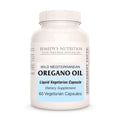
Oregano oil capsules hold a measured dose of essential oil from Origanum vulgare, usually diluted in a carrier oil. Our capsule, for example, contains 45 mg of oregano oil in organic olive oil. The oil is rich in 2 phenols, carvacrol and thymol.[1]Oregano Essential Oil Composition — PubMed View source
Three formats are sold under the oregano name, and they are not interchangeable. The table compares them by what you actually swallow.
| Format | What is inside | Label unit to check | Practical note |
|---|---|---|---|
| Oil capsule or softgel | Oregano essential oil in a carrier oil | mg of oil per capsule, ideally with % carvacrol | Easiest to dose and no taste |
| Herb capsule | Oregano plant material | mg of oregano per capsule | Label may not state carvacrol |
| Liquid oil drops | Oil, sometimes pre-diluted | Drops per serving | Strong taste; dose is harder to measure |
Most research on "oregano oil" uses the distilled oil or carvacrol itself, not the dried herb. Our overview of the benefits of oregano oil supplements covers the wider list of traditional uses.
Carvacrol: The Active Ingredient in Oregano Oil
Carvacrol is the main active ingredient in oregano oil, a phenol also found in thyme. A 2018 review links its strong antimicrobial activity to 1 free hydroxyl group, fat solubility and a phenol ring.[2]Carvacrol and Human Health Review — PubMed View source Our capsules are standardized to at least 70% carvacrol.
Three terms come up on every oregano oil label, and they decide how much active compound you actually get.
- Carvacrol
- The main phenol in most oregano oils and the compound behind most of its antibacterial and antifungal lab results.
- Thymol
- A close chemical relative of carvacrol, found in both oregano and thyme oils, with overlapping lab activity.
- Carrier oil
- A neutral oil, such as olive oil, that dilutes oregano oil so each capsule delivers a measured amount.
The carvacrol percentage is what separates one oregano oil from another. A label that states both the oil amount and the carvacrol share lets you work out the real dose. A label listing only "oregano" does not.
Oregano Oil Capsules Benefits: What the Evidence Shows
Oregano oil capsules benefits have been tested in only a few small human studies. Most positive findings come from cell cultures and animals. The table rates 7 common claims by the best evidence we could verify, from a 14-person parasite study to lab-only tests.
| Claimed benefit | Best evidence found | Who or what was tested | Our read |
|---|---|---|---|
| Gut parasites | 600 mg emulsified oil daily for 6 weeks | 14 adults, no placebo group | Low |
| SIBO | Multi-herb blends vs rifaximin for 4 weeks | 104 patients, chart review | Low |
| Candida yeast | Oil and carvacrol in culture and mice | Lab and animal | Preclinical |
| Drug-resistant bacteria | Oil against 11 resistant isolates | Lab and mouse burn wounds | Preclinical |
| Skin wounds | 3% oregano extract ointment | 40 surgery patients | Moderate, topical only |
| Cholesterol | Oregano distillate for 3 months | 48 adults, different species | Low |
| Antioxidant and antiviral | Isolated oregano compounds | Lab only | Preclinical |
Only 3 of these 7 benefits have human data on an oral oregano product. None comes from a large placebo-controlled trial. A 4th, wound healing, has human data for an ointment only.
Gut Parasites
The main human study of oral oregano oil treated 14 adults whose stool tests showed intestinal parasites. They took 600 mg of emulsified oil daily for 6 weeks. Blastocystis hominis then disappeared in 8 cases, and gut symptoms improved in 7 of 11 carriers.[3]Oregano Oil and Enteric Parasites — PubMed View source
There was no placebo group, so the result is a signal rather than proof. Our guide to oregano oil for intestinal parasites covers how long people use it and what to expect.
SIBO and Gut Bacteria
A 2014 Johns Hopkins chart review compared herbal antimicrobials with rifaximin in 104 people with small intestinal bacterial overgrowth (SIBO). After 4 weeks, 46% of the herbal group had a normal breath test, versus 34% on rifaximin. The difference was not statistically significant.[4]Herbal Therapy vs Rifaximin for SIBO — PubMed View source
Patients chose their own treatment. The herbal arm took commercial multi-herb blends, with oregano oil as 1 ingredient among thyme oil, berberine and others. The study cannot show what oregano oil does alone.
Candida and Fungal Growth
In a 2001 lab study, oregano oil at 0.25 mg/mL completely stopped Candida albicans growth in culture. In mice with systemic candidiasis, 30 days of daily oregano oil gave 80% survival. Untreated mice died within 10 days.[5]Origanum Oil Against Candida — PubMed View source We found no human capsule trial for yeast.
Skin and Wound Healing
The best controlled human data is topical, so it applies to wounds rather than capsules. In a double-blind trial of 40 surgical patients, 3% oregano extract ointment was compared with petroleum jelly. Positive Staphylococcus aureus wound cultures fell to 19%, versus 41% with petroleum jelly.[6]Oregano Ointment for Wound Healing — PubMed View source
Cholesterol
A 3-month study gave 48 adults with mild hyperlipidaemia (high cholesterol) an oregano distillate after meals. It used Origanum onites, a different species, in a water-based form. HDL rose and LDL fell more than with diet advice alone.[7]Oregano Distillate and Blood Lipids — PubMed View source

Oil of Oregano for Infection: What Lab Studies Show
Oil of oregano kills many infection-causing bacteria in lab dishes, including drug-resistant strains. A 2018 Harvard Medical School study tested it on 11 multidrug-resistant clinical isolates. It worked at 0.08 to 0.64 mg/mL, and no resistance appeared after 20 passages.[8]Oregano Oil vs Resistant Bacteria — PubMed View source
Killing germs in a dish is not the same as curing an infection. In infected mouse burn wounds, a topical dose cut bacterial load sharply within 1 hour. Lab and animal results still leave 4 questions open for capsule users:
- Delivery: whether enough carvacrol reaches infected tissue after you swallow it.
- Dose: what amount would be needed inside the human body.
- Comparison: whether it works as well as an antibiotic in a real infection.
- Safety: whether that amount is safe beyond a few weeks.
Antiviral claims rest on even thinner data. In 1 lab study, 12 of 21 phenolic compounds from oregano showed antioxidant activity comparable to vitamin C. The same compounds were also screened against 3 viruses in cell culture.[9]Oregano Phenolics, Antioxidant and Antiviral Tests — PubMed View source
For a fever, spreading redness, or a urinary, chest or skin infection, see a clinician. Oregano oil is not a substitute for an antibiotic that a doctor has prescribed.
How Much Oregano Oil Should I Take Daily?
There is no official daily dose of oregano oil, so start with your product's label. In the parasite study, adults took 600 mg of emulsified oil daily for 6 weeks. A safety trial gave 1 to 2 mg of pure carvacrol per kilogram of body weight daily for 1 month.[10]Carvacrol Safety in Healthy Subjects — PubMed View source
| Source | Daily amount | Length | What it tells you |
|---|---|---|---|
| Parasite study, 2000 | 600 mg emulsified oregano oil | 6 weeks | Small, uncontrolled, but oral oil alone |
| Carvacrol safety trial, 2021 | 1 to 2 mg/kg carvacrol (70 to 140 mg at 70 kg) | 1 month | Lab values stayed within normal range |
| SIBO chart review, 2014 | 2 capsules twice daily of herbal blends | 4 weeks | Blends, not oregano oil alone |
| Remedy's Oregano Oil Capsules | 1 capsule = 45 mg oil, about 31.5 mg carvacrol or more | Label serving | Standard serving is 1 capsule a day |
| Remedy's Mediterranean Oregano | 1 capsule = 1,000 mg organic oregano | Label serving | Carvacrol not stated on the label |
For scale, Remedy's Oregano Oil Capsules deliver 45 mg of oil each. The 600 mg study amount would equal about 13 capsules. That is far above the label serving, and the study used an emulsified oil. Do not scale up to match a study on your own.
Dosage for Oregano Oil Capsules, Step by Step
- Find the oil amount: check mg of oregano oil per capsule, not total capsule weight.
- Find the carvacrol share: look for a stated percentage, such as 70%.
- Start at the label serving: for our oil capsules, that is 1 capsule a day.
- Take it with a meal: a common way to limit stomach upset, though no trial has compared timings.
- Keep courses short: human studies ran 4 to 6 weeks, and we found no long-term safety studies.
- Stop and ask: stop if you notice a rash, wheezing or ongoing stomach pain, and check with a clinician.
How Much Carvacrol per Day?
We found no official daily carvacrol limit for supplements. The only controlled human dosing data we found used 1 to 2 mg/kg daily for 1 month. For a 70 kg adult, that is 70 to 140 mg. All lab values stayed in the normal range, although iron, hemoglobin and HDL fell from baseline.
- 1 Remedy's oil capsule: 45 mg oil × 70% = about 31.5 mg carvacrol, or more.
- Trial range at 70 kg: 70 to 140 mg carvacrol a day, for 1 month only.
- Unknown: safe carvacrol intake beyond 1 month in healthy adults.
Oregano Oil Benefits for Women
Oregano oil benefits for women have 1 notable human trial, and it used a vaginal tablet, not capsules. In 2025, 130 women with bacterial vaginosis used an oregano and lemon balm tablet or metronidazole. Symptoms and Amsel criteria improved equally in both groups.[11]Oregano Vaginal Tablet for Bacterial Vaginosis — PubMed View source
- Vaginal infections: the result applies to a vaginal tablet, and fewer than half of the 130 women completed 10 days.
- Yeast: Candida evidence is lab and animal only, as covered above.
- Iron: iron and hemoglobin fell over 1 month in the carvacrol trial, worth noting with heavy periods or anemia.
- Pregnancy and breastfeeding: no human safety data exist, so see the safety section below.
Vaginal symptoms have several possible causes, so a diagnosis comes before any remedy. Self-treating the wrong condition can delay the treatment that actually works.

Side Effects of Oregano Oil Capsules
Side effects of oregano oil capsules were rare in the small human studies, but those studies were short. In the 2014 SIBO study, 1 of 37 people in the herbal group reported diarrhea. The 1-month carvacrol trial found no lab results outside the normal range.
- Diarrhea or stomach upset: the only side effect reported in the herbal arm of the SIBO study.
- Skin irritation: undiluted oregano oil has caused irritant contact dermatitis.[12]Oregano Oil Contact Dermatitis — PubMed View source
- Allergic reactions: possible in people sensitive to mint-family plants, covered below.
- Blood test changes: small falls in iron, hemoglobin and HDL in the carvacrol trial.
Most of these risks drop with a measured capsule, a meal and a short course. Our guide to oil of oregano side effects explains how to lower each one.
Who Should Avoid Oregano Oil? Safety and Interactions
Oregano oil should be avoided in pregnancy, while breastfeeding, and with an allergy to mint-family plants. A 1996 case report described 3 systemic allergic reactions to oregano and thyme in 1 patient. Skin tests suggested cross-sensitivity across the mint family, which includes basil, sage, marjoram, mint and lavender.[13]Systemic Allergy to Oregano and Thyme — PubMed View source
Talk to a Clinician Before Taking Oregano Oil If You
- Are pregnant or breastfeeding
- Are allergic to oregano, thyme, basil, sage, marjoram, mint or lavender
- Have a bleeding disorder or take warfarin, apixaban, clopidogrel, aspirin or another blood thinner
- Take insulin or other diabetes medicines
- Have surgery scheduled
- Want to give it to a child
| Situation | Why it matters | What to do |
|---|---|---|
| Pregnancy | No human safety data; carvacrol changed pregnant rat uterine contractions in lab tests[14]Carvacrol and Pregnant Rat Uterus — PubMed View source | Avoid supplement doses |
| Breastfeeding | No human safety data | Avoid supplement doses |
| Mint-family allergy | Cross-reactions with thyme and related plants documented | Avoid |
| Bleeding disorders or blood thinners | Carvacrol showed a mild antiplatelet effect in lab tests[15]Antiplatelet Effects of Carvacrol — PubMed View source | Ask your prescriber first |
| Diabetes medicines | Carvacrol lowered blood glucose in diabetic mice[16]Carvacrol and Glucose in Diabetic Mice — PubMed View source | Ask your prescriber and monitor glucose |
| Upcoming surgery | Possible bleeding and blood sugar effects, as above | Stop beforehand; ask your surgeon how far ahead |
| Low iron or anemia | Iron and hemoglobin fell in the 1-month carvacrol trial | Check with your clinician |
| Other prescription medicines | Carvacrol inhibited cytochrome P450 liver enzymes in mice[17]Carvacrol Inhibits Cytochrome P450 — PubMed View source | Ask a pharmacist about interactions |
| Children | We found no pediatric dosing studies | Only with a pediatrician's advice |
How to Choose an Oregano Oil Capsule
A useful oregano oil capsule label states 3 things. They are the species (Origanum vulgare), the milligrams of oil per capsule and the carvacrol percentage. Without all 3, you cannot compare products or relate a capsule to a study dose. A label reading only "oregano" may mean plant material rather than oil.
Here is how our 2 oregano products compare on those points, taken from their labels and product pages.
| Feature | Oregano Oil Capsules | Mediterranean Oregano |
|---|---|---|
| Per capsule | 45 mg oregano oil | 1,000 mg organic oregano (Origanum vulgare) |
| Carvacrol stated | At least 70% per batch | Not listed in Supplement Facts |
| Other ingredients | Organic olive oil carrier; vegan cellulose shell | Cellulose, glycerin, water (vegan capsule) |
| Label serving | 1 capsule a day | 1 capsule a day |
| Capsules per bottle | 60 | 60 |
Skip products that hide the oil amount inside a proprietary blend or promise to cure infections. For dose ranges laid out by goal, see our oregano oil dosage for adults guide.
Limitations of the Oregano Oil Evidence
The evidence for oregano oil is thinnest where it matters most, in people taking capsules. The oral studies we could verify enrolled 14, 48 and 104 people and lasted 4 weeks to 3 months. None was a large placebo-controlled trial of oregano oil capsules alone.
- Most antibacterial, antifungal and antiviral results come from cell cultures and mice.
- The SIBO study tested herbal blends, so it cannot isolate oregano's effect.
- The cholesterol study used a different oregano species in a water-based form.
- We found no safety studies of oral oregano products lasting longer than 3 months.
- Products differ in oil amount and carvacrol share, so study doses rarely convert to a capsule count.
None of this means oregano oil does nothing. It means the honest use today is short, label-dosed courses, with a clinician involved for any real infection.

Frequently Asked Questions
How long do oregano oil capsules take to work? +
Human studies of oral oregano products measured results after 4 to 6 weeks, so there is no evidence for overnight effects. The parasite study checked stools after 6 weeks, and the SIBO study retested breath after 4 weeks. If an infection gets worse or you develop a fever, see a clinician rather than waiting for a supplement to act.
What are the signs that oregano oil is working? +
No study has defined reliable signs that oregano oil is working. In the 2000 parasite study, 7 of 11 people with Blastocystis reported fewer gut symptoms, but clearance was confirmed with stool tests. Feeling better can also be natural recovery, so retesting with a clinician is the only way to confirm a gut infection has cleared.
What infections can oregano oil cure? +
Oregano oil is not proven to cure any infection in people. It kills bacteria and Candida in lab tests, and 1 small trial saw gut parasites clear in 8 of 11 Blastocystis cases, but it had no placebo group. Urinary, chest or skin infections with fever need a clinician and, often, prescription treatment.
Is oil of oregano stronger than amoxicillin? +
We found no human trial comparing oil of oregano with amoxicillin. In lab dishes, oregano oil killed 11 drug-resistant bacterial strains at 0.08 to 0.64 mg/mL, but lab strength does not show what reaches an infection after you swallow a capsule. For a diagnosed bacterial infection, take the antibiotic your clinician prescribes.
Why don't doctors prescribe oil of oregano? +
Oil of oregano is a dietary supplement, not an approved drug, and its human evidence is small. The main oral studies enrolled 14 to 104 people, and none was a large placebo-controlled trial. Some gastroenterology and integrative practices do offer herbal blends that contain it, usually as a 4-week course.
What to avoid when taking oil of oregano? +
Avoid oil of oregano in pregnancy, while breastfeeding, and with an allergy to mint-family plants such as thyme, basil or sage. Ask your prescriber first if you take blood thinners or diabetes medicines, and stop before scheduled surgery. Never swallow undiluted oil, and keep courses short, since human studies lasted 4 to 6 weeks.
Should you take oregano oil at night or in the morning? +
No study has compared morning and night doses of oregano oil, so either works if you follow the label. Many people take it with a meal, which may limit stomach upset, and keep the same daily amount. Our Oregano Oil Capsules list 1 capsule a day as the standard serving.
How many days do you take oregano oil? +
Human studies of oral oregano products lasted 4 to 6 weeks, and a carvacrol safety trial lasted 1 month. We found no long-term safety data, so a short course followed by a break is the cautious approach. Follow the label, and talk to a clinician before continuing beyond 6 weeks.
What is the 72 hour rule about oregano oil? +
We found no clinical source for a 72-hour rule for oregano oil; it appears to be online advice rather than a tested protocol. The human studies we reviewed measured results after 4 to 6 weeks, not 3 days. If symptoms of an infection get worse at any point, seek medical care instead of waiting.
Why do I feel weird after taking oregano oil? +
Feeling unwell after oregano oil can point to stomach irritation, an allergy or an interaction. In the 2014 SIBO study, 1 of 37 people on herbs reported diarrhea, and mint-family allergy can cause systemic reactions. Stop taking it, and get urgent help for swelling, wheezing or hives.
Does oregano reduce belly fat? +
We found no human trial showing that oregano or its oil reduces belly fat. The closest human data is a 3-month study of 48 adults with mild high cholesterol, which measured blood lipids, not body fat. Weight loss is not a reason to take oregano oil capsules on current evidence.
How much carvacrol is in one oregano oil capsule? +
Carvacrol per capsule depends on the oil amount and its carvacrol share. Remedy's Oregano Oil Capsules hold 45 mg of oil at no less than 70% carvacrol, roughly 31.5 mg per capsule. For comparison, a 1-month safety trial gave 1 to 2 mg/kg daily, about 70 to 140 mg for a 70 kg adult.
Related Reading
- Oregano oil vs antibiotics: what the research shows
- Oregano oil capsules for SIBO
- Oregano oil for candida overgrowth
- Best time to take oregano oil capsules
- How long you can safely take oregano oil
- Oregano oil capsules vs liquid and softgels
Related Products




1 comment
En realidad las propiedades de este aceite son muy efectivos, lo recomiendo 200%