What BCAAs Are
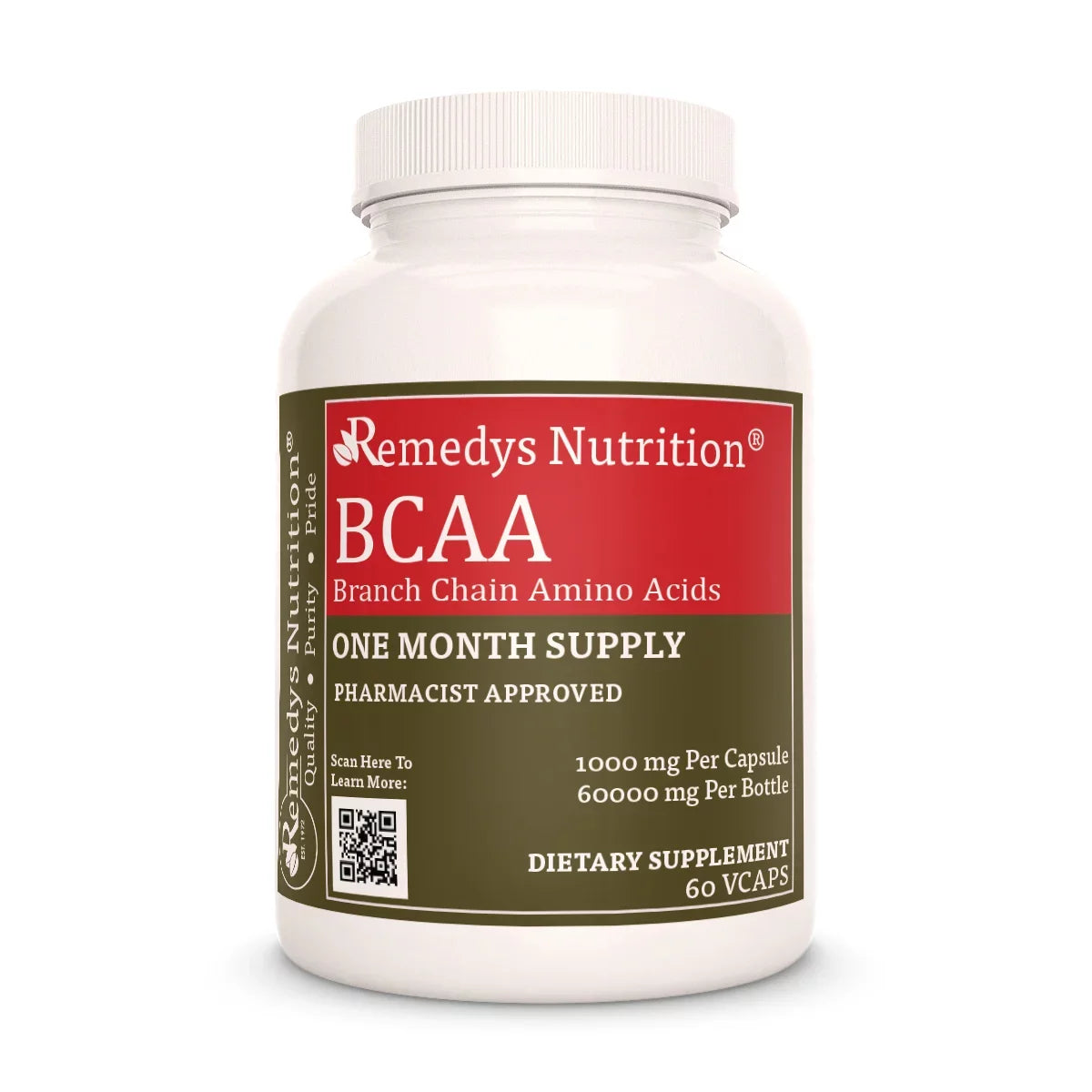
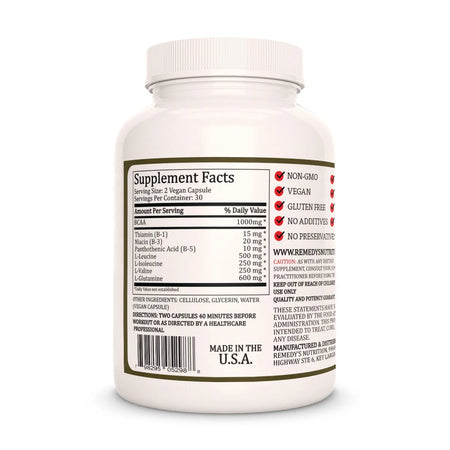
BCAAs are 3 of the 9 essential amino acids: leucine, isoleucine and valine. Remedy's BCAA supplies 1000 mg per 2-capsule serving in the standard 2:1:1 ratio, with 30 servings per bottle, plus 600 mg of L-glutamine.
They are called branched-chain for their molecular structure rather than for anything they do in the body. Being essential means they come from food, not that a supplement is required.
-
1000 mg per serving: 500 mg leucine, 250 isoleucine, 250 valine.
-
Also included: 600 mg L-glutamine and 3 B vitamins.
-
30 servings: Two capsules each, per bottle.
-
Ratio: 2:1:1, weighted towards leucine.
The full claim map is in our BCAA overview.
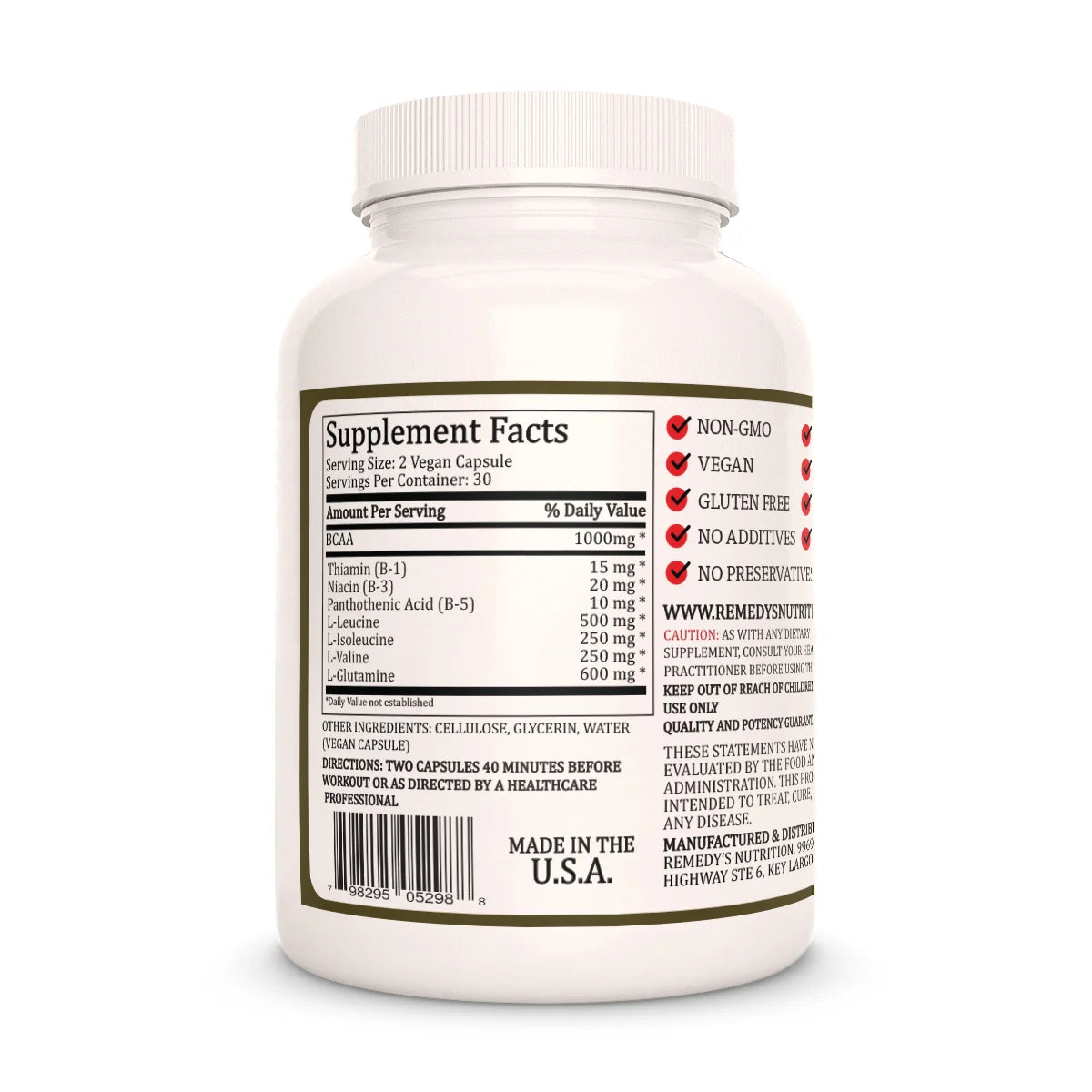
Supplement Facts
Serving size: 2 Vegan Capsules. Servings per container: 30.
| Amount Per Serving |
Amount |
% Daily Value |
|
BCAA — 1000 mg |
| Thiamin (B-1) |
15 mg |
not printed |
| Niacin (B-3) |
20 mg |
not printed |
| Pantothenic Acid (B-5) |
10 mg |
not printed |
| L-Leucine |
500 mg |
* |
| L-Isoleucine |
250 mg |
* |
| L-Valine |
250 mg |
* |
| L-Glutamine |
600 mg |
* |
* Daily Value not established. Where the label prints no %DV for a nutrient that has one, that is recorded as 'not printed'.
Other ingredients: Cellulose, Glycerin, Water (vegan capsule)
Directions: Two capsules 40 minutes before workout, or as directed by a healthcare professional.
Non-GMO, vegan, gluten free, no additives, no preservatives. Made in the USA.
What the Evidence Actually Shows
We would rather state the position of the research than repeat a benefit list, because the research is more interesting than the list.
| Claim |
Best evidence |
Our position |
| Reduces muscle soreness |
9-trial meta-analysis; 7 of 10 trials positive |
The reason to buy it |
| Builds muscle on its own |
Review found 0 oral human MPS studies |
We do not claim this |
| Improves performance |
24-study review called benefits negligible |
We do not claim this |
| Changes body composition |
1 of 22 studies found a difference |
We do not claim this |
| Treats hepatic encephalopathy |
Cochrane, 18 trials, 934 adults |
A clinical use, not ours |
Building new muscle protein requires all 9 essential amino acids, so supplying 3 caps what is possible: a widely cited review put the theoretical ceiling at about 30% above synthesis and called even that an over-estimate, found no human study measuring the response to oral BCAAs alone, and noted both intravenous studies showed synthesis decreased.[1]Branched-chain amino acids and muscle protein synthesis in humans: myth or reality? — Journal of the International Society of Sports Nutrition (2017) View source That is set out in do BCAAs build muscle.
The One Finding We Sell This For
Soreness is the athletic claim that partly survives systematic review, and it carries 4 conditions.
-
Who: Trained subjects; untrained could not be assessed.
-
How much: Up to 255 mg per kg per day.
-
What session: Mild to moderate muscle damage.
-
When: Around the session, not only afterwards.
Of 10 trials, 7 found reduced delayed-onset soreness at 24 to 72 hours under those conditions.[2]The use of BCAA to decrease delayed-onset muscle soreness after a single bout of exercise: a systematic review and meta-analysis — Amino Acids (2021) View source For an 80 kg adult that dose ceiling is about 20 g a day, so our 1000 mg serving sits well below it. The detail is in BCAAs for soreness and recovery.
Where BCAAs Sit Against EAAs, Whey and Creatine
The comparison turns on 1 fact: how many of the 9 essential amino acids each option supplies.
|
Essential amino acids |
Best-supported outcome |
| BCAAs |
3 |
Reduced soreness in trained people |
| EAAs |
9 |
Supplies everything synthesis needs |
| Whey or food protein |
9, plus the rest |
Total protein intake, the main lever |
| Creatine monohydrate |
Not an amino acid blend |
Strength and power output |
Buying BCAAs alongside an EAA or whey product means paying twice for the same 3 amino acids. The full comparison is in BCAA vs EAA and creatine.
How to Use It
There is no established dose in this category: across 22 studies daily amounts ran from 1.5 g to 82 g.
| Question |
Practical answer |
| How much |
2 capsules, delivering 1000 mg of BCAA |
| When |
40 minutes before a workout, per the label |
| Only after training |
No; the soreness review ruled that out |
| Rest days |
Not studied separately |
| What matters more |
Total daily protein, by a wide margin |
A 55-fold spread in study doses means any single recommended number is a choice rather than a finding.[3]The Effect of Oral Pure Branched-Chain Amino Acid Supplementation on Exercise Performance and Body Composition: A Systematic Review — Cureus (2025) View source Timing and amounts are compared in dosage and timing.
Safety
The best adverse-event data come from clinical trials rather than sports studies, and they are specific.
| Measure |
BCAA group |
Control group |
| Participants |
477 |
538 |
| Nausea and diarrhoea |
58 people, or 12% |
16 people, or 3% |
| Trials contributing |
18, published 1984 to 2023 |
Same trials |
| Healthy kidneys |
0 trials showing harm at supplement doses |
Not applicable |
Those were counted as serious adverse events in a Cochrane review of 934 adults with cirrhosis.[4]Branched-chain amino acids for people with cirrhosis and hepatic encephalopathy — Cochrane Database of Systematic Reviews (2026) View source Anyone with liver or kidney disease should be deciding this with a clinician. The full list is in side effects and safety.
Claims We Do Not Make
Four things are commonly said about BCAAs that we will not repeat here.
-
They build muscle: A review found 0 oral human studies of that.
-
They burn belly fat: 1 of 22 studies found any body-composition effect.
-
They replace protein: They supply 3 of 9 essential amino acids.
-
They preserve muscle while fasting: 0 controlled trials support it.
Most BCAA trials never recorded participants' total protein intake, which is the confounder running through the whole literature.[5]Oral Branched-Chain Amino Acids Supplementation in Athletes: A Systematic Review — Nutrients (2022) View source That question is handled in do you need BCAAs if you eat enough protein.
Why Choose Remedy's BCAA
A stated ratio, a stated amount, and a claim we can actually defend.
| What you get |
Why it matters |
| 1000 mg BCAA in a 2:1:1 ratio |
The split is printed, not hidden in a blend |
| 600 mg L-glutamine per serving |
Stated on the label rather than as 'proprietary' |
| Vegan capsules |
Cellulose, glycerin and water |
| 30 servings |
A month at 1 serving per training day or so |
| Honest positioning |
Sold for soreness, not for muscle growth |
Frequently Asked Questions
What does BCAA actually do? +
It supplies 3 of the 9 essential amino acids. The best-supported outcome is reduced soreness in trained people, where 7 of 10 trials found an effect at 24 to 72 hours.
Do BCAAs build muscle? +
The claim is not supported. Building new muscle protein needs all 9 essential amino acids, and both intravenous studies of BCAAs alone found synthesis decreased.
What is the downside of BCAA? +
Digestive upset and cost. In the Cochrane dataset, nausea and diarrhoea affected 12% on BCAAs against 3% on control.
Which is better to take, EAA or BCAA? +
EAAs supply all 9 essential amino acids rather than 3, so they cover what BCAAs structurally cannot.
Is BCAA better than creatine? +
For strength and power, creatine has a far larger evidence base. They are 2 different categories rather than direct alternatives.
When is the best time to take BCAAs? +
Our label directs 2 capsules 40 minutes before a workout. The soreness review specifically ruled out dosing only after the session.
How much BCAA should I take? +
There is no established dose. Across 22 studies the daily amount ranged from 1.5 g to 82 g, and our serving is 1000 mg.
Should I take BCAA every day? +
The trials mostly dosed around training. If your total protein intake already covers these 3 amino acids, daily use adds little.
Is BCAA safe for kidneys? +
In healthy kidneys there are 0 trials showing harm at supplement amounts. Reduced kidney function is a clinician question rather than a label one.
Is BCAA hard on your liver? +
In cirrhosis, BCAAs are studied as a treatment across 18 trials rather than as a risk. In healthy people there is no evidence of liver harm.
Are BCAAs good for women? +
The evidence is the same by sex, since 0 of these reviews found a sex-specific effect. Total protein intake matters more than the supplement.
Do BCAAs help burn belly fat? +
No. Of 22 studies in a 2025 review, 1 found a significant body-composition difference, and none supports targeted fat loss.
You May Also Like