What Is Creatine Monohydrate?
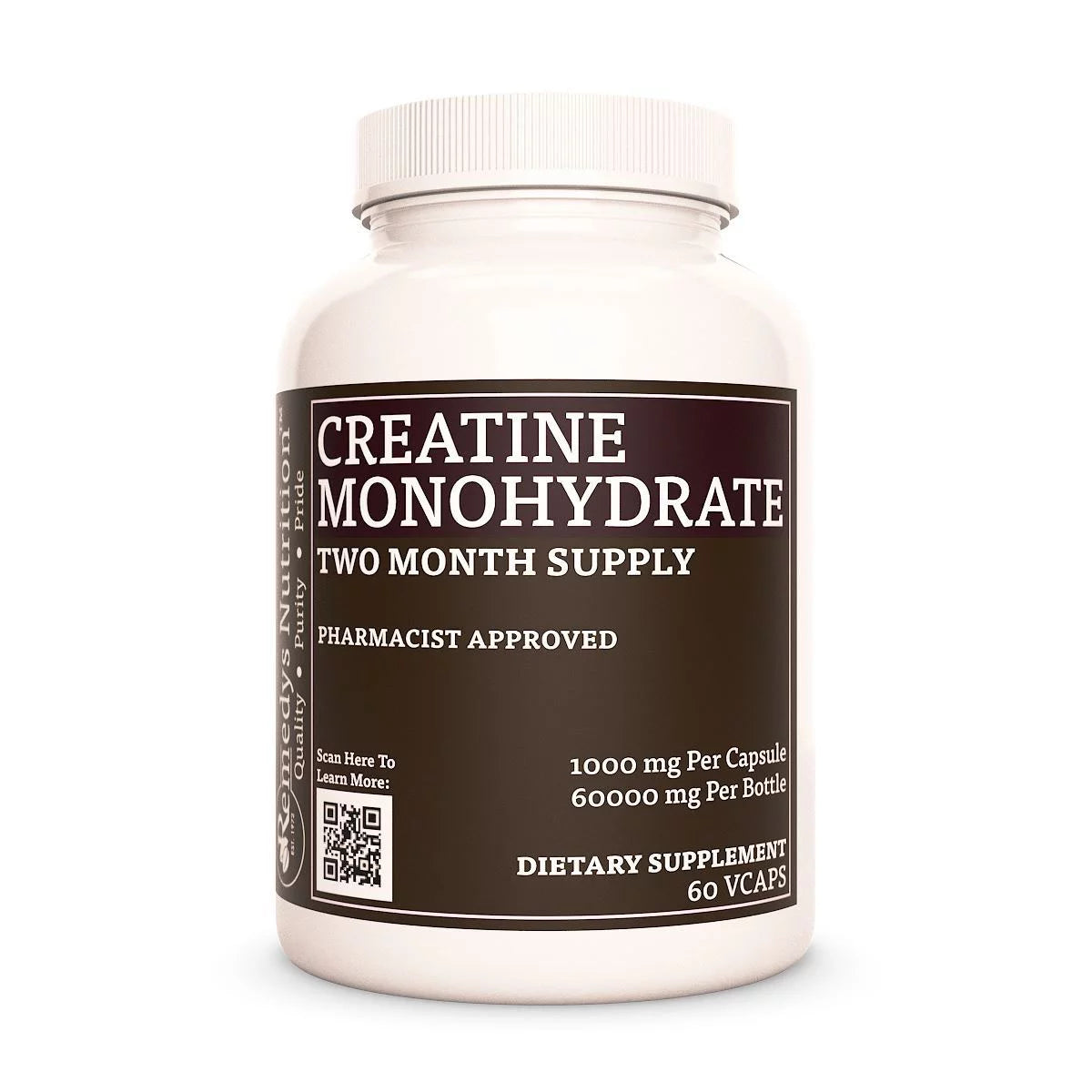
Creatine monohydrate is a compound your body builds from three amino acids and stores mostly in muscle as phosphocreatine. Supplementing 3–5 g daily raises muscle stores by 20–40%, which fuels rapid ATP regeneration for strength and power.[1]ISSN Position Stand on Creatine Safety & Efficacy — J Int Soc Sports Nutr (2017) View source Each Remedy's capsule delivers exactly 1000 mg of creatine monohydrate and nothing else.
Your kidneys, liver, and pancreas make about 1 g of creatine per day, and a mixed diet adds 1–2 g from meat and fish. Most people still sit below saturation, which is why supplementing produces measurable gains, especially for vegetarians. For the deeper science walkthrough, see our complete evidence-based guide to creatine.
-
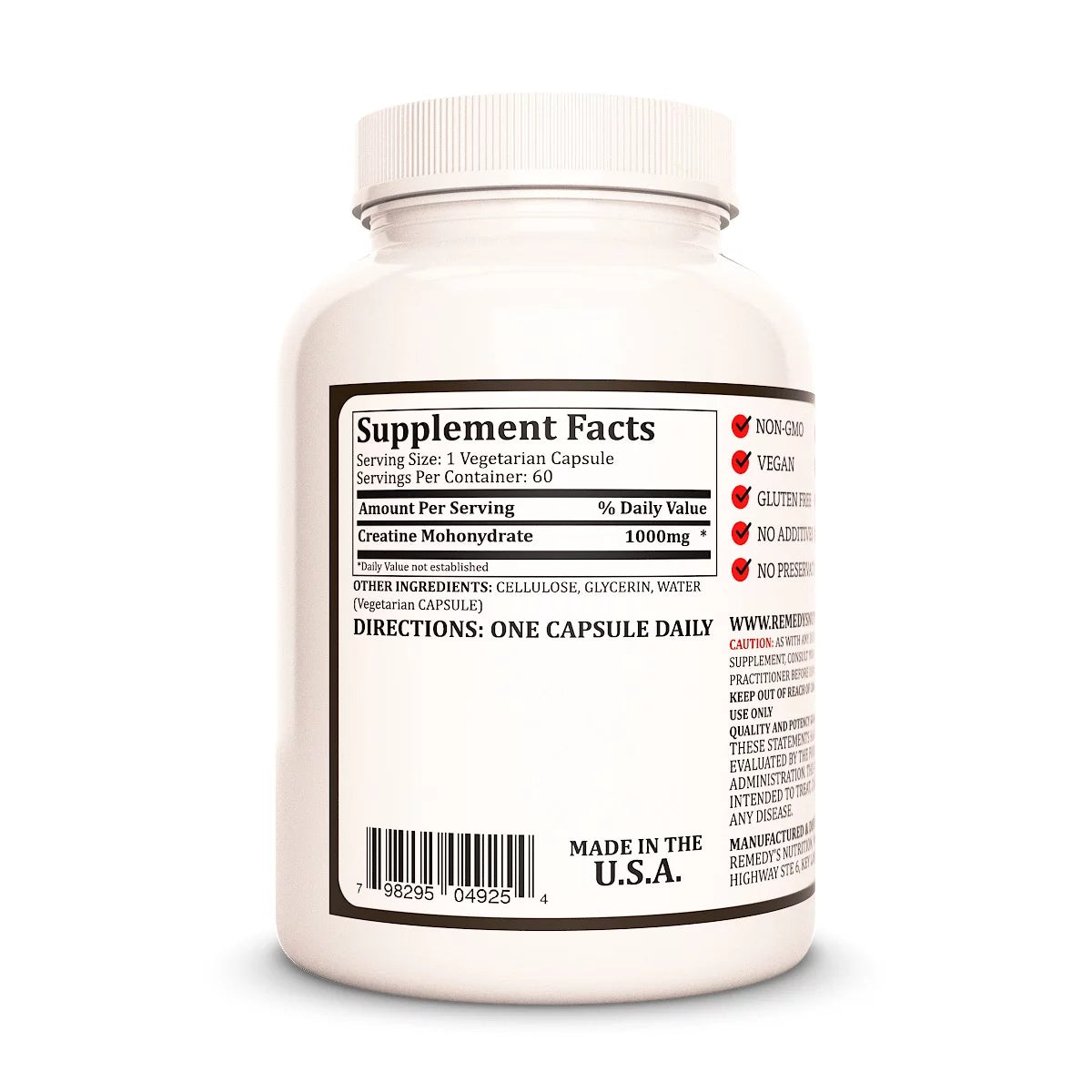
Per capsule: 1000 mg creatine monohydrate
-
Per bottle: 60 vegetarian capsules = 60 g of creatine
-
Other ingredients: cellulose, glycerin, and water (the vegan capsule shell)
-
Dose math: 3 capsules = 3 g, 5 capsules = 5 g
Why Choose Remedy's Creatine Monohydrate
This is a single-ingredient capsule: creatine monohydrate inside a vegan shell, with no proprietary blend, no flavoring, and no bulking agents. The format exists for one reason — a fixed, portable 1 g unit you can count instead of scoop.
| What You Get |
Why It Matters |
| Pure creatine monohydrate |
Near-complete oral bioavailability and the most-studied form on record[2]Absolute Oral Bioavailability of Creatine Monohydrate — Pharmaceutics (2018) View source
|
| Vegan capsule format |
No scoop, no shaker, no chalky texture, and no taste to work around |
| Exactly 1000 mg per capsule |
Dose in clean 1 g steps, useful for 2–3 g trials and for splitting doses |
| No fillers or additives |
Non-GMO, gluten free, with nothing added to dilute the active dose |
| 60 capsules per bottle |
12 days at 5 g/day or 20 days at 3 g/day |
| Made in the USA |
Produced and packed by Remedy's Nutrition in Key Largo, Florida |
Top Benefits of Creatine
Creatine is the most consistently effective sports supplement studied, raising strength and power output by 5–15% and adding 1–2 kg of lean mass when paired with resistance training.[3]Creatine & Body Composition Meta-Analysis — Int J Sport Nutr Exerc Metab (2003) View source Benefits reach beyond the gym, with growing evidence for brain energy, healthy aging, and recovery.
| Benefit Area |
Key Finding |
Typical Dose |
| Strength & Power |
5–15% gains in 1-rep max and high-intensity output vs placebo |
3–5 g/day |
| Lean Muscle |
1–2 kg lean mass added over 4–12 weeks with training[4]Creatine & Resistance Training Strength Gains — J Strength Cond Res (2003) View source
|
3–5 g/day |
| Recovery |
Reduced muscle damage markers and faster repletion between sessions |
3–5 g/day |
| Brain Energy |
Improved short-term memory and processing under stress |
5–10 g/day |
| Healthy Aging |
Supports muscle, strength, and bone in older adults[5]Creatine for Older Adults: Sarcopenia & Bone — Bone (2022) View source
|
3–5 g/day |
For the full evidence breakdown of each benefit, read what the research actually shows about creatine.
How Creatine Works: The ATP-Phosphocreatine System
Your muscles run on ATP but store only enough for a few seconds of all-out effort. Phosphocreatine donates a phosphate to rebuild ATP almost instantly, and supplementation enlarges that phosphocreatine reservoir by 20–40%.[6]Creatine Enhances Anaerobic ATP Synthesis — Mol Cell Biochem (2003) View source
More phosphocreatine means faster energy regeneration during sprints, heavy lifts, and repeated efforts. That extra capacity buys one or two more reps per set, which compounds into real strength and muscle over weeks.
-
Buffer energy: rapid ATP resynthesis during short, intense bursts
-
Cell hydration: draws water into muscle, signaling growth
-
Training volume: more quality reps drive bigger adaptations
Creatine Dosage: Loading and Maintenance
The standard maintenance dose is 3–5 g daily, which is 3 to 5 of these 1000 mg capsules. An optional loading phase of 20 g per day for 5–7 days saturates muscle faster, while a flat 5 g daily reaches the same saturation in roughly 28 days.[7]Practical Aspects of Creatine Supplementation — Nutrition (2004) View source
| Goal |
Dose |
Capsules |
Duration |
| Maintenance (recommended here) |
3–5 g/day |
3 to 5 capsules, together or split |
Ongoing |
| Lower-dose start |
2–3 g/day |
2 to 3 capsules |
First 1–2 weeks |
| Heavier athletes |
5–10 g/day |
5 to 10 capsules, split into 2 doses |
Ongoing |
| Loading (optional) |
20 g/day for 5–7 days |
20 capsules/day — use the powder instead |
5–7 days |
That last row is the honest limit of the capsule format: a 20 g loading day means 20 capsules, which empties this bottle in 3 days. See the full protocol in our creatine dosage and loading guide.
When to Take Creatine
Timing matters far less than total daily intake, which drives about 90% of results. A modest edge may favor taking your 3–5 g after training, when muscle uptake is slightly higher, but the difference is small.[8]Pre vs Post Workout Creatine Timing — J Int Soc Sports Nutr (2013) View source On rest days, take your dose whenever you remember.
Daily consistency is the whole game. Missing an occasional day will not empty your stores, but taking creatine every day keeps saturation high. The details are in our guide on the best time to take creatine.
Capsules vs Powder: Which One You Should Buy
Remedy's makes creatine in both formats, so here is the straight comparison instead of a sales pitch. This bottle holds 60 g of creatine in 60 capsules; the powder tub holds 250 g in 50 scoops of 5 g, which makes it the cheaper format per gram.
| Factor |
Capsules (this product) |
Powder |
| A 5 g dose |
5 capsules |
1 level scoop |
| Creatine per container |
60 g (60 x 1000 mg) |
250 g (50 x 5 g) |
| Cost per gram |
Higher, you pay for the capsule |
Lowest available format |
| Travel and work |
Pocketable, no mixing or water needed |
Needs a scoop and a drink |
| Loading at 20 g/day |
20 capsules per day |
4 scoops per day |
| Micro-dosing |
Exact 1 g steps |
Partial scoops, less precise |
Buy capsules if you travel, dislike mixing, or want a fixed dose you can count. Buy the creatine monohydrate powder if you plan to load, dose above 5 g, or want the lowest cost per gram. Both contain the same molecule, and gummies or HCL are covered in our creatine forms comparison.
Creatine for Women
Women benefit from creatine at the same 3–5 g daily dose as men and do not develop bulk. Creatine raises strength 5–15%, supports bone density and mood, and aids cognition across the lifespan.[9]Creatine in Women's Health: A Lifespan Perspective — Nutrients (2021) View source
Because women naturally store about 70–80% as much creatine as men, supplementing may matter more, not less. The "bulky" fear is unfounded, as explained in our article on creatine for women, benefits and myths.
Creatine for Brain and Cognitive Health
The brain uses about 20% of the body's energy, and creatine helps buffer that demand. Cognitive benefits are strongest under stress such as sleep deprivation, where supplementation has improved short-term memory and reaction time.[10]Creatine Cognition Systematic Review & Meta-Analysis — Front Nutr (2024) View source
Cognitive protocols often run 5–10 g daily, which is 5 to 10 capsules, so this is one case where powder may suit better. The evidence and its limits are covered in our creatine and cognitive health overview.
Side Effects and Safety
Creatine side effects are mild in healthy people, limited mostly to 1–2 kg of water weight and occasional stomach upset after large single doses. Long-term studies up to 21 months show no harm to kidney or liver markers in healthy users.[11]Long-Term Creatine Does Not Impair Renal Function — Med Sci Sports Exerc (1999) View source
Always tell your physician about any supplement, and pair creatine with adequate hydration. The drug classes below warrant a conversation with your doctor before starting.
| Drug / Class |
Concern |
What to Do |
| NSAIDs (ibuprofen, naproxen) |
Added kidney workload |
Discuss with your doctor; stay hydrated |
| Diuretics |
Fluid balance shifts |
Monitor hydration; consult physician |
| Nephrotoxic drugs |
Combined renal stress |
Avoid unless physician-directed |
| Caffeine (high dose) |
Possible GI upset |
Separate timing if sensitive |
| Probenecid |
Altered creatinine clearance |
Inform prescriber |
| Cimetidine |
Renal handling overlap |
Consult physician |
| Trimethoprim |
Raises serum creatinine |
Inform prescriber before lab work |
| Diabetes medications |
Theoretical glucose interaction |
Monitor; consult physician |
| Lithium |
Fluid and electrolyte sensitivity |
Consult physician |
| Cyclosporine |
Kidney-affecting drug |
Avoid unless physician-directed |
The kidney myth is the most persistent one, and a 2023 narrative review called for a "requiem" for it in healthy users.[12]Requiem for Creatine-Induced Kidney Failure? — Nutrients (2023) View source For the full picture, see our deep dive on creatine side effects.
Who Should Not Take Creatine
Most healthy adults can take creatine safely, but a few groups should get medical clearance first. The 2017 ISSN position stand supports broad safety while advising caution where kidney function is already compromised.
-
Pre-existing kidney disease: use only under physician supervision
-
Pregnancy or breastfeeding: data are limited — avoid unless your doctor advises it
-
Teenagers under 18: use only with parental and medical oversight
-
Anyone on the drugs above: confirm with a prescriber before starting
-
Bipolar disorder: discuss with your clinician before starting
What's in the Bottle
Each bottle holds 60 vegetarian capsules, and each capsule delivers 1000 mg of creatine monohydrate. The only other ingredients are the capsule shell itself.
-
Active: Creatine Monohydrate 1000 mg per capsule
-
Capsules per bottle: 60 (12 days at 5 g/day, 20 days at 3 g/day)
-
Other ingredients: cellulose, glycerin, water (vegetarian capsule)
-
Directions: take 3 to 5 capsules daily, with or without food
-
Free from: gluten, GMO, artificial additives, and preservatives
Frequently Asked Questions
How much creatine monohydrate should I take per day? +
Take 3 to 5 grams daily, which equals 3 to 5 of these 1000 mg capsules. An optional loading phase uses 20 grams per day for 5 to 7 days. Loading is not required; 5 g daily fully saturates muscle in about 28 days.
How many capsules equal a 5-gram dose? +
Five capsules equal 5 g, since each one holds exactly 1000 mg. For a 3 g maintenance dose, take 3 capsules. You can take them together or split across the day, because total daily intake is what saturates muscle, not the split.
Should I buy capsules or powder? +
Capsules suit travel and fixed dosing: 5 capsules is 5 g with no mixing. Powder is cheaper per gram and better for loading, where 20 g means 4 scoops instead of 20 capsules. This bottle holds 60 g total; the powder tub holds 250 g.
Is creatine safe for your kidneys? +
Yes, for healthy kidneys. Studies up to 21 months show no harm to kidney function in people without kidney disease. The 2017 ISSN position stand confirms no adverse renal effects at 3 to 5 g daily. Those with kidney disease should consult a doctor first.
Does creatine cause hair loss? +
No strong evidence links creatine to hair loss. The claim traces to 1 study of 20 rugby players in 2009 that measured a DHT ratio but never measured hair loss. Over 15 years of research has not replicated a hair-loss effect at standard 3 to 5 g doses.
Will creatine make me gain weight? +
You may gain 1 to 2 kg of water weight in the first 1 to 2 weeks as muscles pull in water. This is hydration, not fat. Over months, creatine helps add lean muscle with training. Total daily intake matters more than any single dose.
Should women take creatine? +
Yes, at the same 3 to 5 g daily dose as men. Creatine raises strength 5 to 15%, supports bone and mood, and aids cognition. It does not cause bulk; women store about 70 to 80% as much creatine as men, so supplementation can be especially useful.
Do I need a loading phase? +
No, loading is optional. Taking 20 g per day for 5 to 7 days saturates muscle faster, but a steady 5 g daily reaches the same point in about 28 days. In capsule form, 20 g a day means 20 capsules, so most people here skip loading.
When is the best time to take creatine? +
Timing drives only about 10% of results, so daily consistency matters most. A small edge may favor taking your 3 to 5 capsules after training. On rest days, take them any time. Just take them every single day to keep stores saturated.
How long until I see results? +
With loading, performance gains can appear within 5 to 7 days. Without loading, expect full muscle saturation and benefits in about 28 days at 5 g daily. Strength and lean-mass changes build over 4 to 12 weeks of consistent training plus supplementation.
Can I take creatine on rest days? +
Yes, take your usual 3 to 5 capsules on rest days too. The goal is keeping muscle saturation steady, which depends on total daily intake, not workout timing. Skipping rest-day doses slowly lowers stores over a 2 to 4 week span.
Is creatine monohydrate better than HCL? +
Monohydrate wins on evidence and cost, backed by over 700 studies. HCL claims better solubility, but no trial shows it outperforms monohydrate for strength or muscle. Monohydrate also costs far less per gram, making it the gold-standard choice for most users.
Can I stack creatine with protein or pre-workout? +
Yes, creatine stacks safely with whey protein and most pre-workouts. They serve different roles: protein supplies building blocks, creatine fuels the ATP system. Keep total daily creatine at 3 to 5 g; you do not need a creatine-specific pre-workout.
You May Also Like