What Is Betaine HCl?
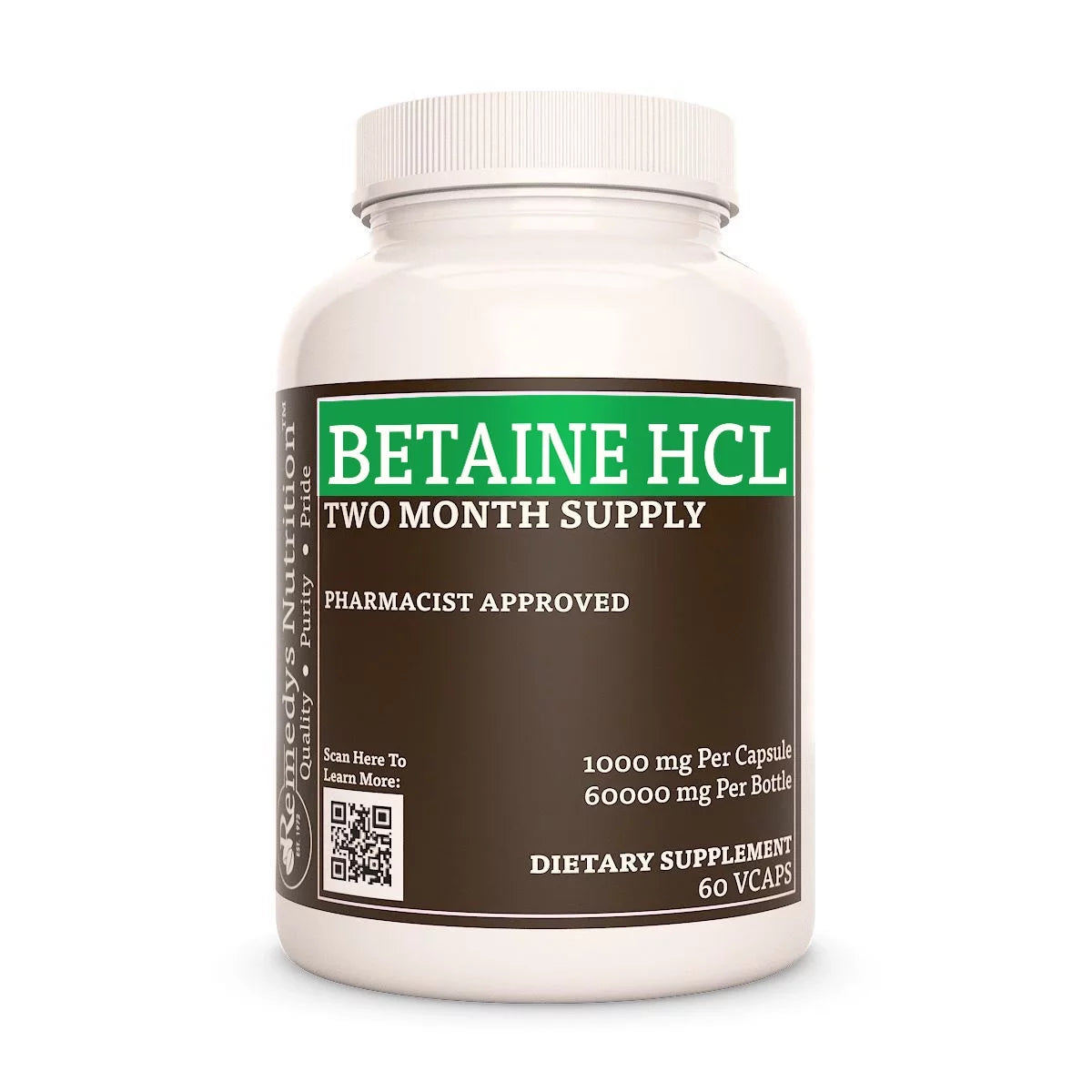
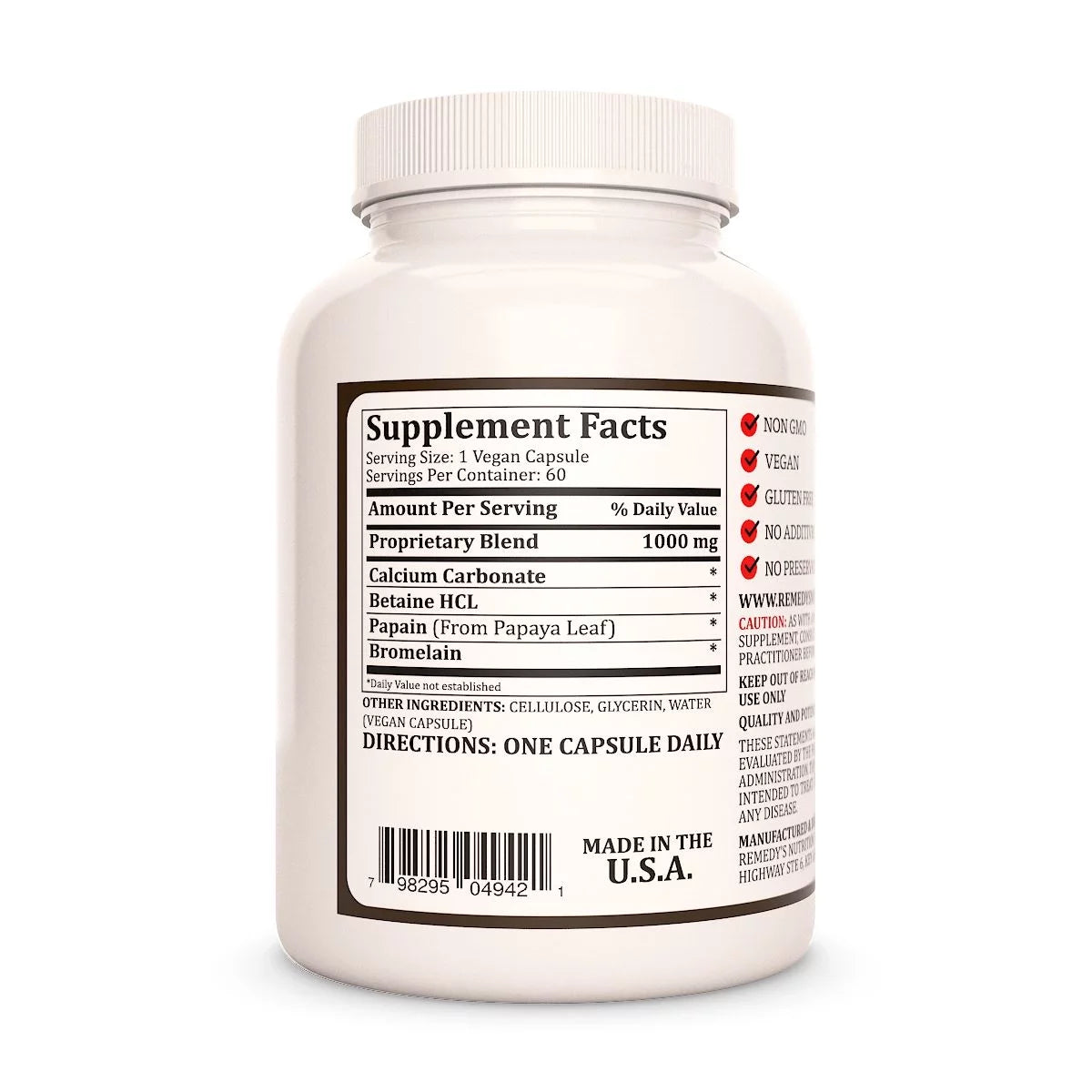
Betaine HCl is betaine bound to hydrochloride, a salt that releases hydrochloric acid when it dissolves in the stomach. Remedy's Betaine HCL supplies 1000 mg per vegan capsule, with 60 capsules per bottle, and it is taken with a protein-containing meal rather than between meals.
It is not the same product as betaine anhydrous, also sold as TMG, which is a methyl donor used for homocysteine and in sports nutrition and does not acidify anything. The 2 are constantly confused because they share 1 word on the label.
Most products in this category combine betaine HCl with pepsin, the stomach's protein-digesting enzyme, because pepsin needs an acidic environment to work. Our full explainer covers what betaine HCl is and how it is used.
What the Evidence Actually Covers
We would rather state this plainly than imply more than exists. The published human work on betaine HCl studied gastric acidity and drug absorption, not bloating, reflux or everyday digestion.
| Question studied |
Population |
What it does not show |
| Can betaine HCl re-acidify the stomach? |
Healthy volunteers given a PPI |
Whether it eases bloating |
| Does restored acid improve drug absorption? |
Healthy volunteers given a PPI |
Whether it helps digestion |
| Is meal-time use supported? |
Reviewed in 2020 |
The review asks the question |
| Does it treat reflux or ulcers? |
Never tested |
Nothing at all |
The first row comes from a study of gastric reacidification in volunteers whose acid was suppressed with rabeprazole.[1]Gastric reacidification with betaine HCl in healthy volunteers with rabeprazole-induced hypochlorhydria — Molecular Pharmaceutics (2013) View source A 2020 review asked directly what evidence supports mealtime use in functional hypochlorhydria.[2]Meal-Time Supplementation with Betaine HCl for Functional Hypochlorhydria: What is the Evidence? — Integrative Medicine (2020) View source Each claim is graded in our review of what the evidence shows.
Who This Is Actually For
Low stomach acid is real and has 4 main causes, and general bloating is not 1 of them. Being specific here saves people money and avoids the situations where added acid does harm.
| Cause of genuinely low acid |
What it needs |
| Long-term acid-blocking medication |
A clinician-led medication review |
| Atrophic or autoimmune gastritis |
Diagnosis, plus B12 monitoring |
| Helicobacter pylori infection |
Testing and eradication treatment |
| Gastric surgery |
Specialist follow-up |
Acid also matters for protein digestion, since it activates pepsin from its inactive precursor.[3]Digestion of food proteins: the role of pepsin — Critical Reviews in Food Science and Nutrition (2025) View source How low acid is properly assessed is set out in our page on low stomach acid signs, causes and testing.
How to Take Betaine HCl
Take 1 capsule at the start of a meal that contains protein. Do not take it on an empty stomach, with a light snack, or between meals, since those are the 3 situations that cause most reports of burning.
-
1 capsule, 1 meal a day: A sensible starting point rather than 3 meals.
-
1000 mg per capsule: Higher than the 500 to 650 mg most online protocols assume.
-
2 to 4 weeks: A fair trial length with 1 tracked measure.
-
Stop if burning occurs: That is a signal, not a dose to adjust downward.
The escalating capsule protocol circulating online is not a diagnostic test, and we do not recommend it. Why, and what to do instead, is explained in our dosage guide.
Who Should Not Take It
This product has more exclusions than anything else we sell, and the reason is simple: it adds acid deliberately. Where the stomach lining is already inflamed or eroded, that is exactly wrong.
| Situation |
Why |
| Peptic ulcer, now or previously |
Acid on damaged tissue is the wrong direction |
| Gastritis or Barrett's oesophagus |
Inflamed tissue reacts badly |
| Active Helicobacter pylori |
Needs eradication treatment instead |
| NSAIDs, aspirin or corticosteroids |
All 3 already stress the gastric lining |
| Proton pump inhibitors or H2 blockers |
Prescribed to reduce acid; do not stop them on your own |
| Pregnancy and breastfeeding |
0 safety data available |
Red-flag symptoms outrank all of that: new indigestion after age 55, unintentional weight loss, difficulty swallowing, persistent vomiting, black or bloody stools, or anaemia all warrant prompt medical assessment rather than a supplement. Details are in side effects and who should avoid it.
Not the Same as Betaine Anhydrous
This is the most common purchasing mistake in the category. Betaine anhydrous, or TMG, is a different supplement with a different purpose and a dose about 3 times larger.
|
Betaine HCl (this product) |
Betaine anhydrous |
| Function |
Adds acid at mealtimes |
Methyl donor |
| Typical dose |
500 to 1000 mg with a meal |
About 2.5 g daily |
| Used for |
Suspected low stomach acid |
Homocysteine, sports nutrition |
| Acidifies the stomach |
Yes |
No |
The full comparison is in betaine HCl vs betaine anhydrous.
Why Choose Remedy's Betaine HCl
Single ingredient, stated amount, and no attempt to sell it as a cure for indigestion. That is the whole proposition, and for a product with 6 exclusions it is the right one.
| What you get |
Why it matters |
| 1000 mg betaine HCl per capsule |
A stated amount you can compare and adjust |
| Single ingredient |
Any reaction is traceable to 1 thing |
| Vegan capsule |
No porcine pepsin, which matters to some buyers |
| 60 capsules per bottle |
60 meals at 1 capsule each |
| Honest positioning |
For suspected low acid, not for reflux or ulcers |
Pepsin combinations and pancreatic enzyme blends are compared in betaine HCl with pepsin and digestive enzymes.
Frequently Asked Questions
What is betaine HCl good for? +
It adds hydrochloric acid to the stomach at mealtimes. The 2 main human studies examined temporary re-acidification in volunteers whose acid was suppressed by a proton pump inhibitor, and then whether that improved absorption of a drug needing acid.
How many capsules should I take? +
Start with 1 capsule at the beginning of 1 protein-containing meal per day. Our capsule contains 1000 mg, which is higher than the 500 to 650 mg units most online protocols assume, so start low.
When was betaine HCl banned? +
It was not banned, and this is 1 of the most repeated errors about it. Betaine hydrochloride appears in the US regulation listing ingredients not generally recognised as safe and effective for over-the-counter digestive-aid drug products, while remaining legal as a dietary supplement.
Should I take it before or after meals? +
At the start of the meal or 2 bites in, never before eating and never afterwards on an empty stomach. Acid matters during digestion, and food provides the buffer that keeps the dose comfortable.
Who should not take betaine HCl? +
Six groups: anyone with an ulcer, gastritis or Barrett's oesophagus, anyone with active H. pylori, anyone taking NSAIDs, aspirin or corticosteroids, anyone on 1 of the acid-blocking medications, and anyone pregnant or breastfeeding.
What if it burns? +
Stop taking it. Burning is a symptom rather than a dose endpoint, and it points to 3 possibilities: your acid was never low, your stomach lining is irritated, or you took it with too little food.
Is the HCl challenge a good way to test my acid? +
No. Escalating capsules until burning appears has 0 validation as a diagnostic method, and the burning endpoint is indistinguishable from the symptoms of gastritis or an ulcer, which are exactly what you would want to exclude.
Can I take it with my acid reflux medication? +
No. A proton pump inhibitor or H2 blocker exists to reduce acid, so adding an acidifier works against it. Never stop that medication on your own either, since rebound acid can appear within 1 to 2 weeks.
Is this the same as betaine anhydrous or TMG? +
No. Betaine anhydrous is a methyl donor dosed at around 2.5 g daily for homocysteine and sports nutrition, and it does not acidify the stomach. The 2 products share 1 word and nothing else.
Does it contain pepsin? +
This is a single-ingredient betaine HCl capsule. Many competing products add pepsin, which is usually porcine, so a plain capsule suits anyone avoiding animal-derived ingredients or testing 1 variable at a time.
How long should I try it? +
Two to 4 weeks with 1 defined measure, such as a daily 0 to 10 fullness score after meals. There are no long-term human trials, so open-ended daily use is not supported by anything published.
Does low stomach acid cause reflux? +
That idea is popular online and not established. Reflux involves the barrier between stomach and oesophagus more than acid quantity, and adding acid can worsen the 2 conditions most likely to be present.
How long does 1 bottle last? +
60 capsules is 60 meals at 1 capsule each, which covers a full 2 to 4 week trial with room to spare. It is meant as a defined trial rather than a permanent daily habit.
You May Also Like