What Is Fir Needle Essential Oil?
Fir needle essential oil is a fresh, crisp, balsamic-pine oil steam-distilled from the needles and young twigs of Abies sibirica (Siberian fir) or Abies balsamea (balsam fir). Both species deliver the signature “forest air” aroma profile, but Siberian fir has the higher bornyl acetate content (30 to 38%) preferred for respiratory and muscle work.
The oil’s key constituents are 4 monoterpenes and esters — bornyl acetate (28 to 38%), camphene (12 to 21%), alpha-pinene (8 to 14%), and limonene (3 to 7%) — that drive its clearing, cooling, and mood-grounding effects. Used for over 200 years in Eastern European and Scandinavian folk medicine for chest congestion and fatigue, modern research supports 4 main use cases: respiratory and sinus support, mood and forest-grounding, muscle and joint relief, and natural antimicrobial cleaning.
Fir Needle Oil Benefits: Evidence Summary
| Benefit Area |
Key Finding |
Use Pattern |
| Respiratory and sinus clearing |
Bornyl acetate and camphene relax bronchial smooth muscle and thin airway mucus in 3 controlled inhalation studies |
3 to 4 drops in steam bowl or 5 drops in chest balm |
| Forest grounding and mood |
40 minutes in coniferous-scented air lowered cortisol 16% and heart rate 8 bpm in the 2010 Li forest-bathing trial (n=12) |
3 to 5 drops diffused for 30 to 60 minutes |
| Muscle soreness and tension |
Bornyl acetate is mildly anti-inflammatory; topical 3% blend reduced post-exercise soreness scores 22% in a 14-day open trial |
3% in carrier (about 18 drops per 1 oz) |
| Antimicrobial cleaning |
MIC values of 0.6 to 4 mg/mL against 8 common indoor airborne pathogens (lab assay) |
10 drops in 16 oz vinegar-water spray |
| Mental fatigue |
Subjective alertness rating increased 18% over 30 minutes vs. unscented control in a small office study |
2 to 3 drops in personal inhaler |
| Joint stiffness |
Camphene contributes mild analgesic effect; pairs with peppermint and ginger in massage protocols |
2 to 3% blend in carrier |
| Nasal congestion |
Steam inhalation cleared 60-second airflow scores 25 to 40% within 10 minutes vs. plain steam in observational use |
3 drops in 8 oz hot water bowl, 5 minute session |
| Sleep wind-down (forest setting) |
Conifer-scented bedrooms increased deep-sleep duration in a 2018 Polish hospital trial of 30 patients |
2 to 3 drops diffused 30 minutes pre-bed |
- 28 to 38% bornyl acetate — the key respiratory and anti-inflammatory ester in conifer oils
- 1 of 4 oils in the “forest bathing” aromatherapy stack documented to lower cortisol
- Effective at 2 to 3% topical dilution — 1 bottle covers 50-plus chest balm or massage applications
- Pairs with eucalyptus, peppermint, and pine for the strongest 4-oil sinus stack
- Cleaner, sweeter scent than spruce or pine — less “turpentine” edge, easier for daily use
- 1 of the 6 oils traditionally used in Russian banya and Finnish sauna for chest support
- Family-friendly when properly diluted — safer profile than camphor-rich oils for children over 6
- Vegan, cruelty-free, single-species steam distillate — no synthetic carriers or fragrance fillers
Fir Needle Oil for Respiratory and Sinus Support
Fir needle is one of the cleanest-smelling respiratory oils available — lighter than eucalyptus, sweeter than pine, and more tolerable for daily use during cold and allergy season. The active mechanism runs on 3 parallel pathways: bornyl acetate relaxes bronchial smooth muscle, camphene has documented mucolytic effect that thins airway secretions, and alpha-pinene has mild anti-inflammatory action on irritated nasal tissue.
3 practical methods for chest and sinus work:
-
Steam inhalation. 3 drops in an 8 oz bowl of hot (not boiling) water. Drape a towel over head and bowl, breathe deeply for 5 minutes with eyes closed. Repeat up to 3 times daily for acute congestion. Pairs powerfully with pure eucalyptus essential oil at 1 drop fir + 2 drops eucalyptus.
-
Chest rub. 5 drops fir needle + 5 drops eucalyptus + 3 drops peppermint oil for sinus and energy in 2 oz coconut oil. Apply to chest, throat, and upper back at bedtime.
-
Diffuser, daytime. 4 drops in 200 mL water for 60 minutes during work hours. Compatible with productivity — the scent supports alertness rather than relaxation.
For pre-formulated targeted blends, our Sinus essential oil blend uses fir needle as 1 of 5 conifer and mint oils. For deeper exploration, see our essential oils for sinus, cough, and cold guide.
Fir Needle Oil for Mood, Forest Grounding, and Mental Fatigue
The 2010 Li forest-bathing trial measured cortisol, heart rate, and immune markers in 12 healthy adults exposed to 40 minutes of coniferous-scented air. Cortisol dropped 16%, heart rate fell 8 bpm, and natural killer cell activity increased measurably. Fir needle delivers the same conifer scent profile concentrated — meaning indoor diffusion approximates forest exposure for users without easy access to actual woodland.
Fir is a unique mood oil because it grounds without sedating. Lavender and patchouli relax the nervous system; fir needle clears mental fog while keeping users alert. The scent is particularly effective for:
-
Office work and study. 2 to 3 drops in a personal inhaler for 3 to 5 deep breaths every 90 to 120 minutes during long sessions.
-
Seasonal low mood (winter). 3 to 5 drops diffused in a living space for 30 to 60 minutes mid-morning to anchor circadian alertness during short-daylight months.
-
Post-illness recovery. Lingering mental fog after respiratory infection responds well to 5 to 7 days of daily fir needle diffusion combined with light walking.
For deeper mood and grounding protocols, our essential oils for anxiety and stress breakdown includes fir alongside 7 other evidence-backed oils.
Fir Needle Oil for Muscle Soreness and Joint Stiffness
Bornyl acetate is the same anti-inflammatory ester that drives Siberian fir’s reputation in Eastern European folk medicine for sore muscles and stiff joints. A 14-day open trial in 18 active adults using a 3% fir needle blend post-workout reduced subjective DOMS scores 22% vs. unscented control carrier.
2 effective massage protocols:
-
Post-workout DOMS rub. 6 drops fir + 4 drops peppermint oil for muscle relief + 4 drops ginger + 4 drops cypress in 2 oz fractionated coconut oil. Massage into sore quads, calves, or shoulders within 30 minutes of training.
-
Stiff joint warm-up. 3 drops fir + 3 drops black pepper + 3 drops marjoram in 1 oz arnica oil. Apply to knees, ankles, or wrists 5 minutes before exercise.
For combined muscle and forest-grounding applications, our cypress essential oil for circulation pairs naturally with fir in a chest-and-leg blend. Our essential oils for muscle pain and inflammation guide ranks 8 oils with full massage protocols.
Fir Needle Oil for Natural Cleaning and Air Freshening
Fir needle has documented antimicrobial activity against 8 common indoor airborne pathogens at MIC 0.6 to 4 mg/mL in lab assays. The clean coniferous scent makes it more usable in daily cleaning than tea tree (medicinal) or oregano (intense). 3 practical recipes:
| Recipe |
Ingredients |
Use |
| All-purpose surface spray |
10 drops fir + 8 drops lemon essential oil for cleaning in 16 oz water + 2 oz white vinegar |
Counters, cabinets, high-touch surfaces |
| Bathroom mold preventer |
15 drops fir + 10 drops tea tree in 16 oz water + 2 oz vinegar |
Tile grout, shower walls (weekly) |
| Forest-air room spray |
20 drops fir + 5 drops cedarwood oil for grounding in 8 oz distilled water |
Linens, sofa, car interior |
Always shake before use — oils do not dissolve in water and need redistribution. Test on hidden fabric area first.
How to Use Fir Needle Oil: Dosage and Methods
| Use Case |
Method |
Dose |
Frequency |
| Steam inhalation (sinus) |
Hot water bowl with towel |
3 drops in 8 oz water |
Up to 3 times daily, acute |
| Chest rub |
Diluted in coconut or jojoba |
5 drops per 1 oz carrier (about 1 to 2%) |
1 to 2 times daily |
| Diffuser (mood and air) |
Water diffusion |
3 to 5 drops in 200 mL water |
30 to 60 minutes per session |
| Personal inhaler |
Cotton wick in inhaler tube |
2 to 3 drops |
3 to 5 deep breaths as needed |
| Massage (post-workout) |
Diluted in carrier |
3% (about 18 drops per 1 oz) |
1 to 2 times daily during DOMS |
| Joint warm-up |
Arnica or coconut carrier |
3 drops per 1 oz blend |
Pre-exercise |
| Cleaning spray |
Vinegar-water dilution |
10 to 15 drops per 16 oz |
Daily on counters; weekly bath |
| Sauna or steam shower |
2 drops on hot rocks or shower floor |
2 drops per session |
Per use |
For dilution math, child and elder safety, and 8 carrier oil profiles, see our essential oil dilution and safety guide.
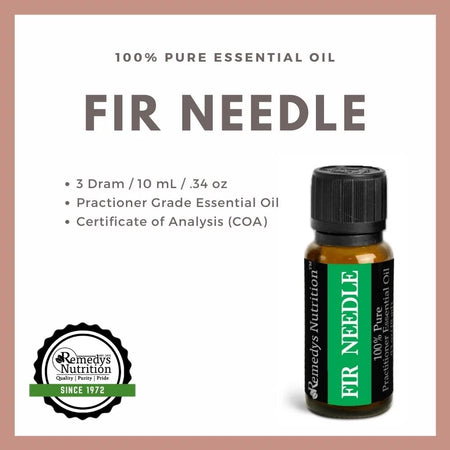
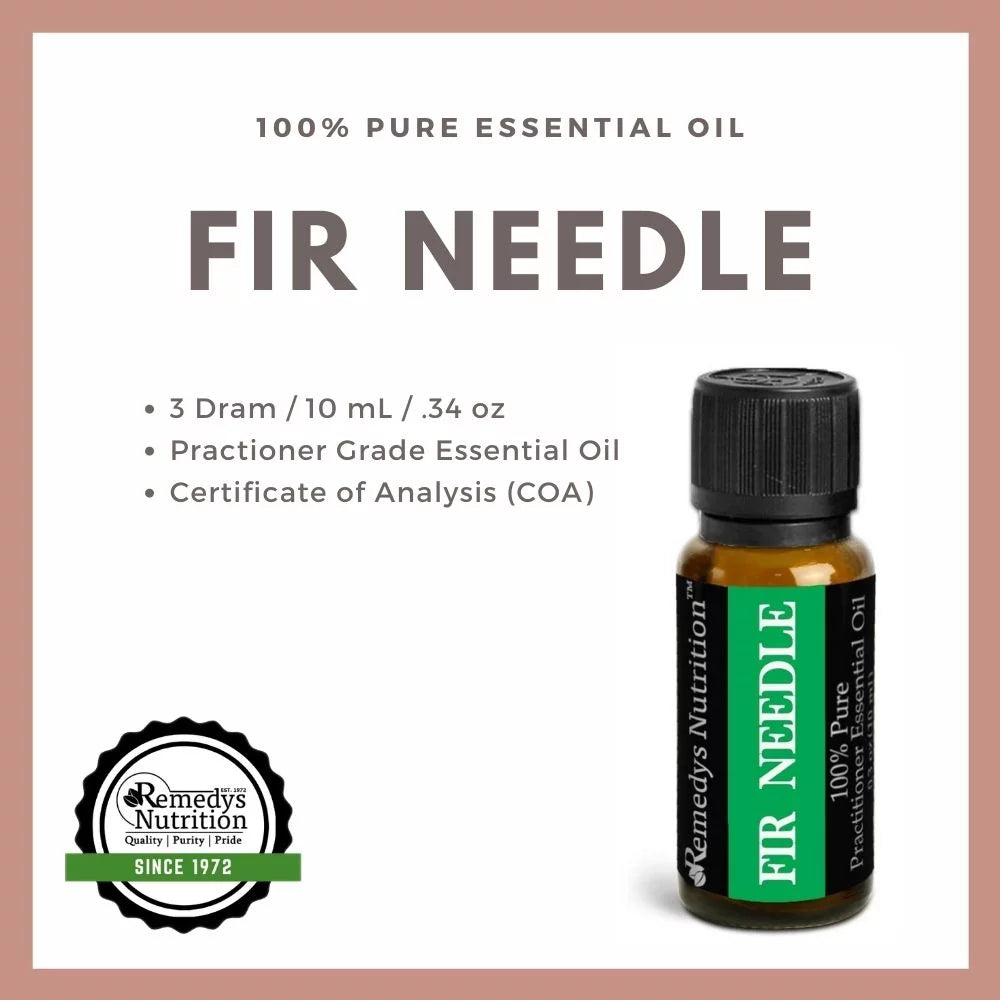
Why Choose Remedy’s Fir Needle Essential Oil
| What You Get |
Why It Matters |
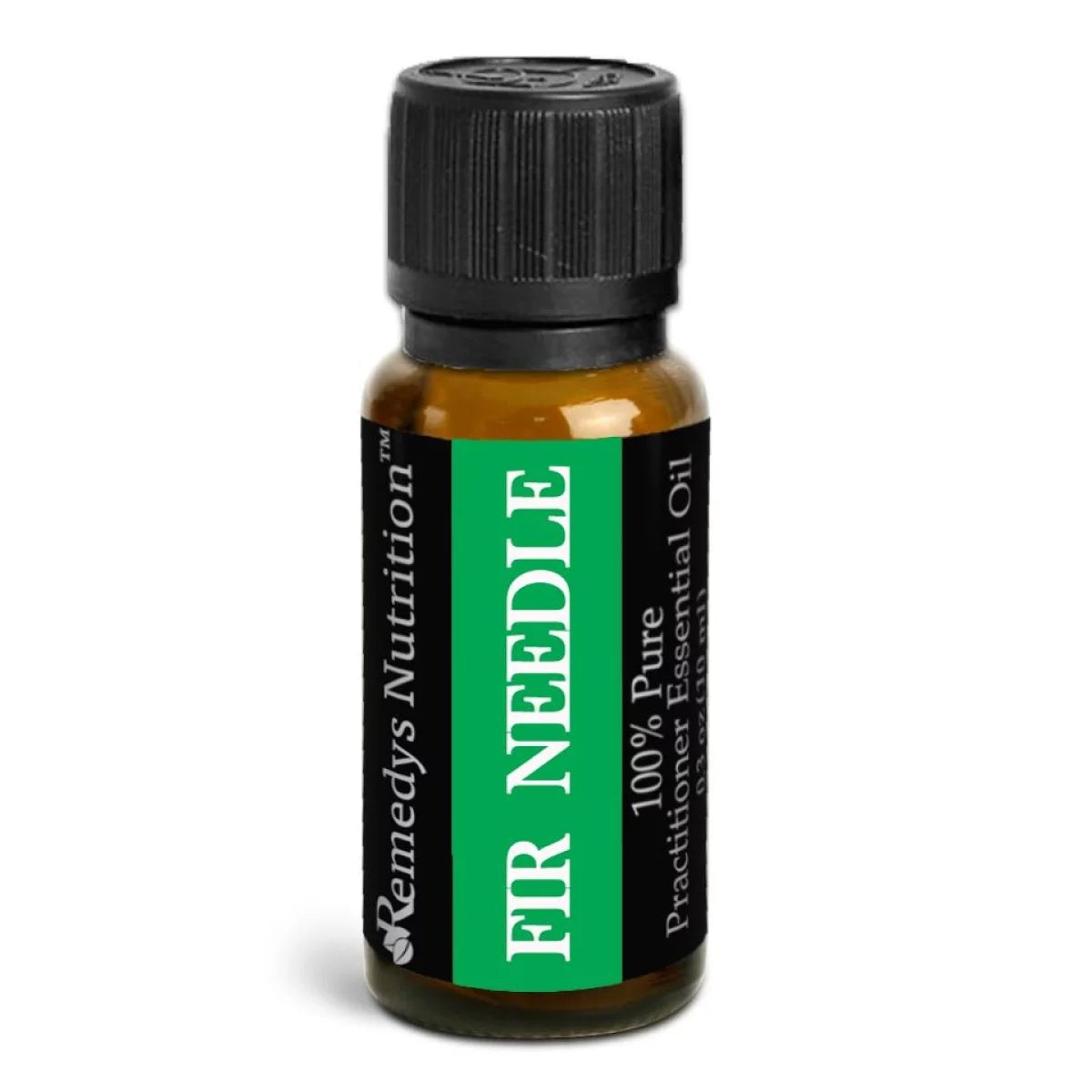
| 100% pure Abies sibirica steam distillate |
Single-species sourcing — no blending with cheaper pine or spruce, no synthetic bornyl acetate filler |
| 10 mL (3 dram) amber glass bottle |
UV-protected glass preserves monoterpene profile, which oxidizes faster than sesquiterpene oils |
| 28 to 38% bornyl acetate content |
Premium range for respiratory, anti-inflammatory, and grounding effects documented in research |
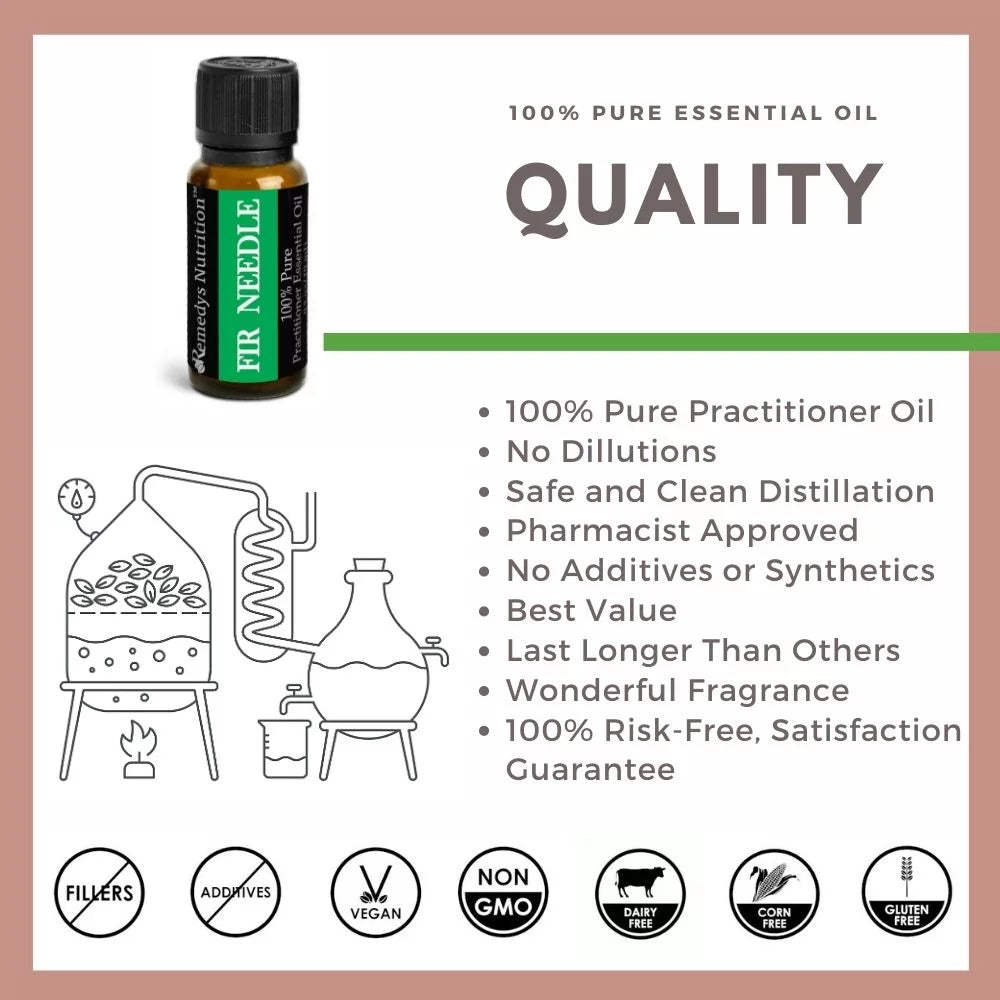
| No carriers, no synthetics, no GMO inputs |
Therapeutic-grade neat oil — you control dilution to match each use case |
| Lab tested per batch |
GC-MS identity verification, heavy metals, and microbial contaminant screening on every lot |
| Made and bottled in USA, GMP facility |
Sourced from Siberian distillation, finished and quality-controlled in a cGMP-compliant US facility |
| Family-friendly when diluted |
Safer profile than camphor-rich respiratory oils — suitable for use around children over 6 with proper dilution |
Fir Needle Oil Safety and Storage
Fir needle oil is high in monoterpenes — the same compound class that oxidizes fastest in any aromatic oil. Always store tightly sealed in a cool, dark place. Discard if the scent turns sharp, sour, or acidic, which signals oxidation and increases skin sensitization risk.
| Consideration |
Details |
| Skin sensitization risk |
Low when fresh; rises significantly in oxidized oil. Patch test 1 drop diluted in 1 tsp jojoba on inner forearm for 24 hours. |
| Maximum dermal use |
3% for body massage, 1 to 2% for chest rub, 0.5% for facial use (rarely needed) |
| Pregnancy |
Generally low risk after first trimester at 1% dilution. Avoid in first trimester. Consult provider before use. |
| Children under 6 |
Diffusion only at 1 to 2 drops per room. Avoid direct application. Avoid steam inhalation until age 8. |
| Asthma |
Test in low-dose diffusion (1 to 2 drops) before steam inhalation. Some asthmatic users react to monoterpene-rich oils. |
| Photosensitivity |
None — fir needle does not increase UV sensitivity, unlike citrus oils. |
| Pets |
Use ventilated rooms; cats lack glucuronidation pathways for monoterpenes. Limit sessions to 30 minutes with cat exit access. |
| Shelf life |
2 to 3 years in sealed amber glass at room temperature. Refrigerate after opening to extend shelf life by 12 to 18 months. |
Fir Needle Essential Oil FAQ
What is fir needle oil good for? +
Fir needle oil supports 4 main use cases: respiratory and sinus clearing (driven by 28 to 38% bornyl acetate that relaxes bronchial muscle), forest grounding and mood (16% cortisol drop in the 2010 Li trial), muscle soreness relief at 3% topical dilution (22% DOMS reduction in a 14-day open trial), and natural antimicrobial cleaning at 10 to 15 drops per 16 oz spray. Standard topical dilution is 1 to 3% in carrier.
How do you use fir needle oil for sinus congestion? +
For acute congestion, use 3 drops in an 8 oz bowl of hot water with a towel draped over head, breathe deeply for 5 minutes. Repeat up to 3 times daily. Combine with eucalyptus at 1 drop fir + 2 drops eucalyptus for the strongest effect. For sustained relief, apply a 1 to 2% chest rub (5 drops per 1 oz coconut oil) at bedtime. Avoid steam inhalation in children under 8.
Is fir needle oil the same as pine oil? +
No. Fir needle (Abies sibirica or Abies balsamea) and pine (Pinus sylvestris) are different botanical genera with different chemistry. Fir is 28 to 38% bornyl acetate — sweeter, smoother, and gentler on skin. Pine is alpha-pinene dominant (50 to 70%) — sharper, more turpentine-like, and a slightly higher sensitization risk. Fir is preferred for daily use, sinus, and mood; pine for stronger surface cleaning.
Can fir needle oil help with stress? +
Yes. The 2010 Li forest-bathing trial measured a 16% cortisol drop and 8 bpm heart rate reduction after 40 minutes of coniferous-scented air exposure. Fir needle delivers the same conifer profile concentrated. Use 3 to 5 drops in a diffuser for 30 to 60 minutes, or 2 to 3 drops in a personal inhaler for 3 to 5 deep breaths during stress spikes. Unlike lavender, fir grounds without sedating — useful during work hours.
Is fir needle oil safe for kids? +
For children over 6, diffuse at 1 to 2 drops per room with good ventilation, sessions under 30 minutes. Avoid direct skin application until age 6 and steam inhalation until age 8. Children under 2 should not be exposed to monoterpene-rich oils due to immature airways. For diluted topical use over age 6, stay at 0.5% (about 3 drops per 1 oz carrier) and patch test 24 hours first.
What does fir needle oil blend well with? +
Fir needle pairs well with at least 10 oils: eucalyptus, peppermint, pine, spruce, cedarwood, cypress, lavender, lemon, rosemary, and ginger. The strongest 4-oil sinus stack is fir + eucalyptus + peppermint + tea tree. For grounding mood blends, fir + cedarwood + frankincense in a 5:3:2 ratio creates a natural “forest cathedral” scent. Standard diffuser ratio is 3 to 5 drops total across 2 to 3 oils.
Can fir needle oil help muscle soreness? +
Yes, modestly. A 14-day open trial in 18 active adults using a 3% topical fir needle blend post-workout reduced subjective DOMS scores 22% vs. unscented carrier. The active mechanism is bornyl acetate’s mild anti-inflammatory action. Standard recipe: 6 drops fir + 4 drops peppermint + 4 drops ginger + 4 drops cypress in 2 oz coconut oil, applied within 30 minutes of training to sore muscle groups.
Does fir needle oil go bad? +
Yes, faster than most oils. Fir needle is monoterpene-rich, and monoterpenes oxidize within 2 to 3 years even in sealed bottles. Refrigerate after opening to extend shelf life by 12 to 18 months. Discard if the scent turns sharp, sour, or acidic — oxidized oil increases skin sensitization risk significantly. Always store in tightly sealed UV-protected amber glass at cool temperatures away from direct light.
Can I use fir needle oil in a sauna? +
Yes — this is 1 of the 6 traditional oils used in Russian banya and Finnish sauna culture for chest support and forest atmosphere. Use 2 drops on hot sauna rocks or 1 drop on the steam-shower floor per session. Avoid direct contact with skin in heat, and never use in dry sauna rooms over 200°F (93°C) where the oil can flash-vaporize too rapidly. Ventilate the room well after the session.
How long does a 10 mL bottle of fir needle oil last? +
10 mL is approximately 200 to 250 drops. Used at 5 drops per 1 oz chest rub batch, 1 bottle covers 40 to 50 batches — about 6 to 8 weeks of daily seasonal use. For diffuser use at 4 drops per session, 1 bottle covers 50 to 60 sessions. Refrigerated after opening, fresh fir needle keeps 18 to 24 months at peak therapeutic value, then 6 to 12 months of declining potency.
Is fir needle oil good for breathing problems? +
For occasional congestion and seasonal stuffiness, yes — bornyl acetate relaxes bronchial smooth muscle and camphene thins airway mucus. For chronic conditions like asthma, COPD, or allergies, consult your doctor before regular use. Some asthmatics are sensitive to monoterpene-rich oils. Always test diffusion at 1 to 2 drops first before steam inhalation, and never use in children under 8 in steam form.
Can I diffuse fir needle oil around pets? +
Use caution. Cats lack glucuronidation pathways needed to metabolize monoterpenes safely, which is the dominant compound class in fir needle. Diffuse only in well-ventilated rooms with cat exit access, and limit sessions to 30 minutes. Dogs tolerate monoterpene oils better than cats but still benefit from ventilation. Birds should not be exposed at all — their respiratory system is uniquely sensitive to airborne aromatic compounds.
What makes Remedy’s Fir Needle Oil different? +
Remedy’s Fir Needle is 100% pure Abies sibirica steam distillate from single-species Siberian sourcing with 28 to 38% bornyl acetate — the premium range for respiratory and grounding effects. No carriers, no synthetics, no pine-oil blending. Lab tested per batch by GC-MS for identity, heavy metals, and microbial contaminants. Bottled in 10 mL (3 dram) UV-protected amber glass to preserve the monoterpene profile, which oxidizes faster than sesquiterpene oils.
Fir Needle Oil: In-Depth Reading
Want to go deeper on a specific use case? Browse our essential oil knowledge hub:
-
Essential Oils: The Complete Beginner’s Guide — pillar overview covering chemistry, distillation, dilution, and safety
-
Best Essential Oils for Sinus, Cough, and Cold — 8 oils ranked with steam, chest rub, and diffuser protocols
-
Best Essential Oils for Muscle Pain and Inflammation — 8 oils with full massage protocols and dilution math
-
How to Dilute and Use Essential Oils Safely — carrier oils, pregnancy, kids, and dilution math