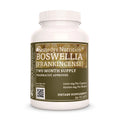


Boswellia (Frankincense) 1000 mg 60 Vegan Capsules
- Supports Respiratory System Health*
- Supports Joint Comfort & Mobility*
- Boswellic Acids for Anti-Inflammatory & Joint Wellness*


Couldn't load pickup availability
*These statements have not been evaluated by the Food and Drug Administration. This product is not intended to diagnose, treat, cure, or prevent any disease.
What Is Boswellia?
Boswellia is the hardened gum resin of the Boswellia serrata tree, the same material known as frankincense. Remedy's Boswellia supplement delivers 1000 mg of whole gum resin per vegan capsule, with 60 capsules per bottle, which is a 2-month supply at 1 capsule daily.
Its active compounds are boswellic acids, and the most studied of them is AKBA, acetyl-11-keto-beta-boswellic acid. They inhibit 5-lipoxygenase, an enzyme that converts arachidonic acid into leukotrienes.
Frankincense essential oil is not the same product. Steam distillation carries over aromatic compounds and leaves the boswellic acids behind, so an oil cannot substitute for a resin capsule. Our full explainer covers what boswellia is and how it works.
Boswellia Benefits: What the Research Shows
Joint comfort and stiffness after activity are the best-researched uses of boswellia, and the results are mixed and vary from person to person. Everything else rests on small or old studies that we are not going to inflate.
For readers who want the research, each claim is graded separately in our review of what the benefit research actually found.
How Boswellic Acids Work
Boswellic acids inhibit 5-lipoxygenase, reducing leukotrienes.[1]Boswellic acids in chronic inflammatory diseases — Planta Medica (2006) View source That pathway differs from the one turmeric acts on, and it is why boswellia is often used alongside turmeric rather than instead of it.
- 5-LOX inhibition: The best-characterised action of the resin.
- Mechanism is not outcome: A lab pathway does not predict how you will feel.
The pathway is explained in full on our page about boswellia and inflammation.
Boswellia for Joint Comfort and Mobility
Joint comfort and mobility are the main reasons people choose boswellia. Research on it is mixed, and results vary from person to person. Long-term data are limited, so set realistic expectations.
- Realistic: Support during a defined 4 to 8 week trial.
- Not realistic: Cartilage regrowth or a permanent fix.
- Never: A replacement for prescribed arthritis treatment.
For readers who want the research, the trial evidence is set out joint by joint in our review of boswellia and joint comfort.
Extract Strength Versus Milligrams
This is the part most boswellia labels obscure. A milligram count describes the weight of material, not its potency, and a concentrated extract is a different product from whole resin even when the numbers look similar.
| Product type | Typical daily amount | What it is |
|---|---|---|
| Extract standardised to 30% AKBA | 100 to 250 mg | Concentrated, trial-tested |
| Extract standardised to 65% boswellic acids | 300 to 500 mg | A broader standardisation |
| Whole gum resin (this product) | 800 to 1600 mg | The traditional material |
| Frankincense essential oil | Not comparable | Almost no boswellic acids |
This bottle sits in the third row and says so. If you want trial-matched dosing, look for a stated AKBA percentage instead; if you want the traditional resin, this is it. Label reading is covered in extracts, AKBA and what to look for.
Why Choose Remedy's Boswellia
The design decision here is simplicity: whole resin, 1 ingredient, a stated amount, and no proprietary joint blend hiding how much boswellia you are actually getting.
| What you get | Why it matters |
|---|---|
| 1000 mg whole gum resin per capsule | A stated amount you can compare and adjust |
| Single ingredient | Any reaction or benefit is traceable to 1 thing |
| Vegan capsule | No gelatin, suitable for plant-based routines |
| 60 capsules per bottle | 2 months at 1 daily, 1 month at 2 |
| No blend, no fillers listed as actives | Blends routinely under-dose the herb on the front label |
How to Take Boswellia
Take 1 capsule daily with a meal, ideally one containing some fat. Boswellic acids are lipophilic, and food intake affects their bioavailability in humans, which means the same capsule delivers differently on an empty stomach.[2]Effect of food intake on the bioavailability of boswellic acids from a herbal preparation in healthy volunteers — Planta Medica (2004) View source
- With food: Better absorbed and better tolerated.
- 1 to 2 capsules daily: 1000 to 2000 mg of whole resin.
- Minimum 4 weeks: Give it at least this long before judging it.
- Track 1 number: A daily 0 to 10 pain score beats a vague impression.
Dose arithmetic, including how whole resin compares with concentrated extracts, is in our boswellia dosage guide.
Safety and Who Should Avoid It
Boswellia is well tolerated. In the 90-day knee trial, serum biochemistry, haematology and urine analysis were essentially unchanged against placebo. Mild digestive upset is the usual complaint, and taking the capsule with a meal resolves most of it.
| Situation | What to do |
|---|---|
| Pregnant or breastfeeding | Avoid, based on traditional emmenagogue use |
| Taking anticoagulants or antiplatelets | Ask your clinician before starting |
| Taking immunosuppressant or biologic therapy | Clinician conversation first |
| Liver disease or abnormal liver tests | Do not start without medical advice |
| Surgery within 2 weeks | Stop and tell your surgical team |
| Under 18 | Not intended for children |
The liver question, the interaction list and what the trial actually measured are covered on our page about boswellia side effects and who should avoid it.
Frequently Asked Questions
What does boswellia do for you? +
Mainly it supports joint comfort and mobility. Its boswellic acids inhibit 5-lipoxygenase, and research results are mixed and vary from person to person. Plan on at least 4 weeks of use before judging it.
How many capsules should I take a day? +
Start with 1 capsule daily with a meal, which is 1000 mg of whole gum resin. Traditional daily amounts run 800 to 1600 mg, so some people take 2. Concentrated 30% AKBA extracts are a different product dosed at 100 to 250 mg.
Is boswellia the same as frankincense? +
The resin is the same material, but the 2 products differ. Frankincense essential oil is steam distilled and contains almost no boswellic acids, while these capsules contain the resin itself. Only the resin matches the clinical trials.
How long does boswellia take to work? +
Allow at least 4 weeks of daily use with a meal before judging it. Results vary from person to person, and some people notice little change.
Which is better for joint comfort, turmeric or boswellia? +
Neither is clearly ahead. They act on different enzymes, which is why many people run 1 for 4 weeks and then try the other.
What are the side effects? +
Mild digestive complaints, mainly nausea, reflux and loose stools, most often on an empty stomach. In the 90-day trial of 75 patients, blood, urine and biochemical safety parameters were essentially unchanged versus placebo.
Who should not take boswellia? +
Anyone pregnant or breastfeeding, anyone on anticoagulants or immune-modifying therapy, people with liver disease, anyone within 2 weeks of surgery, and children. That is 5 groups, each with a mechanistic or traditional-use reason.
Should I take it with food? +
Yes. Boswellic acids are fat soluble, and a study in healthy volunteers found food intake affects their bioavailability. Taking 1 capsule mid-meal also reduces the reflux some people report on an empty stomach.
Does boswellia rebuild cartilage? +
No. Claims of rebuilding cartilage go beyond the data. Treat boswellia as daily joint comfort support and judge it over a defined 4 to 8 week trial.
Can I take it with pain medication? +
Often yes, with your doctor’s input. Boswellia acts on 5-lipoxygenase while NSAIDs act mainly on cyclooxygenase, so they are not duplicates. Never stop prescribed treatment to trial a supplement.
Is it safe for long-term daily use? +
The longest good trial ran 90 days with safety parameters unchanged. Beyond that the data thin out, which argues for a review after 8 to 12 weeks.
How long does 1 bottle last? +
60 capsules is 2 months at 1 capsule daily, or 1 month at 2 capsules. That covers a full 4 to 8 week trial.
You May Also Like
- Turmeric Root 1000 mg — the other herb in almost every joint comparison, acting on different pathways
- Glucosamine HCL 1000 mg — the traditional joint staple, with a very different evidence profile
- Superzymes Enzyme Tablets — for people whose stomach struggles with resin capsules