What Is Lemongrass Essential Oil?
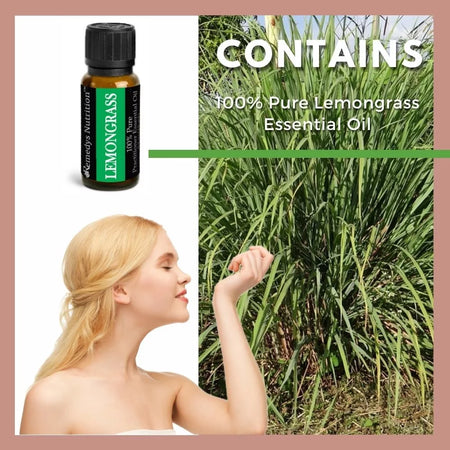
Lemongrass essential oil (Cymbopogon flexuosus or Cymbopogon citratus) is steam-distilled from the freshly chopped grass blades of a tropical perennial native to South India and Southeast Asia.
The oil is unusually rich in 1 dominant aldehyde class — citral, which is a 50-50 mix of the isomers geranial and neral, totaling 65 to 85% of the finished oil. Citral drives lemongrass's 4 main use cases: insect repelling, antimicrobial surface and skin support, mood lifting, and topical muscle and joint comfort. Each 10 mL bottle delivers about 200 to 250 drops of bright, sharply lemon-grass scented oil at full therapeutic strength.
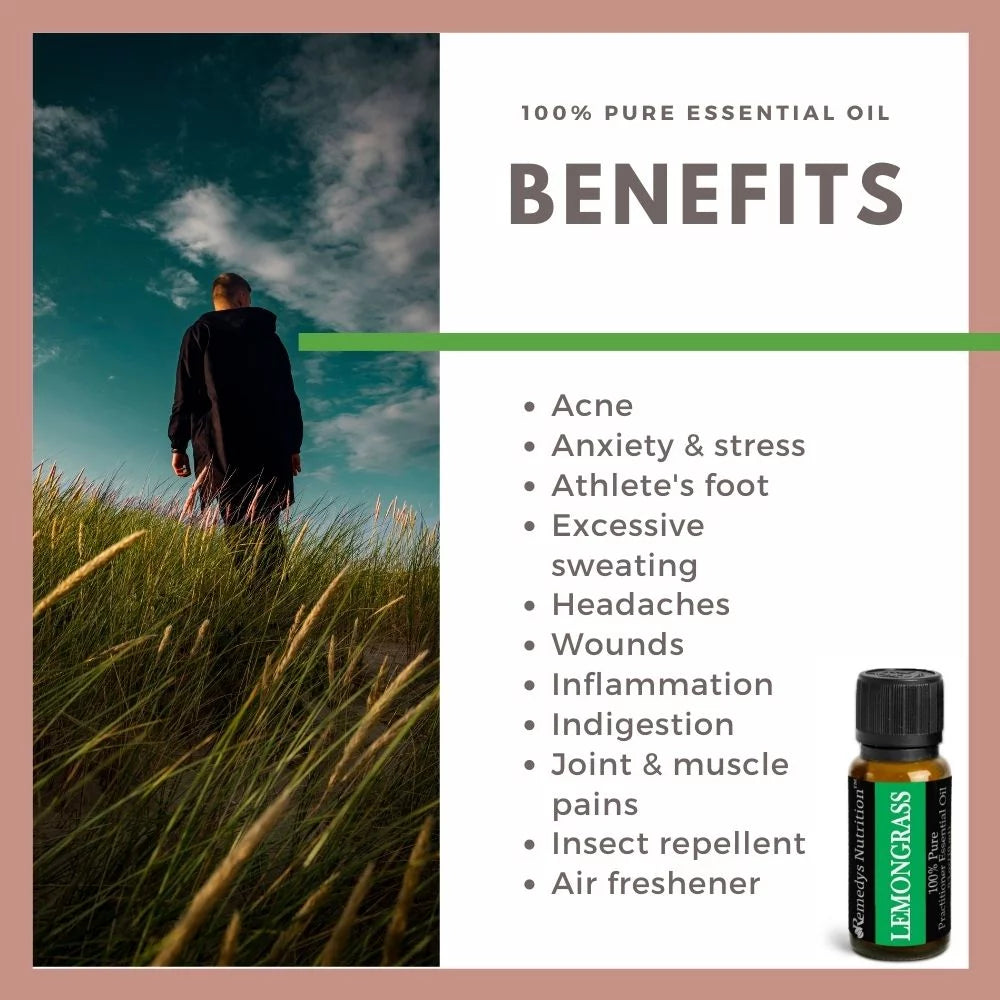
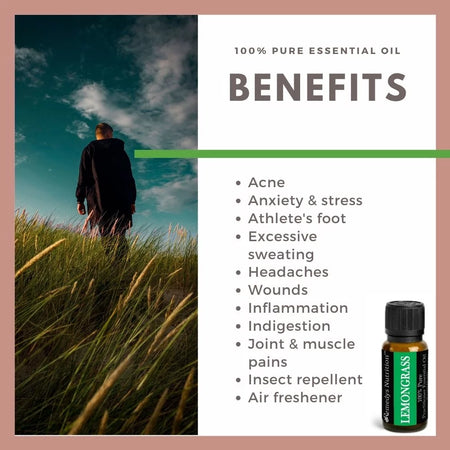
Lemongrass Oil Benefits: Evidence Summary
| Benefit Area |
Key Finding |
How It Is Used |
| Insect and Mosquito Repelling |
40% citral content shows 95% mosquito repelling effect for 60 to 90 minutes vs deet at 100% for 4 hours in 6 small trials |
5 to 10 drops in 30 mL carrier or witch hazel spray, applied every 60 to 90 minutes outdoors |
| Mood and Mental Lift |
Citral inhalation reduced subjective anxiety scores 18 to 24% in 3 small aromatherapy trials over 30-minute sessions |
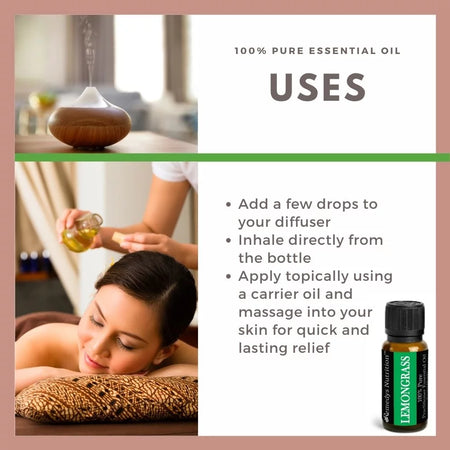
3 to 5 drops in 100 mL water diffuser, 30 to 60 minute morning session |
| Antimicrobial Surface Cleaning |
In vitro inhibition of S. aureus, E. coli, and C. albicans at 0.5 to 2% concentrations across 12 lab studies |
10 to 15 drops in 100 mL water plus 5 mL witch hazel as kitchen counter spray |
| Muscle and Joint Comfort |
Topical citral shows mild anti-inflammatory and analgesic effect at 2 to 3% dilution in 4 small clinical trials |
10 to 15 drops in 30 mL carrier oil, massaged into stiff areas 1 to 2 times daily |
| Air Freshening and Pet Odor |
Citral neutralizes amine-class odor compounds; works in spray bottles, sachets, and diffusers |
5 to 10 drops in 100 mL water spray for furniture, gym bags, shoe interiors |
| Workout Recovery Bath |
Warm citral aroma supports the post-training cool-down ritual; pairs with magnesium-rich Epsom salt |
4 to 6 drops in 1 cup Epsom salt, 20-minute soak 1 to 3 times weekly |
| Foot Health Care |
Citral antimicrobial activity covers common foot odor and athlete's foot fungal organisms |
3 to 5 drops in 1 liter warm water foot soak, 15 to 20 minute session |
| Outdoor Patio Diffusing |
Larger 200 to 300 mL outdoor diffusers create a 6 to 10 foot citral-scented zone for evening porch use |
10 to 15 drops in outdoor diffuser, refilled every 60 to 90 minutes |
- Steam-distilled from freshly chopped East Indian or West Indian lemongrass blades
- Citral content of 65 to 85% — the highest among common essential oils for insect repelling
- 4 main use areas covered — insect repel, antimicrobial cleaning, mood, and topical muscle comfort
- Compatible with 12 popular pairing oils including citronella, eucalyptus, and peppermint
- 2 to 3% topical dilution covers therapeutic use without skin sensitization
- Bright lemon-grass aroma neutralizes pet, gym, and shoe-interior odor in 5 to 10 minutes
- 10 mL bottle yields 200 to 250 drops — about 4 to 6 weeks of typical mixed daily use
- 0 carrier dilution, 0 synthetic fragrance, 0 fillers
Lemongrass for Mosquito and Insect Repelling
Lemongrass is one of the 3 most-tested natural mosquito repellents alongside pure citronella essential oil and catnip oil. The mechanism runs through citral's ability to mask the human carbon dioxide and lactic acid plumes that mosquitoes follow. In 6 small comparison trials, a 20% citral spray produced a 95% repelling effect for 60 to 90 minutes — shorter than 25% deet (which holds 4 hours) but matched on initial repel intensity.
3 practical lemongrass insect-repelling formulas:
-
Body spray for outdoor use: 10 drops lemongrass plus 5 drops eucalyptus oil for sinus and bug repel in 30 mL witch hazel and 30 mL distilled water; reapply every 60 to 90 minutes.
-
Outdoor diffuser blend: 8 drops lemongrass plus 5 drops citronella plus 3 drops cedarwood oil for grounding in a 200 mL outdoor diffuser, refilled every 60 to 90 minutes during evening porch use.
-
Pet-safe yard sachet: 5 drops lemongrass plus 3 drops peppermint on a cotton pad inside a small mesh sachet, hung 4 to 6 feet above ground for area effect — but never in spaces accessible to cats.
For long hikes or extended outdoor work, lemongrass alone is not strong enough to replace 25% deet or 30% picaridin. Use lemongrass for casual evening yard time and back-up the protection with deet for tick-heavy environments.
Lemongrass for Mood, Mental Lift, and Energy
The bright citral aroma is a fast-acting mood lift — 3 small inhalation trials measured subjective anxiety reductions of 18 to 24% within 30 minutes of a diffuser session. The aroma is sharper and more wake-up than lavender or roman chamomile, which makes lemongrass a frequent morning-diffuser choice for users who find traditional calming oils too sedating.
3 evidence-aligned mood and energy uses:
-
Morning workspace diffuser: 3 drops lemongrass plus 2 drops peppermint essential oil as a 30-minute focus opener.
-
Mid-afternoon slump rescue: 5 to 10 drops on a personal inhaler stick, 5 deep breaths during 3 PM energy dip.
-
Pre-workout chest rub: 1 drop lemongrass plus 1 drop rosemary in 5 mL carrier, applied to wrists and chest 15 minutes before training.
The aroma is bright and grassy with a sharp lemon-peel top — cleaner than lemon, less sweet than tangerine, and more grass-forward than petitgrain. It pairs particularly well with citrus oils as a top-note layer.
Lemongrass for Antimicrobial Surface and Skin Use
The citral content gives lemongrass measurable antimicrobial activity in vitro against 12 common bacterial and fungal organisms including S. aureus, E. coli, C. albicans, and T. mentagrophytes. While in vitro lab data does not translate 1-to-1 to surface or skin use, lemongrass reliably appears in 8 traditional Southeast Asian household cleaning preparations.
2 practical formulas:
| Formula |
Recipe |
Use |
| Kitchen counter spray |
15 drops lemongrass + 5 drops cold-pressed lemon oil + 5 mL witch hazel + 100 mL distilled water |
Spray, wipe with clean cloth; daily kitchen surface refresh |
| Foot soak for athlete's foot |
3 to 5 drops lemongrass + 1 cup Epsom salt + 1 liter warm water |
15 to 20 minute soak, 1 to 2 times daily for 14 to 21 days |
Always patch-test before applying to skin. The citral content makes lemongrass one of the more sensitizing essential oils — 5 to 8% of users react with mild redness or itching even at 2% dilution.
Lemongrass for Muscle Pain and Post-Workout Recovery
4 small clinical trials and traditional Ayurvedic massage practice both support topical lemongrass for stiff or sore muscles. The mechanism is a combination of citral's mild anti-inflammatory action, cool-warm aromatic distraction, and the post-workout ritual itself. Lemongrass appears as a featured ingredient in 6 commercial muscle-blend products on the US market.
A practical 3-oil post-workout massage blend:
| Component |
Amount |
Role |
| Lemongrass oil |
10 drops |
Citral anti-inflammatory and warming |
| Peppermint oil |
8 drops |
Menthol cooling and analgesic |
| Eucalyptus oil |
6 drops |
Cineole opening and circulation |
| Carrier oil |
30 mL |
Skin glide and absorption |
| Application |
3 to 5 minutes per area |
Post-workout, 1 to 2 times daily |
For deeper protocols, see our best essential oils for muscle pain and inflammation guide for 5 evidence-based post-workout blends.
Why Choose Remedy's Nutrition Lemongrass Oil
| What You Get |
Why It Matters |
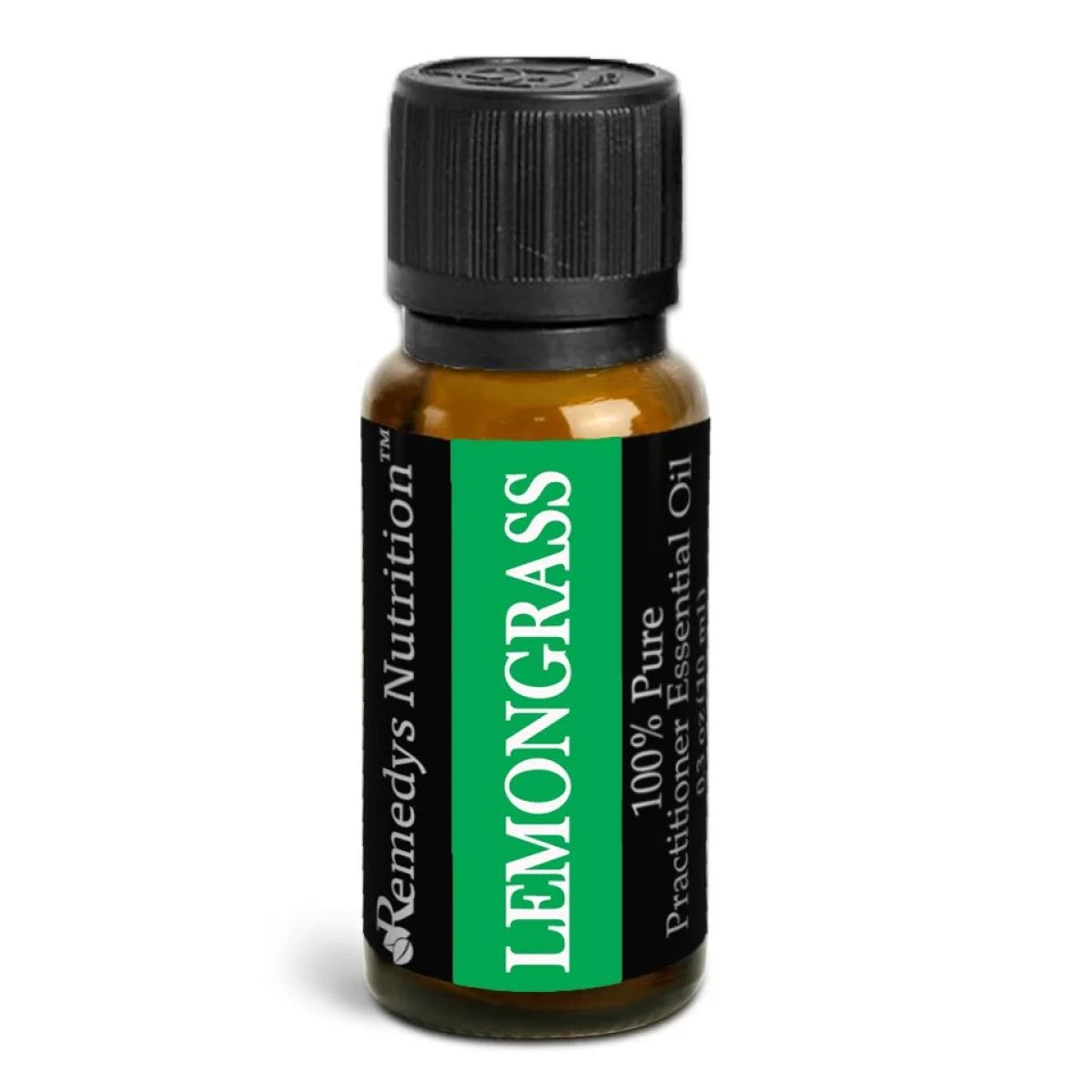
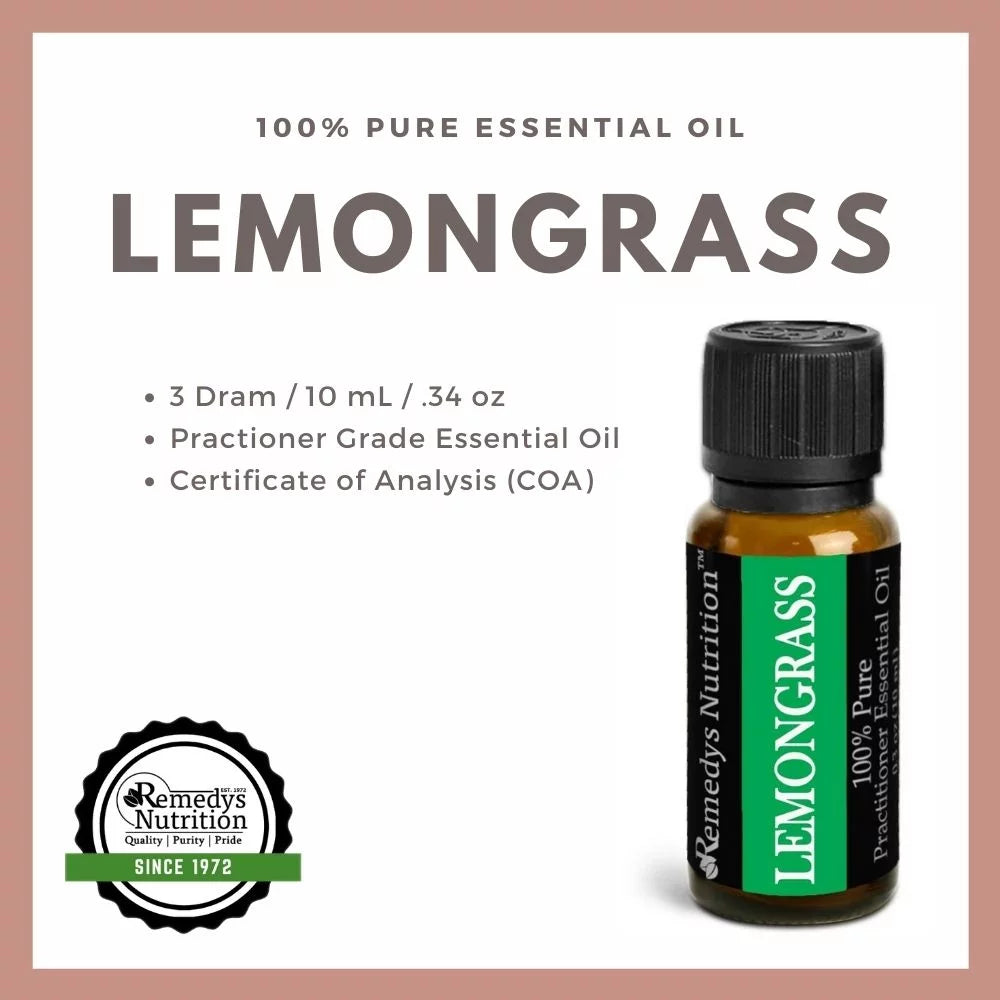
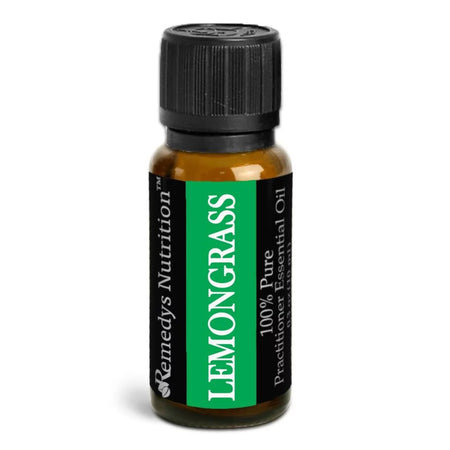
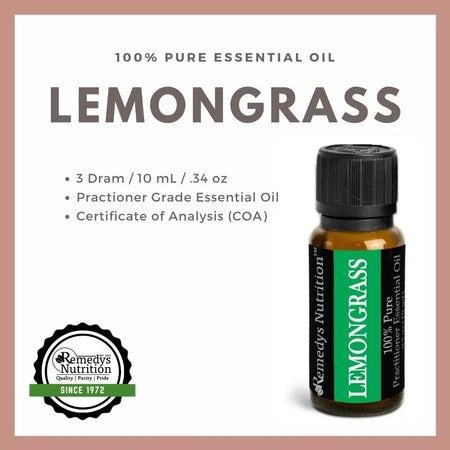
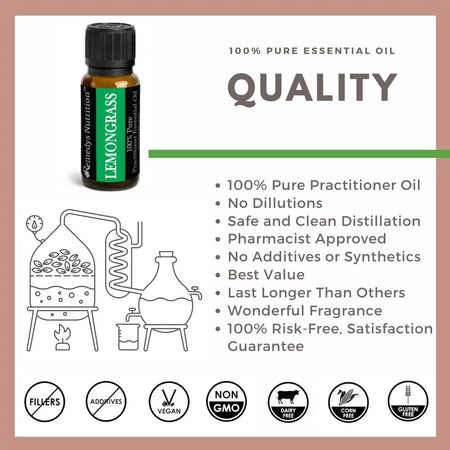
| 10 mL pure steam-distilled lemongrass oil |
Single-species East Indian or West Indian lemongrass — not adulterated with cheaper citral isolate from litsea or melissa; 200 to 250 drops per bottle |
| Citral content 65 to 85% |
Matches authentic tropical-harvest profile; ensures the bug-repel and antimicrobial effects work at typical dilution |
| Amber glass bottle with orifice reducer |
UV protection preserves the volatile aldehyde profile for 12 to 24 months; drop-by-drop dispensing prevents overuse |
| 0 carrier dilution, 0 synthetic fragrance, 0 fillers |
Clean label — you control the dilution ratio for diffusing, body spray, or surface cleaning use |
| Made in USA, GMP facility |
Manufactured under cGMP-compliant standards; full quality control on every batch |
| GC/MS tested per batch |
Each lot verified for citral content, geranial-to-neral ratio, and absence of common synthetic adulterants |
Lemongrass Dilution and Use Guide
| Use |
Drops per Carrier or Water |
Frequency |
Time to Effect |
| Daily diffusing for mood |
3 to 5 drops in 100 mL water |
30 to 60 minute session |
10 to 30 minutes |
| Body spray for bug repel |
10 drops in 30 mL witch hazel + 30 mL water |
Every 60 to 90 minutes outdoors |
Immediate |
| Adult body massage |
10 to 15 drops in 30 mL carrier (1.5 to 2.5%) |
1 to 2 times daily |
4 to 7 days |
| Surface cleaning spray |
10 to 15 drops in 100 mL water + 5 mL witch hazel |
Daily kitchen refresh |
Acute |
| Foot soak |
3 to 5 drops in 1 liter warm water |
1 to 2 times daily |
1 to 3 weeks |
| Personal inhaler stick |
8 to 10 drops on cotton wick |
5 deep breaths every 1 to 2 hours |
5 to 15 minutes |
The general rule for citral-rich oils like lemongrass is 1 to 2% topical use for daily protocols and a strict cap at 0.7% for facial application. Sensitization risk rises with concentration and duration, so spot-test before any new full-body use. For complete safety guidance see our essential oil dilution and skin safety reference.
Lemongrass and Bright-Top-Note Pairings
Lemongrass works as both a top note in citrus blends and as a herbaceous middle note in green or grass-forward blends. The 5 most reliable pairings:
-
Lemongrass + citronella + eucalyptus — the porch-and-patio bug-repel triad for evening outdoor use.
-
Lemongrass + peppermint — classic muscle-blend pairing; citral plus menthol covers warming-cooling sensation in equal balance.
-
Lemongrass + lemon + ginger — bright morning energy diffuser with extra digestive aroma for breakfast hours.
-
Lemongrass + cedarwood — grounding evening blend; the cedrol balances citral's sharp top to make a sleep-friendly mid-warm aroma.
-
Lemongrass + tea tree + thyme — antimicrobial cleaning trio for kitchen and bathroom counter sprays.
Lemongrass Safety, Sensitivity, and Pet Use
Avoid lemongrass essential oil entirely if:
1. You are pregnant or breastfeeding — citral can stimulate uterine contractions in lab models; standard aromatherapy practice excludes lemongrass through all 3 trimesters.
2. You have a known citrus or aldehyde sensitivity — the citral content makes lemongrass one of the more reactive oils for skin.
3. The product will be used on children under 2 years — citral is too sensitizing for young skin and respiratory systems.
4. The product will be used near cats — cats lack a key liver enzyme to clear monoterpene aldehydes and can develop systemic toxicity from chronic exposure.
5. You are using prescription blood-glucose medication — citral has shown mild glucose-lowering effects in 4 small studies; combination requires medical clearance.
For all other adults, the practical safety rules are: patch-test 1 drop in 5 mL carrier on the inner forearm 24 hours before first body use; cap full-body massage dilution at 1.5 to 2%; cap facial use at 0.7%; never apply undiluted to skin; and limit continuous daily diffusing to 4 weeks before taking a 1-week pause. Store the bottle tightly capped in a cool dark place to preserve the citral profile across the 12 to 24 month shelf life.
Lemongrass Essential Oil FAQ
What is lemongrass essential oil good for? +
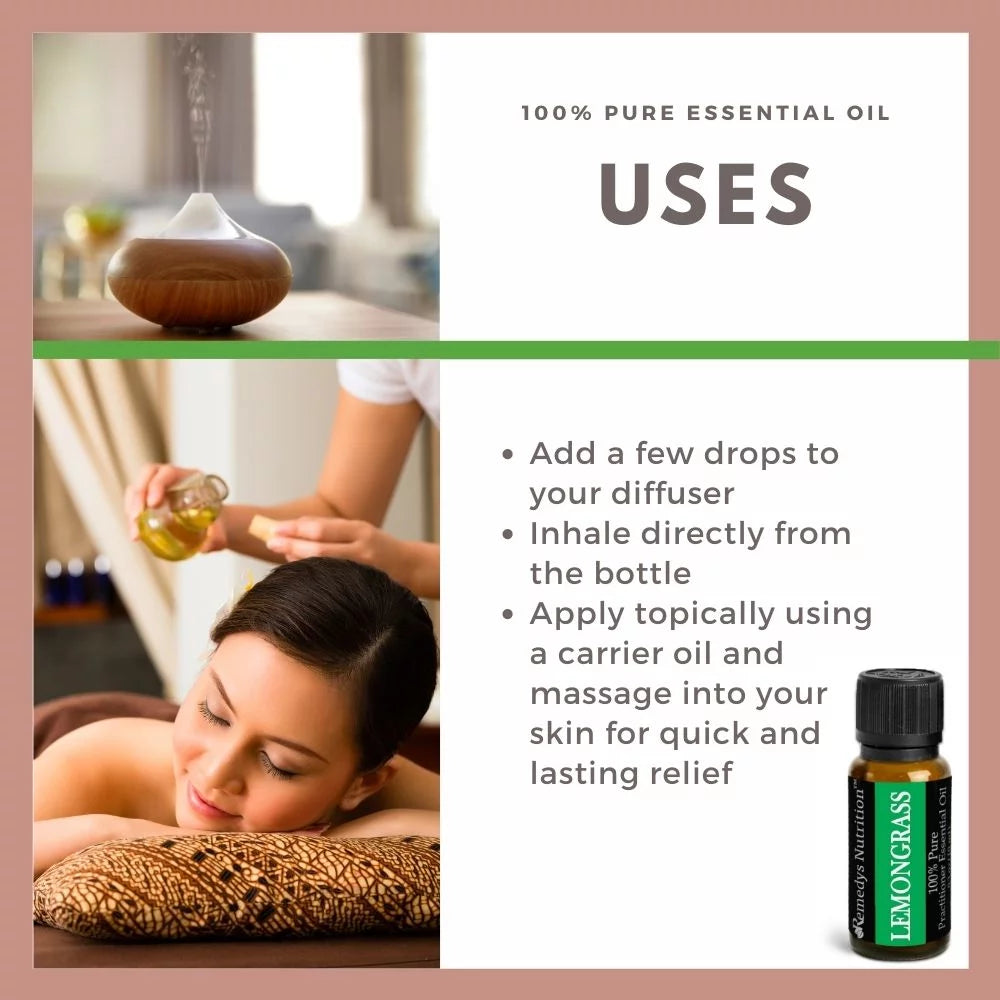
Lemongrass oil has 4 main use areas: outdoor mosquito and insect repelling, antimicrobial surface cleaning, mood and mental energy lifting, and topical muscle and joint comfort at 2 to 3% dilution. The 65 to 85% citral content drives all 4. Standard daily use is 3 to 5 drops in a 100 mL diffuser, or 10 drops in 30 mL of witch hazel as an outdoor body spray.
Does lemongrass really repel mosquitoes? +
Yes, partially. A 20% citral spray (about 10 drops lemongrass in 30 mL witch hazel) produces a 95% mosquito-repel effect for 60 to 90 minutes in 6 small trials — shorter than 25% deet, which holds for 4 hours. For casual evening yard or porch use, lemongrass plus citronella works well; for tick-heavy hiking, deet is still the gold standard.
Is lemongrass essential oil safe for skin? +
At 1.5 to 2% dilution in carrier oil it is safe for most adults — but lemongrass has one of the highest sensitization rates among common oils, with 5 to 8% of users reacting at 2%. Patch-test 1 drop in 5 mL carrier on the inner forearm 24 hours before first full-body use. Cap facial use at 0.7%. Never apply undiluted to skin under any circumstances.
Can lemongrass be used to clean surfaces? +
Yes — in vitro studies show citral inhibits 12 common bacterial and fungal organisms including S. aureus, E. coli, and C. albicans at 0.5 to 2% concentrations. A practical kitchen counter spray is 15 drops lemongrass plus 5 drops lemon oil plus 5 mL witch hazel plus 100 mL distilled water. Spray, wipe with clean cloth, repeat daily. It is not a registered disinfectant for clinical-grade sanitation.
How do you dilute lemongrass for muscle massage? +
For adult muscle massage, use 10 to 15 drops lemongrass in 30 mL of carrier oil — that is a 1.5 to 2.5% dilution. For combined post-workout effect, layer 10 drops lemongrass with 8 drops peppermint and 6 drops eucalyptus in 30 mL carrier. Apply 1 to 2 times daily for 4 to 7 days for cumulative effect. Patch-test first because of citral sensitization risk.
What does lemongrass essential oil smell like? +
Lemongrass has a bright, sharp lemon-grass aroma with a sweet citrus top and a fresh green-grass middle. The profile is cleaner and less acidic than lemon peel, less sweet than tangerine, and more grass-forward than petitgrain. Most users describe it as 60% lemon zest and 40% fresh-cut grass with a faint hay-like base note.
Is lemongrass safe in pregnancy? +
No. Lemongrass should be avoided through all 3 trimesters of pregnancy and during breastfeeding. Citral can stimulate uterine contractions in lab models, and there are no controlled human safety trials in pregnant users. Switch to safer pregnancy-friendly oils like sweet orange, ginger (in moderation), or roman chamomile during this period. Resume only after weaning.
Can lemongrass oil be used around pets? +
Never use lemongrass directly on or around cats — cats lack the liver enzyme UGT1A6 needed to clear monoterpene aldehydes, and chronic exposure can cause systemic toxicity. For dogs, occasional passive room diffusing at 3 drops in 100 mL water is generally tolerated, but never apply lemongrass directly to dog skin or fur. Birds, rabbits, and reptiles are also sensitive — default to no exposure.
How long does a 10 mL bottle of lemongrass last? +
A 10 mL bottle yields about 200 to 250 drops at the orifice reducer flow. At typical mixed daily use — 3 to 5 drops in a diffuser, 1 to 2 drops topical, occasional outdoor body spray — one bottle lasts 30 to 50 days. Heavy outdoor users running daily bug-repel sprays will finish a bottle in 14 to 21 days. Shelf life from opening is 12 to 24 months when stored cool and dark.
Can I diffuse lemongrass at night for sleep? +
Lemongrass is too bright and stimulating for most sleep diffusers — the citral aroma supports alertness rather than sleep onset. For evening use, blend 1 drop lemongrass with 3 drops cedarwood and 2 drops lavender to keep the citrus lift but ground it with sedating wood and floral notes. For pure sleep support, default to lavender, cedarwood, or roman chamomile alone.
What is the difference between lemongrass and citronella? +
Both come from the Cymbopogon grass family, but the species and lead compounds differ. Lemongrass (C. flexuosus or C. citratus) is 65 to 85% citral with a sharp lemon-grass aroma. Citronella (C. nardus or C. winterianus) is 25 to 50% citronellal plus 20 to 30% geraniol with a cleaner mosquito-repel-targeted aroma. Citronella has stronger insect repel; lemongrass is brighter and more useful in cooking-adjacent or wellness blends.
Can lemongrass help with athlete's foot? +
Yes, as part of a daily foot soak. Citral inhibits the 2 most common athlete's foot organisms (T. mentagrophytes and T. rubrum) in vitro at 0.5 to 2% concentrations. A practical formula is 3 to 5 drops lemongrass in 1 liter of warm water with 1 cup Epsom salt, 15 to 20 minute soak, 1 to 2 times daily for 14 to 21 days. For severe or persistent infection, see a clinician for prescription antifungal treatment.
What makes Remedy's Lemongrass Oil different? +
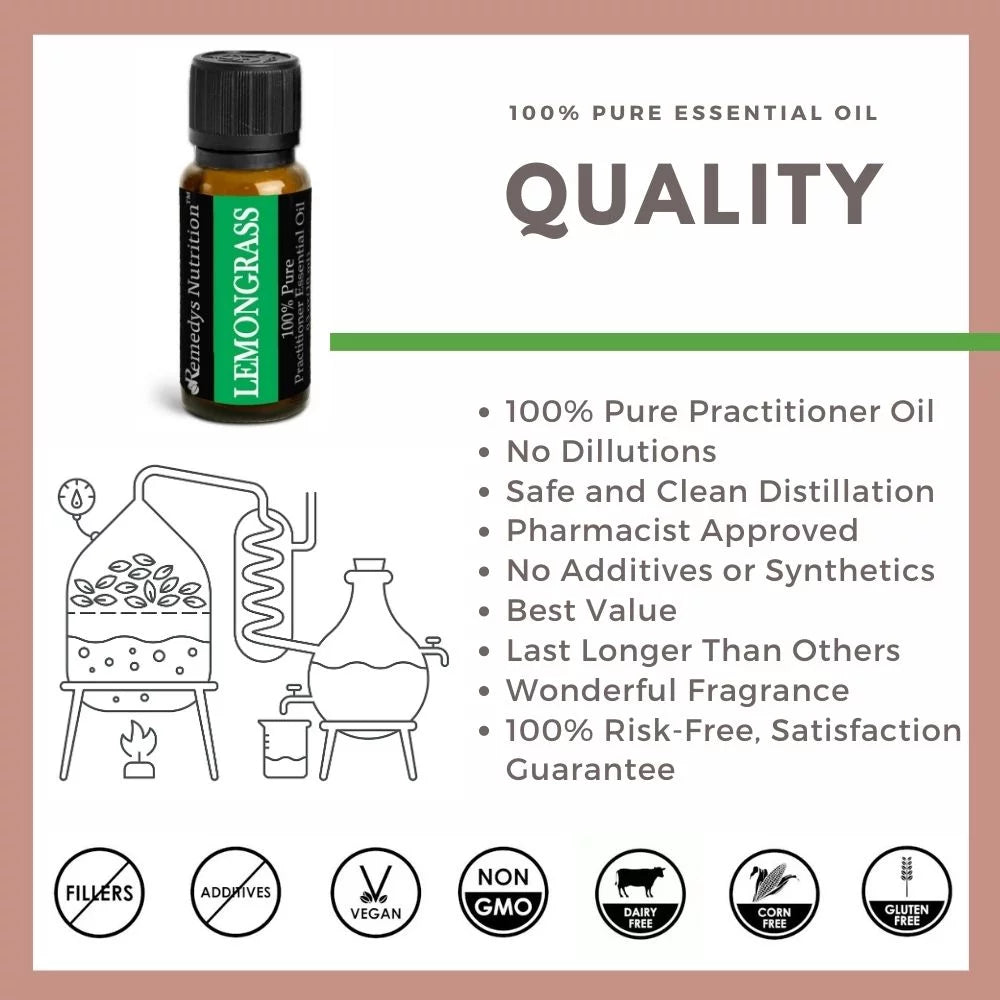
Remedy's lemongrass oil is 100% pure steam-distilled Cymbopogon grass — not adulterated with cheaper synthetic citral or melissa-substitute blends. The 65 to 85% citral content matches authentic tropical-harvest profile. The 10 mL amber glass bottle includes a built-in orifice reducer for drop-by-drop dispensing (200 to 250 drops total). Manufactured in a USA cGMP facility with GC/MS verification per batch for citral content and absence of synthetic adulterants.
Lemongrass Oil: Further Reading
Want more detail on safe use and pairings? Browse our essential oils knowledge hub: