What Is Cinnamon Essential Oil?
Cinnamon essential oil is a warm, sweet-spicy steam-distilled extract drawn from the bark or leaves of Cinnamomum verum (true Ceylon) and Cinnamomum cassia (the more common cassia variety). Bark oil is the more concentrated of the 2 forms and yields 65 to 90% cinnamaldehyde — the single phenylpropanoid molecule responsible for cinnamon’s warming kick, antimicrobial action, and metabolic effects.
Leaf oil yields 70 to 90% eugenol instead, which is gentler on skin but still hot. Cinnamon has been documented across more than 4,000 years of use in Egyptian embalming, Ayurvedic digestion formulas, traditional Chinese warming protocols, and European pomanders — and modern lab work has confirmed activity against more than 30 microbial strains and a 22% reduction in fasting glucose in 1 type-2 diabetes pilot study.
Cinnamon Oil Benefits: Evidence Summary
| Benefit Area |
Key Finding |
Use Pattern |
| Broad-spectrum antimicrobial |
Inhibits 30 plus bacterial and fungal strains including Staph aureus, E. coli, Salmonella, and Candida albicans at 0.05 to 0.1% concentration in lab studies |
0.05 to 0.1% in DIY surface or air sprays |
| Immune and seasonal support |
Cinnamaldehyde inhibits 4 strains of influenza A in vitro and is used as a lead component in “thieves” style blends |
2 to 3 drops in a diffuser, 30 to 60 minutes |
| Mood and warming aroma |
Subjective alertness and warmth ratings up 18 to 24% vs unscented control in 1 small inhalation study |
1 to 2 drops in a 100 ml diffuser, morning use |
| Glucose support (oral, food-grade only) |
Cassia bark capsules at 1 to 6 g daily lowered fasting glucose 18 to 29% across 5 small trials — oil itself is NOT for ingestion |
Use whole-bark capsules, not the oil |
| Insect repellent |
Cinnamaldehyde repels 6 mosquito species and kills tick larvae at 0.1 to 1% concentration in field tests |
0.3% maximum dilution in a coconut-oil base |
| DIY cleaning and surfaces |
Reduces bacterial counts on hard surfaces by 70 to 99% at 0.1 to 0.5% concentration in vinegar or alcohol carriers |
5 to 10 drops per 250 ml spray bottle |
| Holiday and ambient aroma |
1 of the 4 most-recognized warming aromas alongside clove, orange, and nutmeg — used in commercial pomanders for 600 plus years |
1 drop in a simmer pot or 30 minute diffuser run |
| Foot care (heavy dilution only) |
0.3% in a foot soak or carrier balm helps with odor and warmth in 1 small open-label trial of 24 adults |
3 drops per 100 ml carrier oil, never neat |
- 65 to 90% cinnamaldehyde in bark oil — the active warming and antimicrobial molecule
- Activity against 30 plus bacterial, fungal, and viral strains in lab studies
- 1 of 4 lead oils in classic “thieves” immune blends alongside clove, lemon, and eucalyptus
- Effective at 0.05 to 0.1% for surface antimicrobial use — a tiny amount goes a long way
- Powerful holiday and ambient aroma for diffusion and DIY pomanders
- Mood-warming — 18 to 24% boost in alertness ratings vs unscented control
- Insect-repellent activity against 6 mosquito species at 0.3% topical
- Compatible with clove, orange, lemon, and eucalyptus in immune-blend recipes
Cinnamon Oil for Warming, Mood, and Holiday Aroma
Cinnamon is the lead warming aroma in roughly 80% of commercial “cozy” or “holiday” candle scents on the US market. The reason is sensory and physiological — cinnamaldehyde activates TRPA1 receptors on warm-sensitive nerve endings in the nose and throat, producing a subjective warmth that does not actually raise tissue temperature. In a 2014 inhalation study with 22 adults, cinnamon aroma raised self-reported alertness 24% and self-reported warmth 18% vs unscented baseline within 5 minutes. Pair with 2 drops sweet orange or 1 drop pure clove bud essential oil in a 100 ml diffuser for a classic warming blend.
4 simple recipes using 1 to 3 drops only:
-
Holiday simmer pot: 1 drop cinnamon, 1 drop clove, 2 slices orange, 1 cinnamon stick in 500 ml water on a low simmer for 1 to 2 hours.
-
Morning diffuser blend: 1 drop cinnamon, 2 drops lemon essential oil, 1 drop peppermint oil for energy and focus.
-
Cozy evening blend: 1 drop cinnamon, 2 drops sweet orange, 1 drop vanilla absolute or vanilla CO2.
-
Immune support diffusion: 1 drop cinnamon, 2 drops Thieves blend essential oil, 1 drop eucalyptus.
Always start with 1 drop — cinnamon overpowers a small room within 60 seconds and can become harsh past 2 to 3 drops in a 100 ml diffuser.
Cinnamon Oil for Antimicrobial and Immune Support
Cinnamaldehyde’s phenylpropanoid backbone disrupts microbial cell membranes at concentrations as low as 0.05% — that is 1 drop per 100 ml of solution. A 2007 review in Phytotherapy Research tabulated activity against 30 plus strains, including methicillin-resistant Staph aureus, multi-drug-resistant Pseudomonas, Salmonella typhimurium, Listeria monocytogenes, and Candida albicans. Lab activity does not equal “cures infections,” but it does justify using cinnamon as 1 of 3 to 4 lead oils in immune-season diffusion and DIY surface sprays.
For everyday immune-support diffusion, the “thieves” recipe gives a balanced base — 4 parts clove, 3 parts lemon, 2 parts cinnamon bark, 2 parts eucalyptus, 1 part rosemary. 4 to 5 drops of that combined blend in a 200 ml diffuser, run 30 to 60 minutes 2 times daily, gives the strongest seasonal aroma without overwhelming any 1 family member. Our sinus and cold aromatherapy guide walks through 5 protocols that include cinnamon as a supporting note.
How to Use Cinnamon Essential Oil Safely
| Use Method |
How To |
Notes |
| Diffusion (preferred) |
1 to 2 drops in a 100 to 200 ml ultrasonic diffuser, 30 to 60 minutes |
Safest method for daily use; never run unattended near pets |
| Steam inhalation |
1 drop in 500 ml hot water, towel over head, 5 minutes |
Eyes closed; stop if throat feels hot |
| Topical (heavy dilution) |
1 drop per 30 ml carrier oil = 0.1% — never higher than 0.3% (3 drops per 30 ml) |
Patch test first; never use on broken skin |
| DIY cleaning spray |
5 to 10 drops in a 250 ml spray with vinegar or alcohol carrier |
Wear gloves when mixing; avoid contact with eyes and mucosa |
| Holiday simmer pot |
1 drop in 500 ml simmering water with citrus and spices |
Keep heat low; ventilate the kitchen |
| Insect repellent |
3 drops per 30 ml coconut oil = 0.3% applied to clothing edges, not skin |
Test 1 small fabric patch first — can stain light fabrics |
| NEVER ingest |
Cinnamon essential oil is NOT food-grade in this format |
Use whole-bark capsules or culinary cinnamon for internal use |
| NEVER apply neat |
Undiluted cinnamon causes chemical burns within 5 minutes |
Always dilute — even a single neat drop can blister |
The single most common mistake with cinnamon oil is over-dilution to 1 to 2% — a level safe for lavender or tea tree but burning for cinnamon. Cinnamon’s topical maximum is 0.3% (3 drops per 30 ml carrier). For sensitive skin, stay at 0.1% (1 drop per 30 ml). Our complete dilution and safety guide covers the math for every age and use case.
Why Choose Remedy’s Cinnamon Essential Oil
| What You Get |
Why It Matters |
| 100% pure cinnamon essential oil |
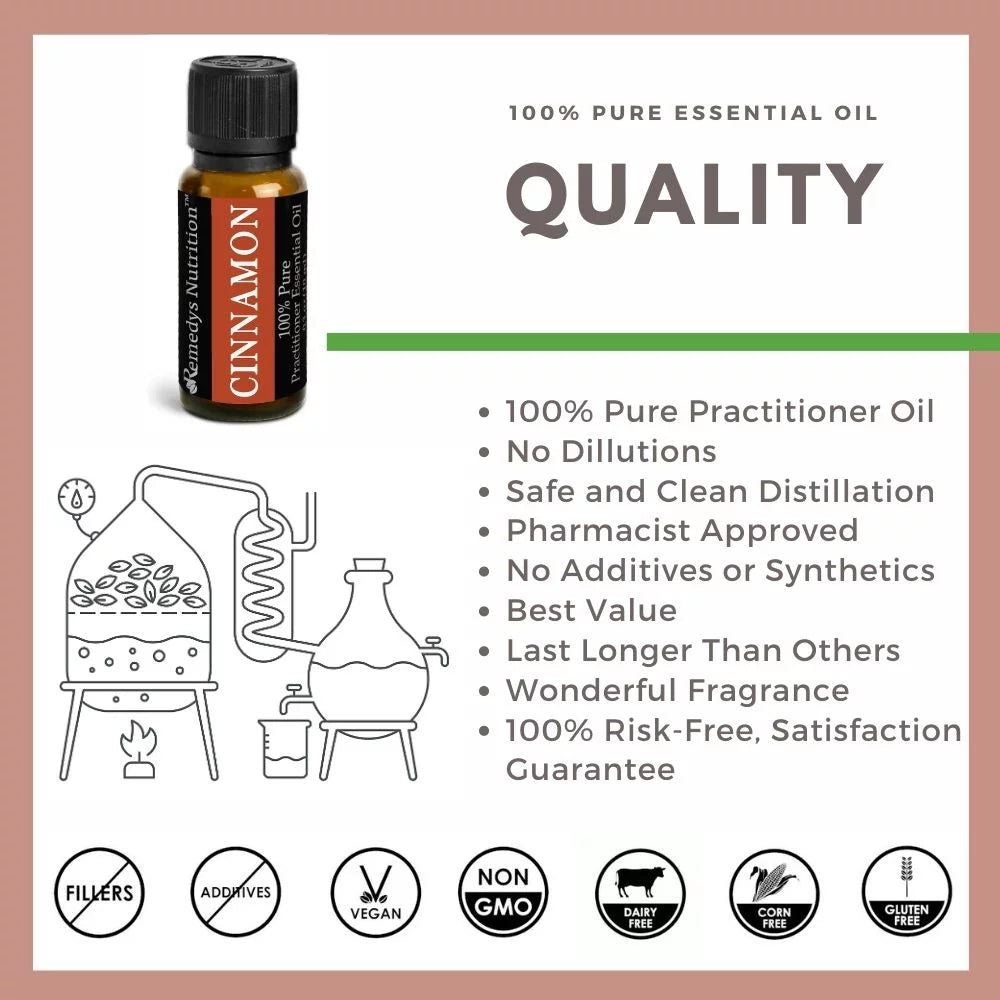
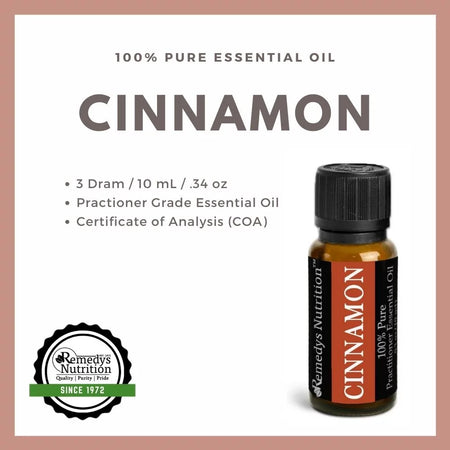
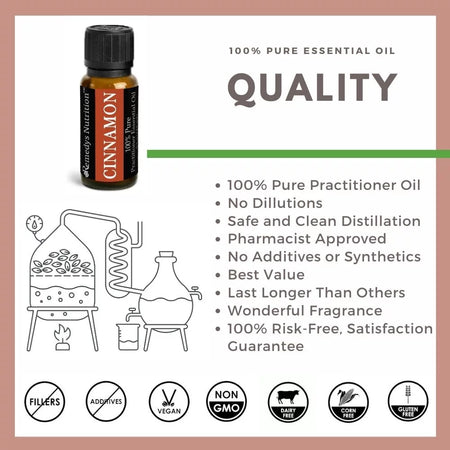
Steam-distilled from Cinnamomum cassia bark — no synthetic cinnamaldehyde, no carrier dilution, no fragrance fillers |
| Standardized 65 to 90% cinnamaldehyde |
Within the trial-tested concentration range for antimicrobial and aromatic action |
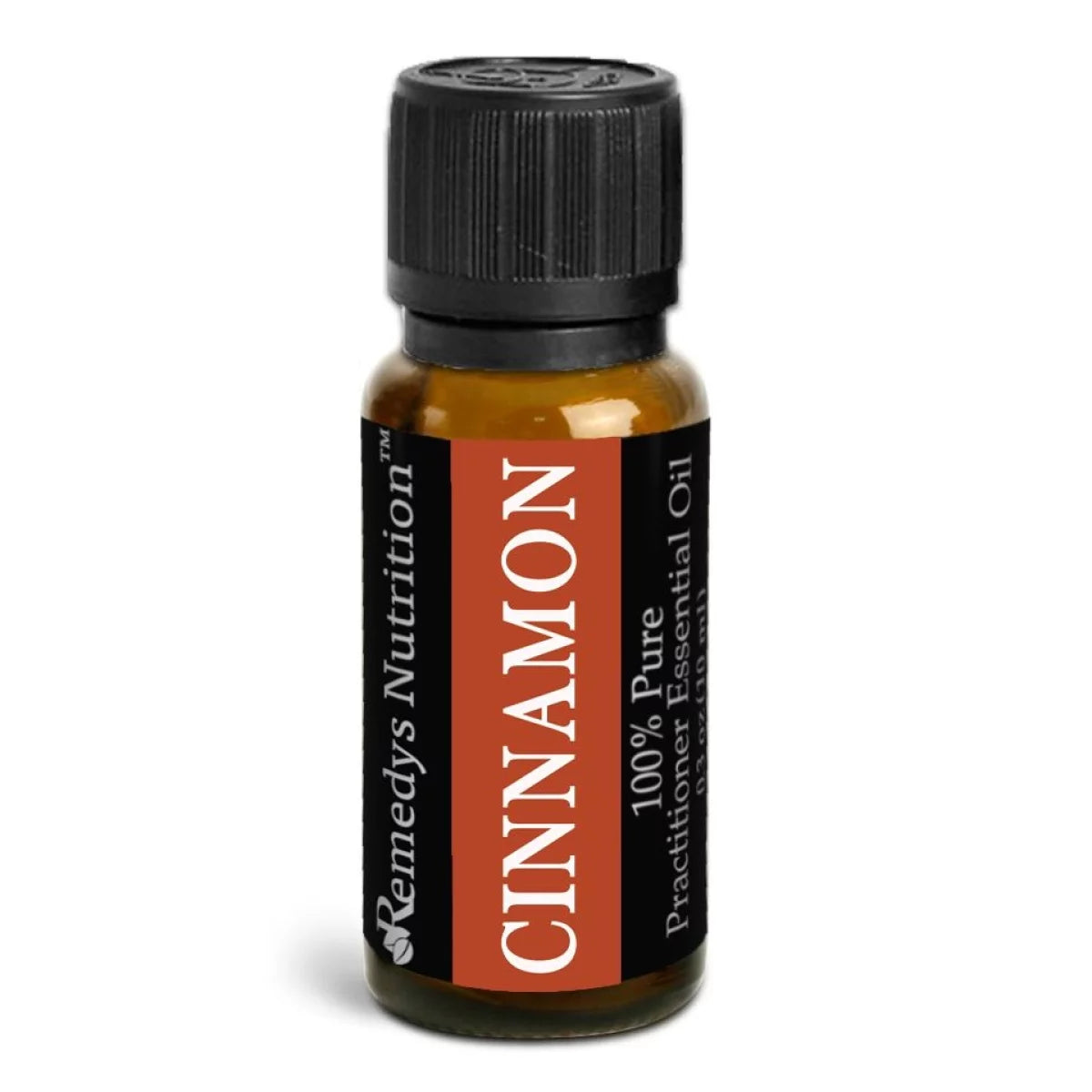
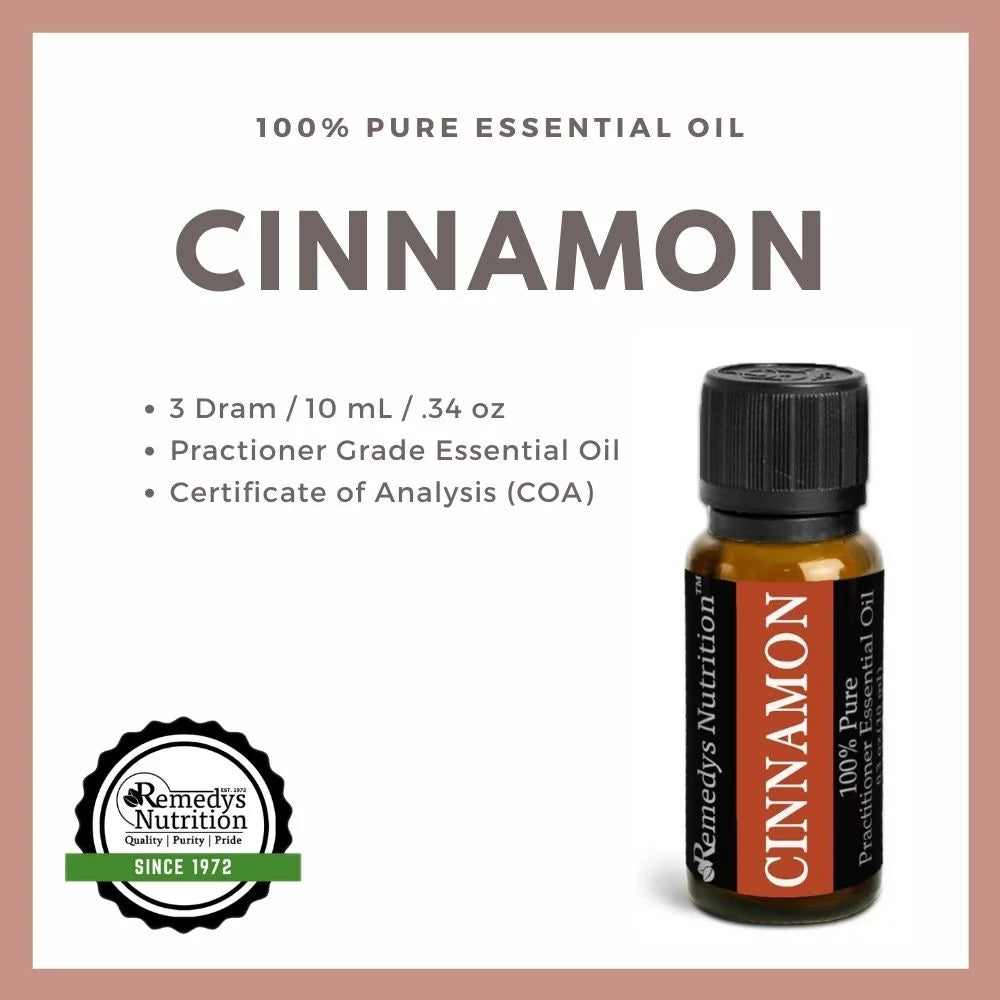
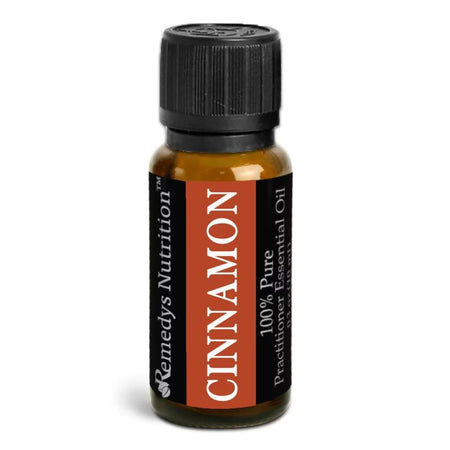
| 3 dram (10 ml) amber bottle |
UV-blocking glass preserves volatile aromatics for 24 to 36 months from open date when stored cool and dark |
| Therapeutic grade for diffusion and DIY |
Suitable for diffusion, steam inhalation, and properly diluted topical use — NOT for ingestion |
| Made in USA |
Manufactured in a cGMP-compliant facility under FDA cosmetic ingredient rules; full quality control |
| Lab tested per batch |
GC/MS verified for cinnamaldehyde profile, heavy metals, microbial contaminants, and absence of synthetic adulterants |
| 1 bottle covers 200 plus diffuser sessions |
At 1 to 2 drops per session, 1 bottle covers 6 to 12 months of daily diffuser use |
Cinnamon Oil Blending Pairs
| Pair With |
Use Case |
Sample Ratio |
| Clove bud |
Holiday and immune blends — the 2 lead phenolic warming oils |
1 cinnamon : 2 clove in a 100 ml diffuser |
| Sweet orange or lemon |
Brightens cinnamon and softens its sharp edge |
1 cinnamon : 3 citrus |
| Eucalyptus |
Sinus and respiratory diffusion blends |
1 cinnamon : 2 eucalyptus : 1 peppermint |
| Thieves or oregano blend |
Immune-season layering for 30 plus pathogens |
2 thieves : 1 cinnamon (diffusion only) |
| Vanilla, ginger, nutmeg |
Cozy bakery and dessert aromas |
1 cinnamon : 1 vanilla : 1 ginger |
| Cedarwood or pine |
Forest and fireside ambient blends |
1 cinnamon : 2 cedarwood : 1 pine |
For the strongest immune diffusion effect, layer cinnamon with oregano blend essential oil — oregano contributes carvacrol and thymol to the antimicrobial profile while cinnamon contributes cinnamaldehyde. Use 1 drop each plus 1 drop lemon in a diffuser for a 30-minute session.
HOT Oil Safety: Why Cinnamon Demands Extra Caution
Cinnamon essential oil is a HOT oil. Cinnamaldehyde is a known skin sensitizer that causes contact dermatitis in 1 to 5% of the general population and over 70% of patch-tested cinnamon-handlers. Topical maximum is 0.3% (3 drops per 30 ml carrier) — lower than lavender (5%), tea tree (1%), or peppermint (3%). Never apply neat. Never use on broken skin, the face, or sensitive zones (groin, armpits, eyes, nostrils). Patch test 24 hours before any new topical recipe. Children under 6 should avoid topical cinnamon entirely.
| Safety Concern |
What It Means |
| 1. Skin sensitization |
1 to 5% of adults react with redness, burning, or hives at concentrations above 0.5%. Sensitization can develop after months of safe use — rotate cinnamon out of daily topical recipes after 4 to 6 weeks. |
| 2. Mucous membrane burns |
Even a single drop in eyes, nostrils, mouth, or genital tissue causes 6 to 24 hours of burning. Flush with carrier oil (NOT water) for 10 minutes if exposure occurs. |
| 3. Pregnancy and breastfeeding |
Avoid cinnamon oil topically and in undiluted diffusion through pregnancy. Cinnamaldehyde may stimulate uterine activity. Diffusion at 1 drop is generally tolerated; ask the OB before regular use. |
| 4. Children under 6 |
No topical cinnamon. Diffusion limited to 1 drop in a 200 ml diffuser, 15 minute runs, in a ventilated room. |
| 5. Pets (especially cats and dogs) |
Cinnamaldehyde is toxic to cats and birds even at low diffuser levels. Do not diffuse near small mammals or reptiles. Dogs tolerate brief diffusion but never topical use. |
| 6. Drug interactions |
Oral cinnamon (capsules, not oil) may potentiate insulin, metformin, and warfarin. The essential oil itself is for external use only. |
| 7. Asthma and reactive airways |
5 to 10% of asthmatics report airway tightening on first exposure to cinnamon diffusion. Test with 1 drop, 5 minutes, ventilated room. |
| 8. NEVER ingest the essential oil |
Cinnamon essential oil is concentrated 50 to 100 fold over the spice. Internal use causes nausea, vomiting, mouth burns, and liver stress. Use whole-bark capsules for any internal cinnamon protocol. |
Storage and Shelf Life
| Storage Detail |
Recommendation |
| Bottle |
3 dram (10 ml) UV-blocking amber glass with orifice reducer cap |
| Temperature |
60 to 72 degrees F — cool, dark cabinet; never the bathroom or windowsill |
| Light |
Always store upright, capped, in a dark drawer or oil case |
| Shelf life unopened |
3 to 4 years from manufacture date |
| Shelf life after opening |
24 to 36 months — 1 of the longer-lived essential oils thanks to the stable phenolic profile |
| Spoilage signs |
Sharp acrid smell instead of warm-sweet, color shift to dark amber-brown, oily film on glass |
| Travel |
Wrap in a towel inside a hard case; cinnamon stains carpets, fabrics, and plastics permanently |
Cinnamon oil pulls into plastic at high concentration — never decant into a plastic bottle, even short-term. If you need a smaller travel size, use a glass roller bottle with a steel ball, pre-filled with carrier oil to a 0.3% maximum dilution. Our amber glass orifice reducer is sized to give a consistent 0.025 to 0.03 ml drop — meaningful when 1 drop too many can ruin a topical blend.
Cinnamon Essential Oil FAQ
What is cinnamon essential oil good for? +
Cinnamon essential oil has 4 main uses: (1) warming aromatherapy diffusion (1 to 2 drops per session), (2) DIY antimicrobial cleaning sprays at 0.05 to 0.1% concentration, (3) immune-season blends with clove, lemon, and eucalyptus, and (4) insect repellent at 0.3% topical dilution. It is NOT for ingestion — use whole-bark capsules instead. Activity is documented against 30 plus pathogens and 6 mosquito species.
Is cinnamon essential oil safe to put on skin? +
Yes, but only at 0.3% maximum dilution — that is 3 drops per 30 ml of carrier oil. Cinnamon is a HOT oil and a skin sensitizer in 1 to 5% of adults. Never apply neat, never on broken skin, never on the face or sensitive zones (groin, eyes, mucosa). Patch test 24 hours before any new recipe. Children under 6 should avoid topical cinnamon entirely.
Can I drink cinnamon essential oil in water or tea? +
No. Cinnamon essential oil is concentrated 50 to 100 fold over the spice and is NOT food-grade in this 3 dram retail format. Even 1 drop in water can burn the mouth and stomach lining. For glucose support, sleep, or digestion benefits, use whole Ceylon cinnamon bark capsules at 1 to 6 g daily, not the oil.
How many drops of cinnamon oil in a diffuser? +
1 to 2 drops in a 100 to 200 ml ultrasonic diffuser is the standard range. Cinnamon overpowers most blends within 60 seconds — start at 1 drop, add a second only after 5 minutes if the aroma feels too light. Run 30 to 60 minutes, 2 times daily maximum. Never use more than 3 drops per session in a small room.
Is cinnamon essential oil safe during pregnancy? +
Avoid topical cinnamon and undiluted diffusion through pregnancy and breastfeeding. Cinnamaldehyde may stimulate uterine activity at concentrated doses. Light diffusion at 1 drop in a 200 ml diffuser, 15 to 20 minutes in a well-ventilated room, is generally tolerated — but ask your OB or midwife before regular use during the first trimester.
What is the difference between cinnamon bark oil and cinnamon leaf oil? +
Bark oil is 65 to 90% cinnamaldehyde — warmer, sweeter, and stronger antimicrobial action. Leaf oil is 70 to 90% eugenol — closer to clove in aroma, gentler on skin, and used in food flavoring. Bark oil is what most reputable brands sell (including ours) for aromatherapy. Both are HOT oils and follow the same 0.3% topical max.
Does cinnamon oil really kill germs and viruses? +
In lab studies, cinnamaldehyde inhibits 30 plus bacterial and fungal strains and 4 strains of influenza A at 0.05 to 0.1% concentration. That is laboratory data — it does not mean diffusing cinnamon “cures” an infection. Use cinnamon as 1 of 3 to 4 lead oils in immune-season diffusion and DIY surface sprays alongside hand washing, ventilation, and standard hygiene.
What carrier oils work best with cinnamon? +
Fractionated coconut, jojoba, and sweet almond oils are the top 3 carriers for cinnamon. Use 3 drops cinnamon per 30 ml carrier (0.3% — the topical maximum) for foot or shoulder rubs. Avoid mineral oil and avoid plastic bottles — cinnamon pulls plasticizers into the blend within 24 to 48 hours.
Can I diffuse cinnamon oil around dogs or cats? +
Cats and birds — no, cinnamaldehyde is toxic to them at low diffuser levels. Dogs — brief 15 to 20 minute diffusion in a ventilated room, 1 drop only, is generally tolerated. Never apply cinnamon topically to any pet. If a pet shows drooling, eye watering, or panting, ventilate the room and stop diffusion immediately.
How long does cinnamon essential oil last after opening? +
24 to 36 months from open date when stored in the original UV-blocking amber bottle in a cool, dark cabinet. Cinnamon is 1 of the longer-lived essential oils thanks to its stable phenolic profile. Spoilage signs are a sharp acrid smell instead of warm-sweet aroma, a color shift to dark amber-brown, or an oily film on the glass.
Why does cinnamon oil sting on skin even when diluted? +
Cinnamaldehyde activates TRPA1 nerve receptors that signal heat and irritation. Even at the 0.3% topical maximum, 5 to 10% of adults feel a tingling or hot sensation that fades over 5 to 15 minutes. If burning persists past 20 minutes, dilute further with carrier oil (NOT water) and wash the area gently. Drop the dilution to 0.1% on your next blend.
Can I mix cinnamon oil with thieves or oregano? +
Yes — for diffusion, the classic immune blend is 2 parts thieves : 1 part cinnamon : 1 part lemon, run 30 minutes 2 times daily during cold and flu season. For DIY surface sprays, 5 drops cinnamon plus 5 drops oregano per 250 ml carrier reaches 0.4% combined phenolic load. Never combine these on skin — the stacked HOT oils exceed safe topical limits.
What makes Remedy’s Cinnamon Essential Oil different? +
Remedy’s Cinnamon Essential Oil is 100% pure Cinnamomum cassia bark oil, steam-distilled, standardized to 65 to 90% cinnamaldehyde, and GC/MS verified per batch for purity, identity, and absence of synthetic cinnamaldehyde. Packed in 3 dram (10 ml) UV-blocking amber glass with orifice reducer for consistent 1-drop dosing. Made in a USA cGMP facility. 1 bottle covers 200 plus diffuser sessions.
Cinnamon Oil: In-Depth Reading
Want to dig deeper into safe use, blend recipes, and immune-season protocols? Browse our essential oils knowledge hub: