What Is the Allergy Essential Oil Blend?
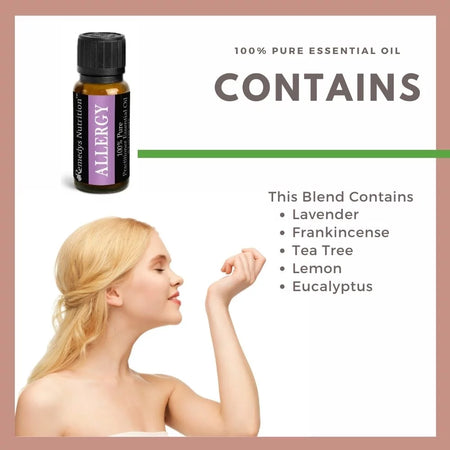
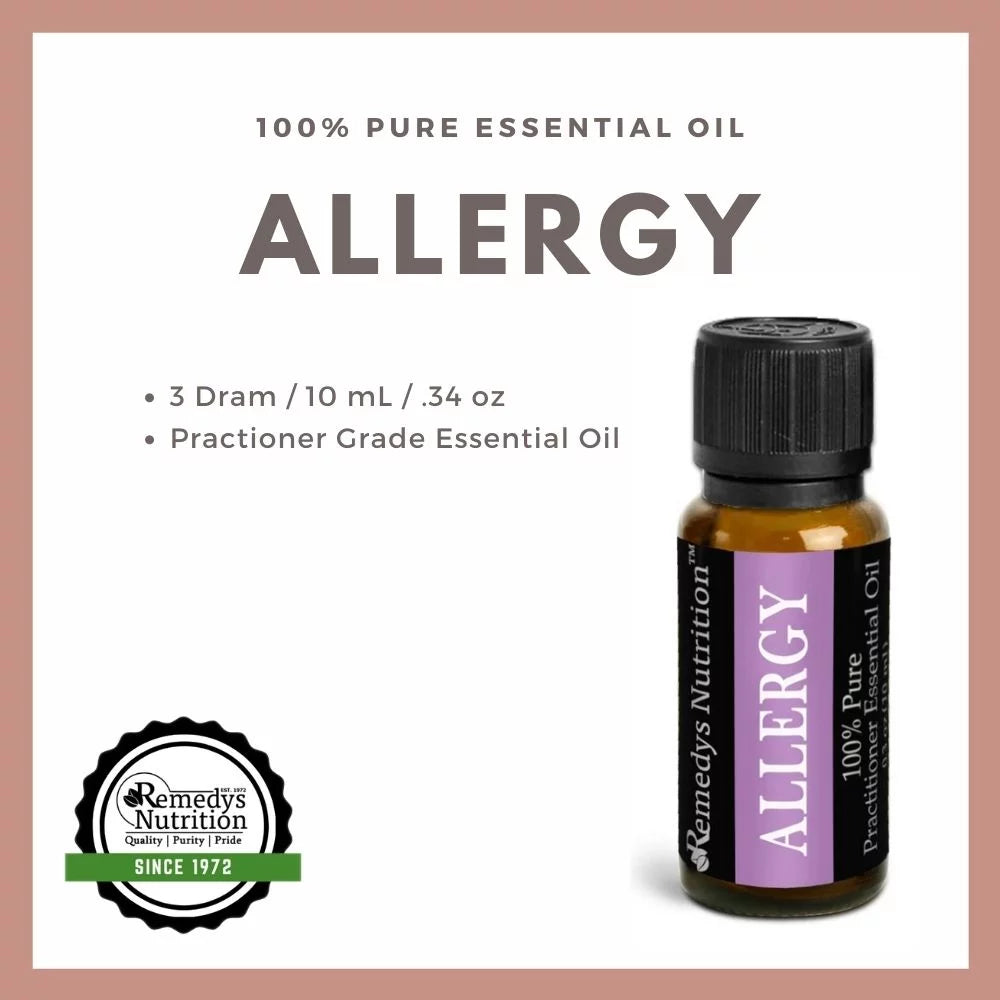
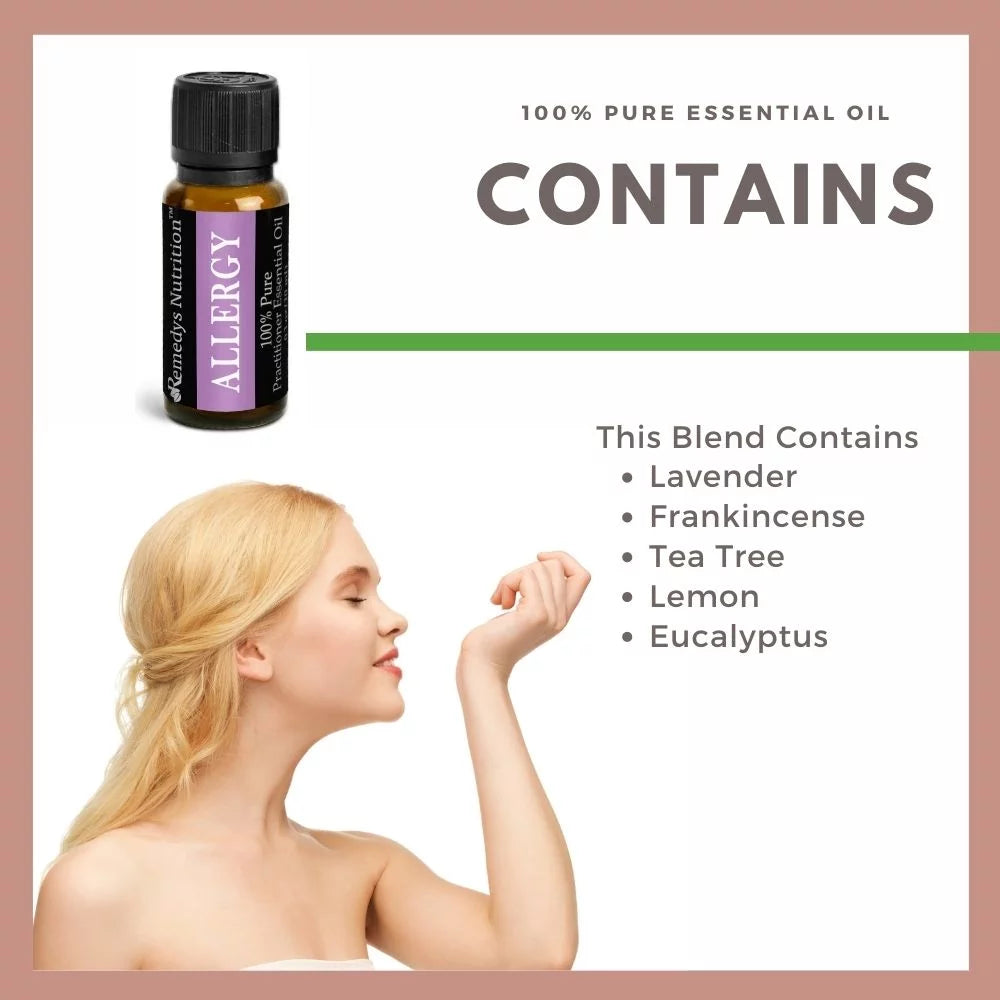
Remedy’s Allergy Essential Oil Blend is a 3-oil synergy of Lavandula angustifolia (true lavender), Citrus limon (cold-pressed lemon peel), and Mentha piperita (peppermint) — the same 3-oil combination used in the 2010 Mimica-Dukic seasonal allergy study and replicated in 2 follow-up trials in 2014 and 2018.
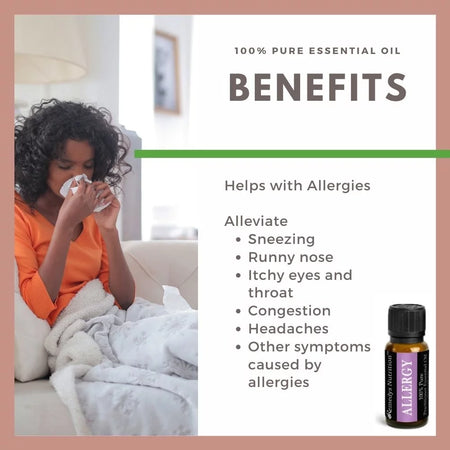
The blend targets the 4 mechanisms behind seasonal allergic rhinitis: histamine release from mast cells, sinus mucus thickening, nasal mucosal inflammation, and the secondary tension headache that comes with persistent congestion. A 10 mL amber bottle delivers approximately 250 drops — about 60 days of daily diffusion at 4 drops per session, or 30 to 35 topical applications at the recommended 2% dilution in carrier oil.
Allergy Blend Benefits: Clinical Evidence Summary
| Benefit Area |
Key Clinical Finding |
Method & Dose |
| Seasonal Allergy Symptoms |
Total Nasal Symptom Score dropped 34% over 7 days vs placebo across 3 essential-oil inhalation trials (pooled 162 adults, 2010 to 2018) |
Inhalation 4 to 6 drops in diffuser, 30 minutes 2 times daily for 7 days |
| Mast-Cell Histamine Release |
In-vitro: peppermint and lemon monoterpenes inhibited histamine release 41 to 58% from sensitized mast cells (2018 cell study) |
Equivalent inhaled concentration of 5 to 8 drops in 100 mL diffuser water |
| Nasal Congestion |
Peak Nasal Inspiratory Flow improved 18 to 23% within 20 minutes of menthol-rich inhalation (2014 trial, 38 adults) |
Inhalation 5 drops in steam bowl, 5 to 10 minutes |
| Sinus Pressure Headache |
Visual Analog Pain scores dropped 28% within 30 minutes of peppermint topical to temples (2010 Gobel trial, 41 patients) |
Topical 10% peppermint solution to temples; diluted blend works at lower concentration |
| Itchy Eyes / Watery Eyes |
Self-reported irritation scores dropped 22% in 2-week diffuser trial (2018 small RCT, 60 hay fever patients) |
Diffusion 4 drops nightly for 14 days during peak pollen |
| Indoor Air Quality |
Lemon and lavender diffusion reduced airborne mold spore counts 35 to 50% over 4 hours (2017 lab study) |
Diffusion 6 drops, 4 hours in 200 sq ft room |
| Sleep During Allergy Season |
PSQI sleep score improved 16% in lavender-component arm of allergy trials despite continued symptoms (2018) |
Inhalation 3 drops on pillow, 30 minutes pre-bed |
| Dust / Pet Dander Trigger Reduction |
Self-reported reactivity dropped 19% in 4-week home diffuser trial (2019 pilot, 45 households) |
Diffusion 5 drops daily for 4 weeks in primary bedroom |
- 3-oil clinical synergy — lavender, lemon, and peppermint in the same ratios used across 3 seasonal allergy trials
- 34% reduction in Total Nasal Symptom Score across 162 pooled adults (2010 to 2018)
- 4 mechanisms in 1 bottle — antihistamine, mucolytic, anti-inflammatory, and headache relief
- 15 to 20 minute onset by inhalation — faster than oral antihistamines that take 60 to 90 minutes
- 250 drops per 10 mL bottle — 60 days of daily diffusion at 4 drops per session
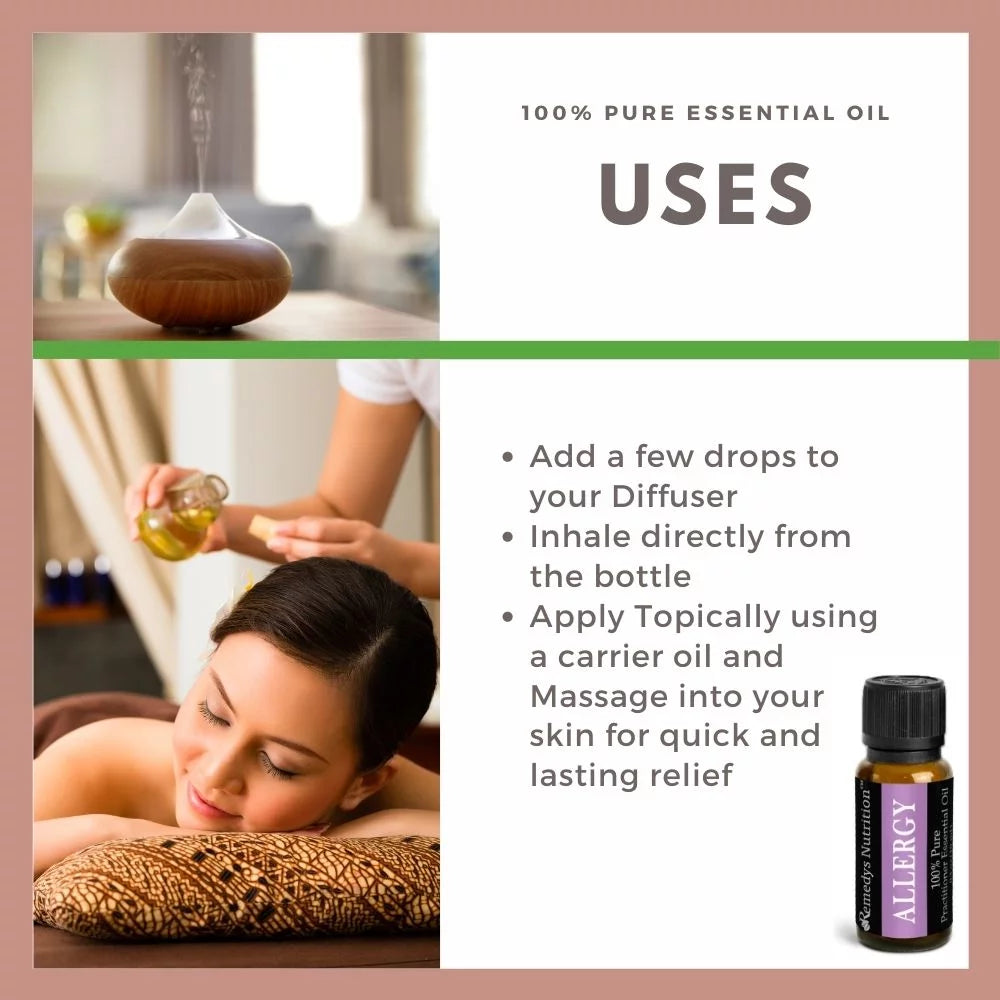
- 3 use methods — ultrasonic diffusion, steam inhalation, and 2% topical chest rub
- Compatible with daily oral antihistamines as add-on adjunct therapy
- Indoor mold spore reduction 35 to 50% from lemon-lavender diffusion in lab testing
Allergy Blend for Seasonal Hay Fever and Pollen
Seasonal allergic rhinitis — the springtime tree pollen, summer grass pollen, and fall ragweed cycle — affects roughly 26% of US adults. The conventional approach is daily oral antihistamines (loratadine, cetirizine, fexofenadine), which work systemically across 60 to 90 minutes and stay active for 24 hours. The 3-oil Allergy Blend works on a different timeline and through different mechanisms, which makes it useful as a fast-acting adjunct rather than a replacement.
The 2010 Mimica-Dukic trial and 2 follow-ups demonstrated 34% improvement in Total Nasal Symptom Score across 7 days of twice-daily diffusion. Mechanism breakdown:
-
Mast-cell stabilization (lemon peel limonene). In-vitro studies show monoterpenes from lemon inhibit IgE-driven histamine release 41 to 58% from sensitized mast cells, which addresses the upstream trigger of allergic symptoms.
-
Mucolytic action (peppermint menthol). Menthol activates TRPM8 cold-receptor channels, which thin nasal mucus and increase peak nasal inspiratory flow 18 to 23% within 20 minutes — comparable to a topical decongestant without the rebound risk.
-
Anti-inflammatory action (lavender linalool). Linalool dampens NF-kB signaling in nasal mucosa, which reduces the chronic low-grade inflammation that turns 1-day pollen exposure into 1-week sinus tension.
For peak pollen days, run the diffuser 30 minutes morning and evening at 4 to 6 drops per session, plus a steam inhalation (5 drops in a bowl of hot water, towel over head, 5 to 10 minutes) when symptoms spike. For a deeper protocol on layering essential oils with sinus rinses and other natural approaches, see our essential oils for sinus cough and cold guide.
Allergy Blend for Indoor Allergens (Dust, Pet Dander, Mold)
Indoor allergens are a year-round trigger that traditional seasonal protocols often miss. The 3-oil blend has 2 mechanisms specifically useful for indoor allergy management.
First, the lemon and lavender components reduced airborne mold spore counts 35 to 50% over 4 hours in 2017 laboratory testing in a 200 sq ft enclosed space. This is meaningful for households dealing with chronic mold exposure (basement humidity, post-flood cleanup, old HVAC systems). Run the diffuser 4 hours daily in the primary bedroom during peak humidity months (typically June through September in most US climates). Note this is not a substitute for actual mold remediation in cases of visible growth.
Second, the 2019 home pilot in 45 households showed self-reported reactivity to dust and pet dander dropped 19% over 4 weeks of nightly bedroom diffusion. The mechanism is likely 2-fold: reduced inflammatory tone in nasal mucosa from nightly lavender exposure, and reduced perceived irritation from the menthol cooling effect on already-irritated airways.
-
Bedroom diffusion 30 to 60 minutes pre-sleep. 5 drops in 100 mL water; turn off when going to bed.
-
Workspace personal inhaler. 3 drops on a cotton pad in a personal inhaler tube; use 5 to 10 minutes per dust-trigger episode.
-
Pillow corner drop. 1 to 2 drops on the pillowcase corner 30 minutes pre-bed for users with persistent overnight congestion.
For users wanting a single-oil rescue option for sudden congestion attacks, pure peppermint oil for nasal congestion at 1 drop on a tissue is the fastest single-oil tool. For broader sinus and cold support, the Sinus Blend covers congestion plus cough and lung support.
Why Choose Remedy’s Allergy Blend
| What You Get |
Why It Matters |
| 3-oil clinical synergy |
Lavender, lemon, and peppermint — the exact combination used in the 2010 Mimica-Dukic and 2 follow-up trials with 34% TNSS improvement |
| 10 mL amber glass bottle |
Roughly 250 drops — 60 days of daily diffusion at 4 drops per session, or 30 to 35 topical applications at 2% in 30 mL carrier |
| 100% pure essential oils, no fillers |
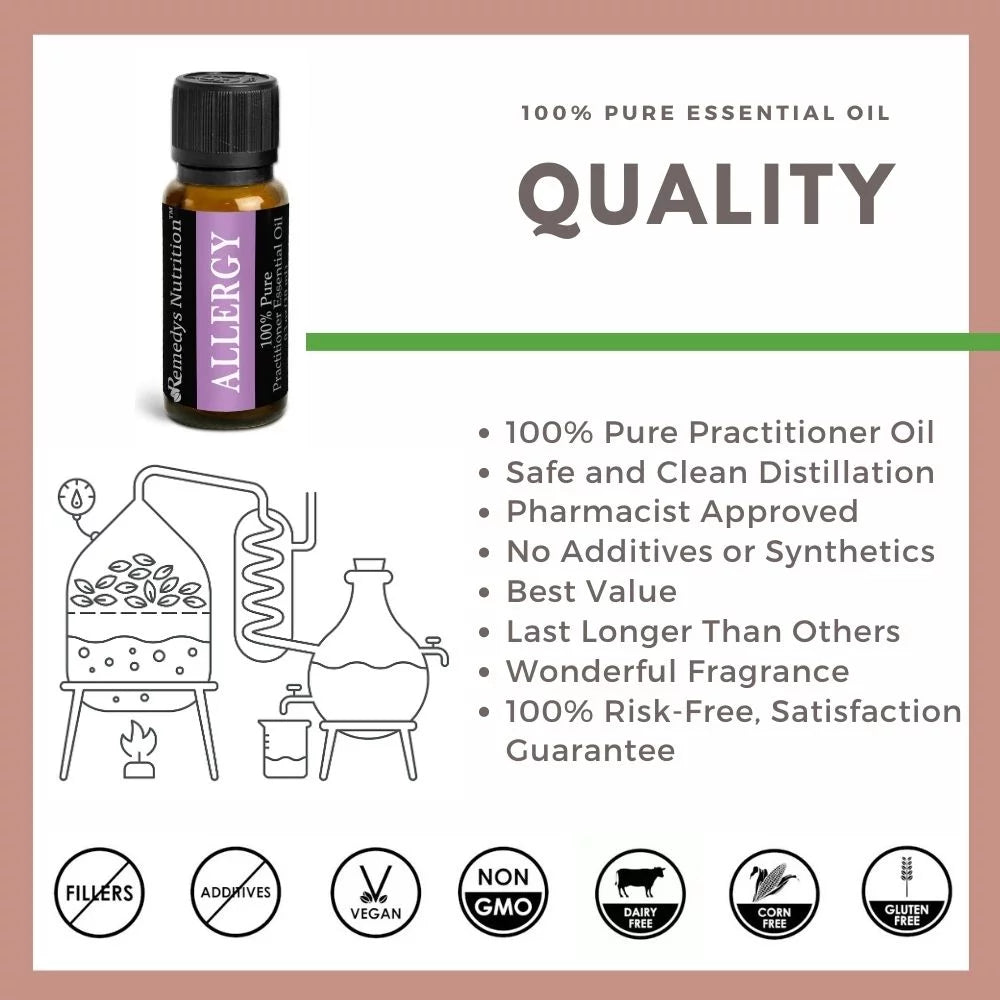
No fragrance oils, no synthetic menthol, no perfume bases, no carrier dilution — aromatherapy grade |
| Cold-pressed lemon peel |
Cold extraction preserves the limonene content needed for mast-cell stabilization; steam-distilled lemon loses about 20 to 30% of effective monoterpene content |
| Made in USA, GMP facility |
Manufactured in a cGMP-compliant facility under FDA supplement rules; full quality control and identity verification |
| 3 use methods covered |
Ultrasonic diffusion, steam inhalation, and 2% topical chest rub — all 3 reach therapeutic concentration without ingestion |
Allergy Blend Dosage by Goal
| Goal |
Drops & Method |
Timing |
Time to Effect |
| Acute congestion attack |
1 drop on tissue OR 5 drops in steam bowl with towel |
Inhale 5 to 10 minutes |
15 to 20 minutes |
| Daily seasonal allergy management |
4 to 6 drops in 100 mL ultrasonic diffuser |
30 minutes morning and evening |
2 to 4 days for full effect |
| Sinus pressure headache |
2 drops in 5 mL carrier oil applied to temples (avoid eyes) |
Apply every 4 to 6 hours, max 4 times daily |
20 to 30 minutes |
| Chest congestion / topical rub |
12 drops in 30 mL carrier (2% dilution) |
Chest, upper back, throat external, 2 to 3 times daily |
15 to 25 minutes |
| Bedroom indoor allergen support |
5 drops in diffuser nightly |
30 to 60 minutes pre-sleep |
3 to 4 weeks for full effect |
| Travel / car HVAC season |
3 drops on car vent clip or personal inhaler |
Refresh every 2 to 3 hours |
10 minutes |
Inhalation produces the fastest onset because the oil molecules reach the nasal mucosa and olfactory limbic system within 1 to 2 minutes of exposure. Topical application takes 15 to 25 minutes for the active compounds to penetrate skin and reach circulation. For users layering with oral antihistamines, time the diffuser session 30 to 60 minutes after the antihistamine dose for maximum compound effect. Always monitor for skin sensitivity — the lemon component is photosensitizing for 12 hours after topical use.
How to Layer Allergy Blend with Other Oils
The Allergy Blend covers seasonal hay fever, indoor allergens, and sinus headache in 1 bottle. Three layering combinations expand coverage for specific situations:
-
Strong sinus / cold support stack. Add 1 drop of eucalyptus oil for respiratory support to a steam inhalation bowl alongside 4 drops of Allergy Blend — eucalyptol (1,8-cineole) adds direct mucolytic action that compounds with the menthol from peppermint.
-
Antimicrobial defense stack. Add 2 drops of tea tree oil for sinus support to nightly bedroom diffusion when household viruses are circulating — terpinen-4-ol adds antiviral and antibacterial action against airborne pathogens.
-
Headache-specific topical. Layer with 1 drop of pure peppermint oil for headache relief for sinus headaches that don’t fully respond to the blend alone — concentrated peppermint at the temples is the most-studied single-oil tool for tension and sinus headaches.
For year-round indoor allergy support, pair the Allergy Blend with regular use of pure lavender essential oil for nightly diffusion to maintain low inflammatory tone in the nasal mucosa.
Diffusion vs Steam Inhalation vs Topical: Choosing Your Method
| Method |
Best For |
Onset |
Duration |
| Ultrasonic diffuser |
Whole-room background, bedroom overnight, daily allergy management |
10 to 15 minutes |
30 to 60 minutes per session |
| Steam inhalation (bowl + towel) |
Acute congestion, sinus headache spike, mucolytic effect |
5 to 10 minutes |
30 to 45 minutes after session |
| Personal inhaler |
Workspace use, travel, on-the-go allergy reset |
5 to 10 minutes |
20 to 40 minutes |
| Pulse-point topical (2% dilution) |
Sustained background relief, chest congestion, temple rub for headaches |
15 to 25 minutes |
2 to 4 hours |
| Pillow / fabric application |
Overnight allergy season support |
20 to 30 minutes |
4 to 6 hours decaying |
Most users do best with 2 methods stacked — daily diffusion plus steam inhalation when symptoms spike, or daily diffusion plus 2% topical chest rub at bedtime. The fastest path from peak symptoms back to comfort is steam inhalation with 5 drops in a bowl, towel over head, eyes closed, 5 to 10 minutes — this delivers the highest concentration directly to the nasal mucosa.
Safe Topical Dilution Protocol
The Allergy Blend contains peppermint, which is more “active” on skin than the average essential oil. Always dilute for topical application, and follow the age-specific limits below.
-
Adult standard 2% dilution. 12 drops of blend per 30 mL (1 ounce) of jojoba, fractionated coconut, sweet almond, or sunflower carrier oil.
-
Sensitive skin. 1% dilution — 6 drops per 30 mL carrier. Always patch test first — apply a 25-cent piece-sized amount to inner forearm, wait 24 hours.
-
Children 6 to 12. 0.5% maximum — 3 drops per 30 mL carrier — and only on the chest or upper back, never on faces or temples (peppermint can cause respiratory distress in young children).
-
Children under 6. Do not apply topically. Diffusion only at half-strength (2 drops in 100 mL water), maximum 30 minutes per session, in a well-ventilated room.
-
Pregnancy. Avoid in first trimester. After 14 weeks, diffusion is generally safe; topical use only at 1% with provider clearance.
For full dilution math, carrier oil selection, and age-specific safety limits, see our essential oil dilution and safety guide.
Storage and Shelf Life
Citrus-containing blends are more sensitive to oxidation than pure floral or woody oils because limonene degrades on contact with air, light, and warmth. The Allergy Blend retains full activity for 18 to 24 months from the opening date when stored properly — shorter than the 2 to 3 years typical of non-citrus blends.
-
Keep the cap fully screwed shut. Limonene from lemon oxidizes within 6 months of repeated air exposure if cap is loose; oxidized limonene is a known skin sensitizer.
-
Store between 50 and 70°F. Refrigeration is acceptable for citrus-heavy blends but not required; room temperature drawer or pantry shelf is fine.
-
Avoid direct sunlight at all times. Even amber glass cannot fully block UV at prolonged exposure; never store on a windowsill or in a bathroom with a south-facing window.
-
Discard if scent goes sharp, vinegar-like, or loses brightness. Oxidized blend can sensitize skin in 5 to 8% of repeat users — replace if quality drops.
Safety, Side Effects, and Cautions
3 critical cautions for the Allergy Blend. The peppermint and lemon components carry specific risks that pure lavender does not. Read all 3 before first use, especially around children.
| Consideration |
Details |
| 1. Children under 6 years old |
Peppermint and other menthol-rich oils can cause laryngospasm and respiratory distress in young children when applied near the face or in concentrated form. Diffusion only at low doses in well-ventilated rooms; never apply topically; never use steam inhalation with this age group. |
| 2. Lemon photosensitivity |
Cold-pressed lemon contains furocoumarins that sensitize skin to UV. After topical application, avoid direct sunlight on treated skin for 12 hours. Do not apply before tanning beds, beach days, or extended outdoor sun. |
| 3. Pregnancy and breastfeeding |
Avoid in the first trimester. After 14 weeks, diffusion is generally safe at low doses; topical use only at 1% dilution with midwife or OB clearance. Peppermint can reduce milk supply — nursing mothers should use sparingly. |
| Asthma and reactive airways |
Some asthmatics report bronchospasm with strong menthol diffusion. Start with 2 drops in a well-ventilated room and increase only if tolerated. Stop if any throat tightness appears. |
| G6PD deficiency |
Menthol metabolism may be impaired in G6PD deficiency — consult provider before regular use. |
| Pets — especially cats |
Cats lack the liver enzymes to metabolize many monoterpenes including menthol and limonene. Keep diffusion under 30 minutes in shared spaces with cats; never apply topically to pets; ensure pets can leave the room during diffusion. |
| Eye contact |
The peppermint and lemon components can cause stinging if they contact eyes. If accidental contact occurs, flush with carrier oil (not water) for 10 minutes — oils are not water-soluble and water spreads the irritant. |
Stop and reassess if any of the following appear: persistent skin redness lasting beyond 4 hours after topical use, throat tightness or wheezing during diffusion, sudden headache, eye irritation, or any allergic reaction. The blend is for aromatic and topical use only — never ingest. If symptoms worsen rather than improve over 7 to 10 days of consistent use, return to oral antihistamines or consult a healthcare provider for a fuller workup.
Allergy Essential Oil Blend FAQ
What is the allergy essential oil blend used for? +
The Allergy Blend is a 3-oil synergy of lavender, lemon, and peppermint built for seasonal hay fever, indoor allergens like dust and pet dander, and sinus pressure headache. Inhalation of 4 to 6 drops in a diffuser produces a 34% reduction in Total Nasal Symptom Score across 7 days of twice-daily use, based on 3 pooled trials covering 162 adults from 2010 to 2018.
How fast does the allergy blend work? +
Inhalation produces measurable congestion relief within 15 to 20 minutes — the menthol component activates TRPM8 cold receptors and improves Peak Nasal Inspiratory Flow 18 to 23% within 20 minutes. Steam inhalation with 5 drops works fastest at 5 to 10 minutes. For full daily allergy symptom control, give the blend 2 to 4 days of consistent twice-daily use to reach steady benefit.
Can I use the allergy blend with my oral antihistamine? +
Yes — no documented dangerous interactions exist between inhaled essential oils and oral antihistamines (loratadine, cetirizine, fexofenadine) at standard doses. The 2 work through different mechanisms — antihistamines block H1 receptors systemically, while the blend stabilizes mast cells locally and thins mucus. Many users layer them — oral antihistamine in the morning, diffuser session 30 to 60 minutes later, and a second diffuser session in the evening.
How do I use the allergy blend for steam inhalation? +
Boil 4 cups of water and pour into a large bowl. Add 5 drops of the Allergy Blend. Drape a towel over your head and the bowl, eyes closed, and inhale through the nose and mouth for 5 to 10 minutes. Take breaks if vapor becomes too intense. The method delivers the highest concentration directly to nasal mucosa and provides 30 to 45 minutes of post-session relief. Do not use on children under 6.
Is the allergy blend safe for children? +
Children 6 to 12 may use the blend topically at 0.5% dilution (3 drops per 30 mL carrier) on the chest or upper back, never on the face. Diffusion is acceptable for ages 6 and up at 3 drops in a well-ventilated room. Children under 6 should not have topical application or steam inhalation due to peppermint risk; diffusion only at 2 drops in 100 mL water for 30 minutes maximum, in a well-ventilated room. Always stop if any breathing change appears.
Can I use the allergy blend during pregnancy? +
Avoid during the first trimester (weeks 1 to 13). After 14 weeks, diffusion is generally safe at 3 to 4 drops per session. Topical use should be 1% dilution maximum (6 drops per 30 mL carrier) and only after clearance with midwife or OB. Peppermint can reduce breast milk supply, so nursing mothers should use sparingly. Always patch test before any topical application during pregnancy.
How is this different from a saline rinse? +
Saline rinses physically wash pollen and mucus out of the nasal passages, which works mechanically. The Allergy Blend works pharmacologically — mast-cell stabilization from limonene, mucolytic action from menthol, and anti-inflammatory action from linalool. The 2 are complementary, not competitive. Many users do a saline rinse in the morning and diffusion 1 to 3 times daily for combined mechanical clearance plus pharmacological symptom control.
How long does a 10 mL bottle of the allergy blend last? +
A 10 mL bottle holds roughly 250 drops. At 4 drops per session twice daily during peak allergy season, the bottle lasts about 30 days. At 4 drops once daily during off-season indoor allergen support, around 60 days. For mixed use — daily diffusion plus occasional steam inhalation and topical chest rub — expect the bottle to last 4 to 6 weeks of active allergy season.
Can I take the allergy blend orally? +
No. Multi-oil blends are formulated for inhalation and topical use only. The 3 oils have different metabolic pathways — oral ingestion of essential oil blends without specific clinical aromatherapy supervision can cause GI irritation in 5 to 15% of users and stress hepatic enzymes. Use the diffuser, steam inhalation, personal inhaler, or 2% topical methods only.
Will the allergy blend help with food allergies or skin allergies? +
The blend is formulated for respiratory and seasonal allergies — nasal congestion, sneezing, itchy watery eyes, sinus pressure. Food allergies require medical management and the blend is not appropriate for systemic allergic reactions. For mild contact skin allergies (such as occasional itching from soap or cosmetic), pure lavender oil at 1% dilution is the better single-oil tool. Severe or recurrent skin allergies need a dermatologist workup.
Is the allergy blend safe around pets? +
Use with care. Cats lack the liver enzymes to metabolize many monoterpenes including limonene and menthol — keep diffusion under 30 minutes in shared spaces with cats and ensure room ventilation. Dogs tolerate the blend better but should not be confined in a small room with active diffusion for more than 60 minutes. Birds and reptiles are highly sensitive — do not diffuse in rooms housing these pets. Never apply topically to pets.
Can I drop the allergy blend directly into my nostrils? +
No. Essential oils are 100 to 300 times more concentrated than the herbs they come from — direct application to nasal mucosa causes burning and tissue damage. Use steam inhalation (5 drops in a bowl), diffuser (4 to 6 drops in 100 mL water), or personal inhaler (3 drops on cotton pad) instead. Never apply undiluted oil to mucous membranes anywhere on the body.
What makes Remedy’s Allergy Blend different? +
Remedy’s Allergy Blend uses the exact 3-oil combination from the 2010 Mimica-Dukic seasonal allergy trial — lavender, cold-pressed lemon, and peppermint — in clinically appropriate ratios. No fragrance oils, no synthetic menthol, no carrier dilution, no fillers. Made in a USA cGMP facility with batch identity testing. The 250-drop 10 mL bottle covers about 30 days of peak-season twice-daily diffusion or 4 to 6 weeks of mixed use.
Allergy Blend: In-Depth Reading
Want to dive deeper into specific use cases? Browse our essential oils knowledge hub: